
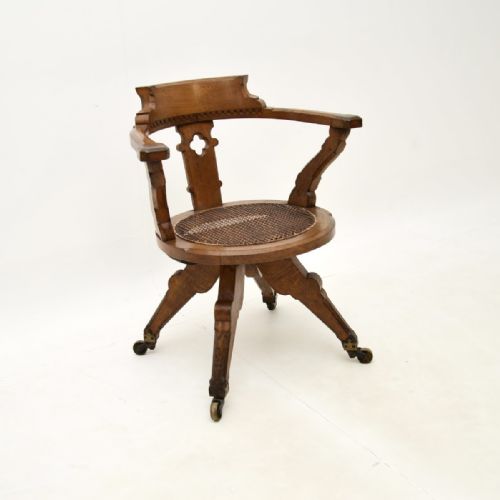


Oak Revolving Desk Chair
An oak revolving desk chair brings functional Victorian and Edwardian mechanics together with sturdy timber for daily workspace use.
Forms and periods
An oak revolving desk chair combines swivel mechanics with heavy timber frames suited to studies and offices. These pieces appear across Victorian, Edwardian, and later periods spanning from eighteen eighty to nineteen twenty.
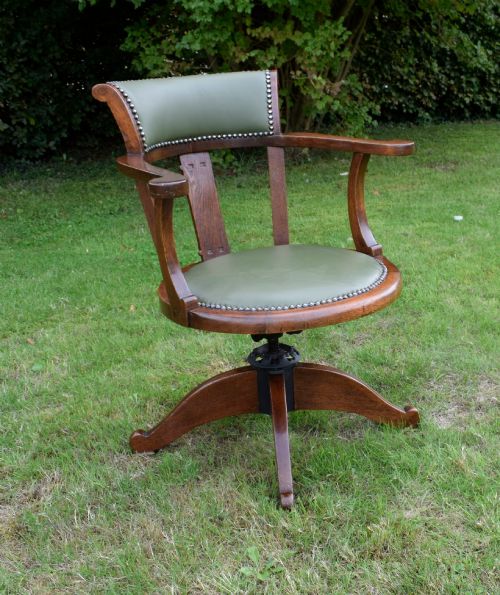
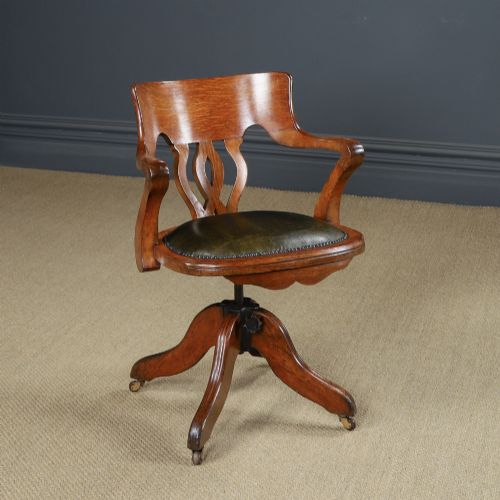
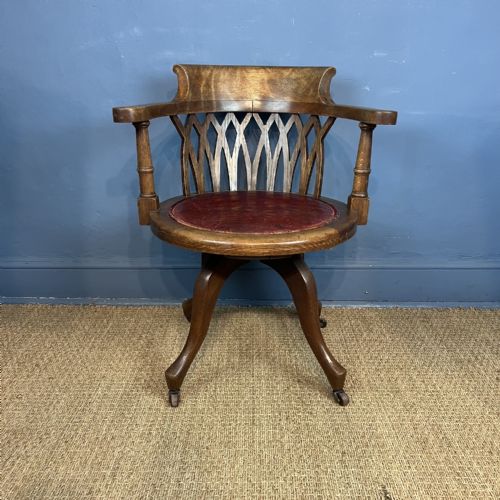
The most common formats on this page are armchairs and tub chairs fitted with leather or fabric seats. Examples range from plain timber saddle seats to sophisticated upholstered swivel designs built for long hours at a desk.
Materials and construction
Makers utilised solid oak alongside bentwood for the main framework, pairing the timber with iron and cast iron swivel mechanisms. Brass and metal fittings support the adjustable height and tilting actions found beneath the seat.
Upholstery in green, red, and brown leather or fabric covers the pads and armrests, secured with metal tacks. Frames incorporate joined elements and bentwood components designed to withstand continuous movement.
Retail Price Guide 2026
Typical UK retail prices for oak revolving desk chair, calculated from the Sellingantiques database of over a million retail prices indexed since 2003. This retail price guide relies exclusively on Sellingantiques data; no external sources or auction records are used, so the figures do not describe the wider market.
The listings show oak, leather, iron, brass, and fabric as the primary materials used across Victorian and Edwardian desk chairs.
Build and materials
Quality rests in the robustness of the iron swivel mechanism and the density of the oak frame. Superior examples combine smooth rotation with uncompromised joinery and thick, resilient leather upholstery.
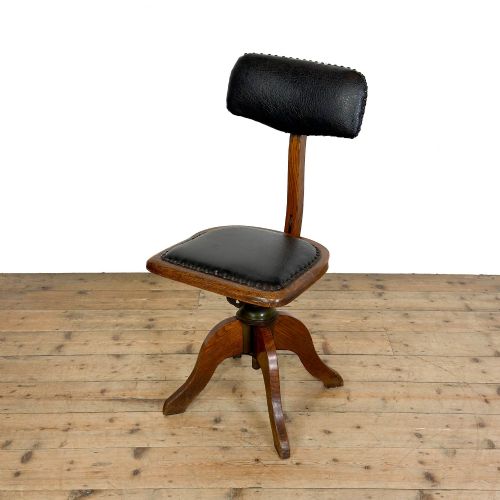
Simpler models feature plain solid timber saddle seats without padding, representing a more utilitarian approach to office seating. The presence of makers' stamps and sophisticated adjustable hardware elevates specific items.
Bell Barn Furniture·William Birchcraft
The Oak Revolving Desk Chair Glossary
- Swivel
- A mechanism allowing the upper portion of the chair to rotate fully on its base. This function depends on concealed iron or cast iron spindles.
- Bentwood
- Timber shaped by steaming to create curved components without joints. This technique produces durable, flowing structural lines in chair backs and arms.
- Saddle seat
- A solid timber seat carved into a contoured shape resembling a riding saddle. It offers ergonomic support without requiring padded upholstery.
- Captain's chair
- A robust armchair with a rounded wooden back rail supported by spindles. These pieces frequently feature revolving bases for office use.
- Tub chair
- An armchair featuring a continuous curved back and armrest enclosing the user. They appear with leather upholstery and swivel mechanisms.
Frequently Asked Questions
How do I date an oak revolving desk chair?
Dating relies on stylistic details, timber treatments, and the complexity of the iron mechanism underneath. Victorian examples often display heavier Gothic Revival influences or dark finishes, whilst Edwardian pieces tend to feature lighter golden oak.
Stamped names from cabinetmakers or patent marks on the cast iron swivel hardware also provide reliable chronological markers. Comparing the joining techniques helps place the chair between eighteen eighty and nineteen twenty.
Were these chairs used only in offices?
While primarily designed for commercial offices, banks, and legal practices, these seats also served in home libraries and studies. Maritime variants were even produced for ships such as P and O liners.
Their adjustable height and revolving action made them versatile for various professional and domestic tasks requiring movement around a desk.
Are all these chairs height adjustable?
Most models feature a central threaded iron spindle that allows the seat height to be altered by spinning it. Some Edwardian versions also incorporate tilting mechanisms for added posture control.
Armless side chairs and simpler fixed-height swivel variants do appear alongside the fully adjustable armchairs.
How should I care for the leather upholstery?
Leather seats benefit from periodic conditioning to keep the hide supple and prevent cracking. Gentle cleaning with appropriate balms preserves the original colour and texture.
Avoiding direct sunlight and excessive heat protects both the leather and the underlying oak frame from drying out.