
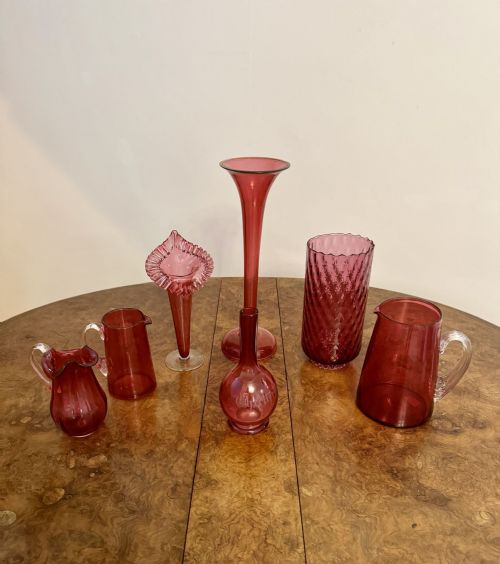
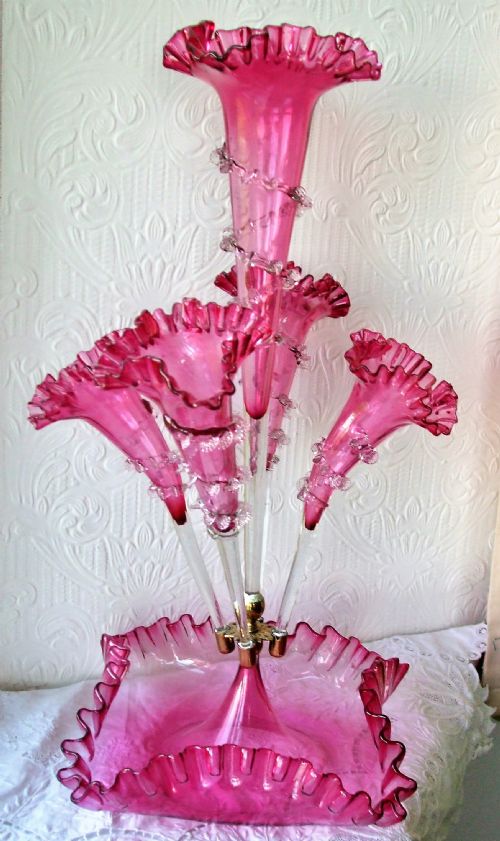


Cranberry Glass Trumpet Vase
These cranberry glass trumpet vases bring a rich, translucent colour to a room, catching the light in a way few other table pieces manage.
Cranberry Glass Trumpet Vase
A cranberry glass trumpet vase is a slender, flaring vessel designed to hold single blooms or to form part of a larger epergne arrangement. These pieces stand tall on tables and sideboards, drawing the eye with their distinct flared rims and graduated pinkish-red tones. Most examples found here belong to the Victorian period, spanning the late nineteenth century.
The form ranges from simple single trumpet vases to elaborate matching pairs and multi-stem epergne table centrepieces. Some pieces incorporate clear glass elements, brass mounts, or contrasting bases in uranium green glass, reflecting the varied tastes of the nineteenth century. Buyers encounter both straightforward table vessels and grander floor-standing versions.
How they were made
The distinctive colour relies upon a gold salt additive introduced to the molten glass formula during production. Glassmakers shaped the vessels while hot, pulling and flaring the metal to create the characteristic trumpet silhouette.
Many items combine cranberry glass with clear glass overlays or crystal, sometimes mounted in silver plate, brass, or supported by mirrored plate bases. Craftspeople also produced layered effects, overlaying cranberry glass onto crystal or pairing it with contrasting coloured glass bases.
Makers utilised gold salt additives to achieve the signature pink and ruby hues seen across these trumpet vases and epergne centrepieces.
What varies in quality
Quality shows in the depth and evenness of the colour throughout the vessel, as well as the grace of the flared rim. Superior pieces display a smooth transition of tone from the deep ruby base to the lighter upper rim without muddiness.
The fineness of the glass-blowing technique dictates the weight and balance of the trumpet. Master makers achieved thin, elegant walls while maintaining structural integrity, whereas lesser examples appear heavy and lack fluid movement in the silhouette.
The Cranberry Glass Trumpet Vase Glossary
- Cranberry glass
- A type of transparent glass coloured by the addition of gold chloride to the molten batch. It yields shades from pale pink to deep ruby red.
- Trumpet vase
- A vessel characterised by a narrow base that flares outward toward the rim in the shape of a musical horn. This form supports tall stems and floral displays.
- Epergne
- A decorative table centrepiece featuring a central bowl with multiple detachable arms and vases for flowers or fruit. Victorian dining tables frequently displayed these elaborate tiered structures.
- Overlay glass
- A technique involving two or more distinct layers of glass fused together, often with the outer layer cut away to reveal the contrasting colour beneath.
Cranberry Glass Trumpet Vase: Frequently Asked Questions
How do I clean a trumpet vase?
Wash the glass gently in lukewarm water using mild detergent and a soft cloth. Avoid abrasive sponges that might scratch the delicate surface.
Dry the vessel thoroughly with a lint-free cloth to prevent water spots from dulling the rich colour of the glass.
Where should I place a trumpet vase?
Position these tall vessels where natural light can pass through the glass to highlight the colour. Dining tables, mantelpieces, and sideboards make suitable locations.
Ensure the spot is stable, as the tall, slender profile makes some pieces top-heavy when holding heavy flower stems.
Are all cranberry glass vases Victorian?
The majority of pieces date from the nineteenth century, particularly the Victorian era, but production extended into the Edwardian period. Makers continued utilising similar methods and forms around the turn of the twentieth century.
Stylistic details, such as Art Nouveau motifs, help distinguish later examples from earlier Victorian ones.
Can I use these vases for fresh flowers?
These vessels hold water and fresh flowers without issue, much as they did in the nineteenth century. The narrow neck naturally supports stems in an upright position.
Take care when filling and emptying tall trumpets to avoid knocking the delicate rims against taps or sinks.