
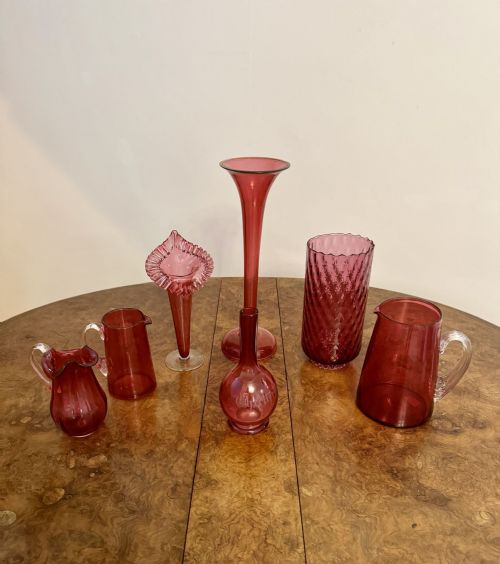


Red Glassware Set
A red glassware set brings striking colour and vibrant depth to a table, combining rich cranberry hues with historical charm.
Red Glassware Set
A red glassware set comprises matched pieces intended for wine, liqueur, or preserves, often gathered in groups of four, six, or fifteen. These collections predominantly feature cranberry glass and Bohemian styles, spanning periods from the Victorian era through the Edwardian years and into the 1920s and 1930s.
The forms found in this category range from wine glasses and liqueur glasses to preserve bowls, jugs, and decanter sets. Buyers searching for a red glassware set will most frequently encounter Victorian cranberry glass stemware alongside later Art Deco Czech and Tango productions.
Materials and production methods
These sets utilise blown glass formed with a gold salt additive, which reacts during melting to produce the characteristic deep red or cranberry colouration. Master makers combined clear glass elements with coloured portions, applying enamel details or silver plate mounts to complete the service.
Techniques such as hand-blowing and deep cutting created substantial faceted surfaces, particularly visible in cut crystal wine glasses and Bohemian hock glasses. The interaction between the metallic colourants and the glass body ensures the rich tone remains permanent throughout the object's life.
Gold is literally dissolved into the furnace to turn ordinary molten glass into a rich, glowing cranberry harvest.
Judging the quality of the set
Quality in these sets rests upon the depth and consistency of the red colouration, which depends directly on the precise proportion of gold salt additive used in the molten batch. Uniformity across every individual glass in a set indicates superior workshop control.
The fineness of the hand-blowing, the crispness of any cut facets, and the harmonious pairing of components in jug and bowl sets or decanter groupings separate standard utility wares from finer cabinet pieces.
The Red Glassware Set Glossary
- Cranberry glass
- A transparent red glass produced by adding gold chloride to the molten metal. This traditional method creates a distinctive pinkish-red shade highly prized by collectors.
- Cut crystal
- High-clarity glass shaped by mechanical or hand cutting to produce sharp facets. These cuts refract light and enhance the brilliance of the object.
- Hock glass
- A tall-stemmed wine glass traditionally used for German white wines. Bohemian examples frequently feature coloured bowls set upon clear or tinted stems.
- Silver plate
- A thin layer of silver applied to a base metal mount or handle. This technique provides the appearance of solid silver on serving ware components.
- Tango glass
- A vibrant style of colourful glassware developed in Austria and Czechoslovakia during the early twentieth century. It is known for intense monochrome bodies paired with contrasting dark rims or handles.
Red Glassware Set: Frequently Asked Questions
What is a red glassware set used for?
These sets serve both decorative and functional purposes, traditionally holding wine, liqueurs, or sweet preserves during formal dining. They bring a distinct splash of historical colour to a display cabinet or a festive table setting.
Collectors often acquire complete sets to preserve their historical integrity, using them occasionally for special dinners or keeping them as display showpieces.
How do I date a cranberry glass set?
Dating relies on examining the manufacturing technique, form, and stylistic markers such as Victorian ornamentation or later Art Deco geometric lines. Pontil marks on the base and the weight of the hand-blown material also offer clues to the decade of origin.
Comparing the rim thickness and the shade of the red coloration helps separate nineteenth-century Victorian pieces from later twentieth-century Bohemian or Czech productions.
How should I clean antique red glass?
Wash these pieces gently by hand using lukewarm water and a mild, non-abrasive detergent. Avoid sudden temperature changes to protect the historical glass body from thermal shock.
Dry each item immediately with a soft, lint-free cloth to prevent water spots and preserve the polish of the glass surface.
Are these glass sets safe for daily use?
While many pieces were originally made for dining, antique glass requires careful handling due to its age and delicate hand-blown construction. Using them for special occasions is common, but modern dishwashers should be strictly avoided.
Hand-washing preserves the gold salt red coloration and any applied enamel details from chemical degradation over time.
What defines Bohemian red glassware?
Bohemian glass is noted for its artistic cutting, rich coloration, and association with historic Central European manufacturing centres. These items often showcase skilled engraving or layered glass techniques.
Regional makers combined traditional craftsmanship with innovative staining methods to achieve deep, luminous red tones across stemware and decanters.