



Antique Champagne Saucers
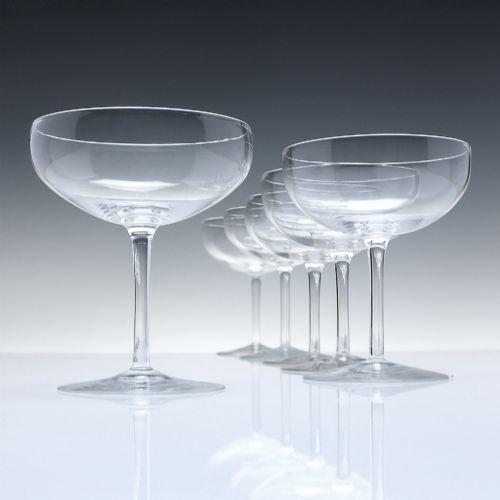
Antique champagne saucers bring shallow bowls and broad rims to the table, offering a traditional way to serve sparkling wine.
Antique Champagne Saucers
When you search for antique champagne saucers, you are looking for shallow glass vessels designed for sparkling wine, spanning Victorian, Edwardian, and Art Deco periods.
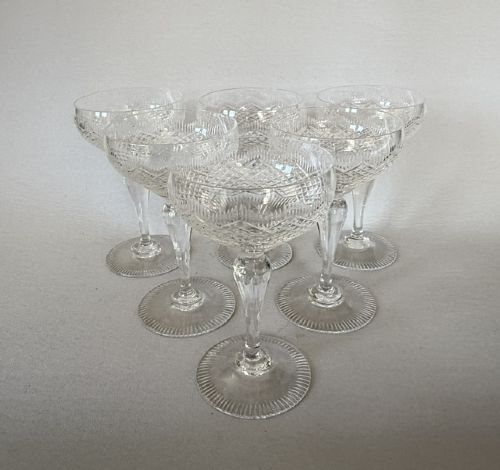
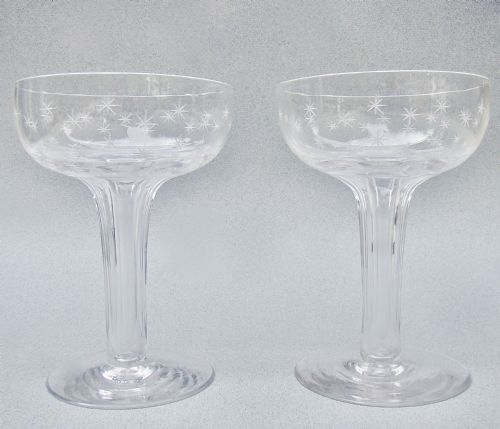
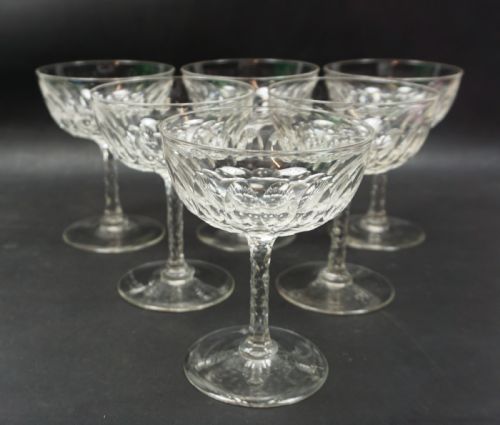
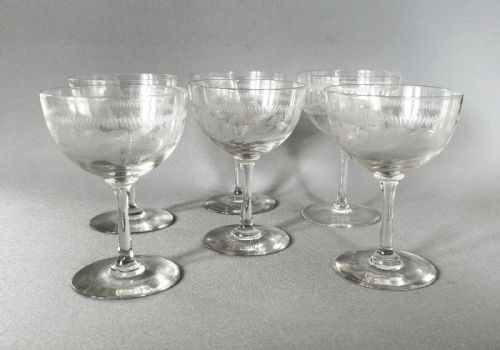
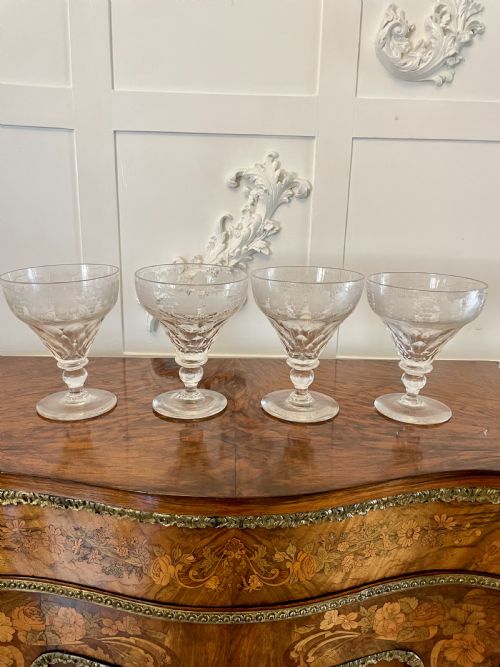
The pieces on this page appear as sets of small cut glass bowls, hollow stem glasses, and engraved coupes originating from English workshops.
You will most commonly meet sets of six Edwardian champagne coupes or Victorian cut glass bowls featuring star-etched designs or Greek key patterns.
How they were made
Maker operations utilised clear glass, lead crystal, and coloured overlay glass, with cranberry and green cased layers cut back to reveal the clear metal beneath.
Techniques relied on wheel cutting for facets, diamond points for engraving, and acid or wheel work for motifs such as convolvulus, ferns, and fruiting vines.
Victorian glassmakers occasionally hid entire botanical gardens inside a single glass, encasing delicate ferns and convolvulus flowers along the rim.
What varies in quality
Quality rests in the clarity of the crystal glass and the crispness of the cutting, where sharp facet-cut stems and deep wheel engraving distinguish finer work from simpler production.
The weight of the lead crystal and the balance of the hollow stem or hourglass form also separate standard sets from exceptional examples.
Fritz Heckert
The Antique Champagne Saucers Glossary
- Champagne coupe
- A broad, shallow bowl on a short stem designed specifically for sparkling wine. This form defines the majority of listings.
- Crystal glass
- Glass containing lead oxide, which increases weight, refractive index, and brilliance. It is frequently seen in Victorian and Edwardian pieces.
- Cut glass
- Glass decorated by holding it against a rotating wheel to grind away material, creating geometric patterns such as facets. This technique creates tactile surfaces on bowls and stems.
- Overlay glass
- Glass made by casing a layer of coloured glass over a clear crystal body, then cutting through the top layer to form patterns. Cranberry and green versions use this method.
- Hollow stem
- A stem containing an internal cavity that connects the bowl to the foot. These are found on specific Victorian examples.
Antique Champagne Saucers: Frequently Asked Questions
Were these used only for champagne?
While originally shaped for sparkling wine, their shallow form and broad rim made them suitable for serving desserts, sorbets, and seafood cocktails during formal Victorian and Edwardian dinners.
Today, collectors frequently utilise them for vintage cocktails and modern sparkling wines where a wider bowl allows the aromas to develop.
How do I date an antique champagne saucer?
Dating relies on combining the glass material, cutting style, and bowl shape with any documented maker marks or known design periods. Victorian examples often feature heavy lead crystal and deep star-cutting.
Edwardian pieces tend toward lighter etched fern or Greek key motifs, while mid-century Art Deco items introduce geometric clarity and simplified stem forms.
Why do some saucers have hollow stems?
Hollow stems allowed the sparkling wine to fill the entire length of the glass from the bowl down toward the foot, creating a continuous column of liquid.
Victorian glassmakers used this technique to demonstrate technical skill and to add visual weight and balance to the piece without increasing the thickness of the bowl.