



Cranberry Glass Stemware
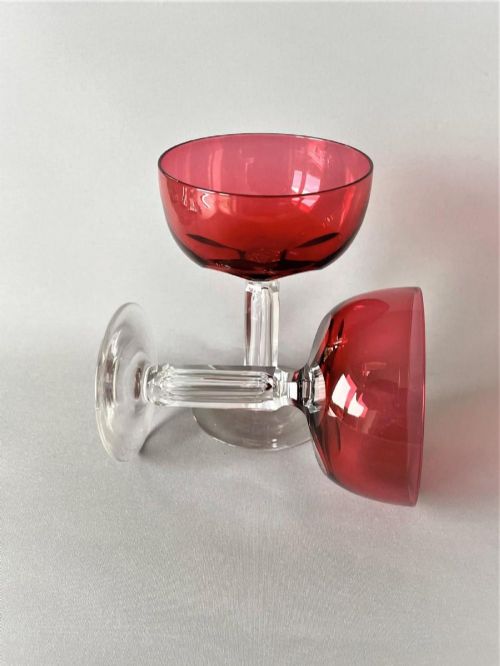
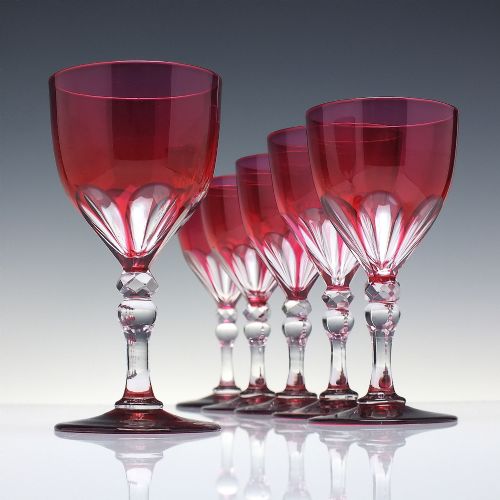
Cranberry glass stemware brings rich pink and red tones to the table, combining deep coloured bowls with clear or cut stems.
Cranberry Glass Stemware
The objects seen here originate from English and French makers, encompassing both matched sets and smaller pairs. Victorian examples dominate the selection, showing the characteristic rich pink to deep red hues achieved through gold chloride in the glass batch.
How they were made
These vessels rely on traditional hand-blowing techniques, shaping molten metal into elegant bowls and slender stems. Artisans combined cranberry glass with clear glass or lead crystal, sometimes employing overlay methods where a coloured layer covers a clear core.
Decoration on finer pieces involved wheel-engraving through the outer layer to reveal the clear crystal beneath. Motifs such as convolvulus and fruiting vines were cut directly into the surface by hand.
Cranberry Glass Stemware Retail Price Guide 2026
Typical asking prices for cranberry glass stemware among the pieces listed under this phrase on Sellingantiques today, from the lower quarter to the upper quarter. They describe what is for sale here now, not the wider market.
Current listings feature cranberry glass stemware primarily from the Victorian era and the Belle Epoque, spanning the mid-nineteenth to early twentieth centuries.
What varies in quality
Quality rests upon the depth and evenness of the colour within the glass body, alongside the precision of the hand-blowing. Superior examples display a rich, uniform saturation without cloudiness or heavy bubbles in the metal.
The finesse of any engraved surface decoration further separates standard items from finer works. Crisp, deep wheel-cut details on overlay glass require considerable skill compared to plain moulded or blown bowls.
Baccarat
The Cranberry Glass Stemware Glossary
- Cranberry glass
- A transparent glass coloured by the addition of gold chloride to the melting pot. It yields shades ranging from pale pink to deep ruby.
- Champagne coupe
- A broad, shallow-bowled stemmed glass traditionally used for sparkling wines. Its wide brim allows the bubbles to dissipate quickly.
- Overlay glass
- A technique where a vessel is formed with a core of one glass colour encased in a layer of another. Cutting through the outer layer exposes the contrasting base colour.
- Lead crystal
- Glass containing lead oxide, which increases the weight, clarity, and refractive index of the material. It rings when struck gently.
- Wheel engraving
- A cold-working technique using small rotating wheels of stone or copper to grind intricate patterns into the glass surface.
Cranberry Glass Stemware: Frequently Asked Questions
What is cranberry glass?
Cranberry glass is a pink-red transparent material produced by adding gold to the molten glass mixture during manufacture. This method creates the distinctive berry hue seen in Victorian tableware.
First popularised during the nineteenth century, the material was widely utilised for decorative table service items, including wine glasses, jugs, and finger bowls.
How do I clean antique stemware?
Wash antique stemware by hand in warm water using a mild, non-abrasive detergent. Avoid sudden temperature changes to protect the old glass.
Place a towel at the bottom of the sink to cushion the base and stem during washing. Dry each piece immediately with a lint-free linen cloth.
Are these glasses safe to use?
These nineteenth-century glasses are generally suitable for gentle use with cold or room temperature beverages. Modern dishwashers and hot liquids should be strictly avoided.
Hand-blown antique glass has delicate walls and pontil marks that do not tolerate thermal shock well. Treat them with care as functional antiques.
How do I date Victorian stemware?
Dating relies on examining the manufacturing traits, pontil marks on the base, and overall form. Victorian pieces often display slight irregularities characteristic of hand-working.
Engraving styles and the depth of the cranberry colour also help assign pieces to specific decades within the nineteenth century.