
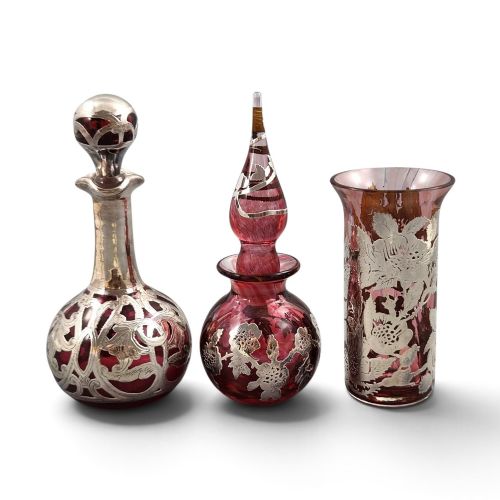
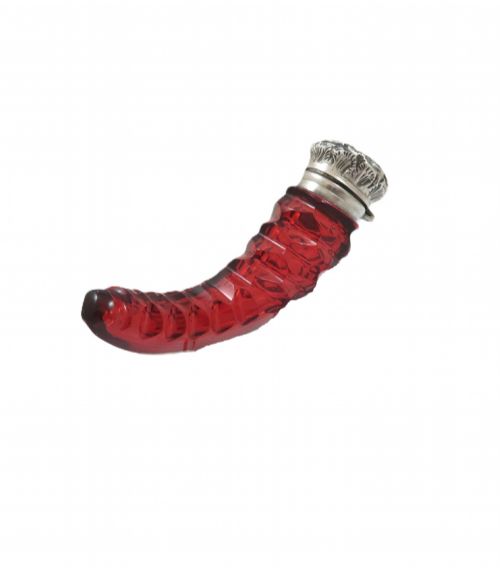
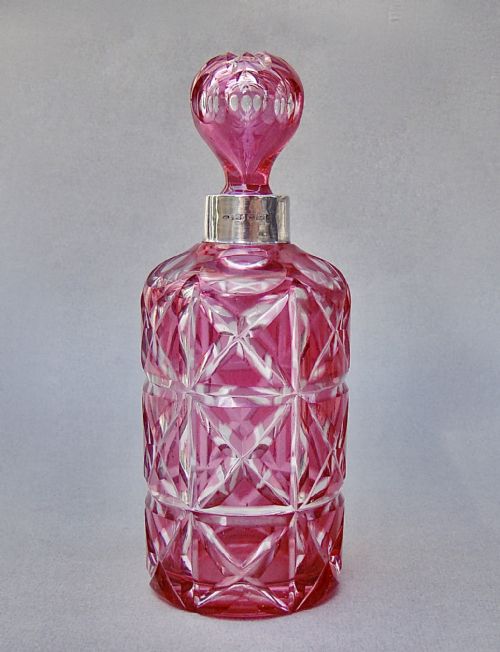
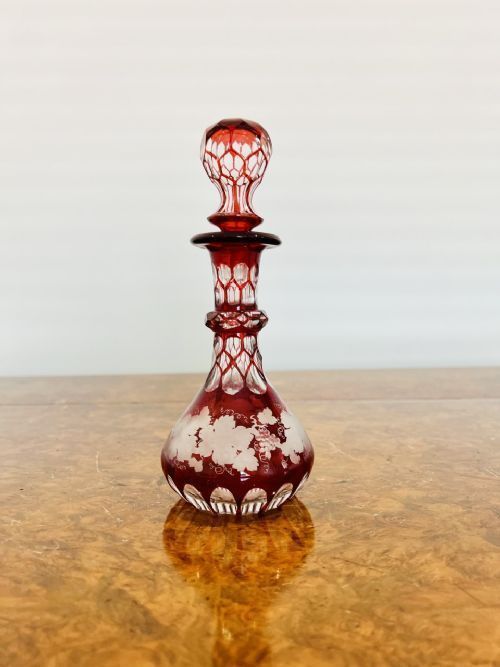
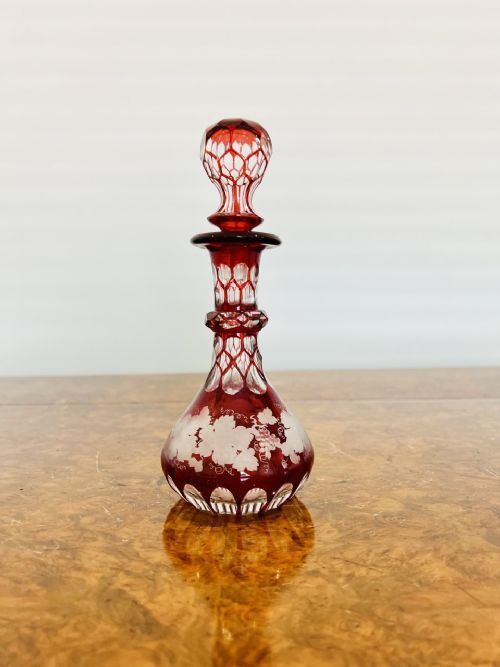


Cranberry Glass Scent Bottle
A cranberry glass scent bottle brings intense ruby colour and heavy silver mounts to a dressing table.
The Nature of Cranberry Glass Scent Bottles
A cranberry glass scent bottle is a small personal container designed for holding perfume, combining rich pinkish-red glass with protective metal mountings. These portable items emerged primarily during the Victorian and Edwardian periods, reflecting an era when personal fragrance was an essential part of daily grooming.
The versions most commonly met on this page combine vibrant cranberry glass with sterling silver tops, hinged caps or screw fittings. They appear in diverse forms ranging from straight icicles and flattened penny shapes to bulbous gourds and cornucopias.
Makers across Britain and continental Europe produced these pieces, with Birmingham silversmiths contributing heavily to the mounted hardware. Bohemian glasshouses also supplied distinct overlay and cut variations that reached British dressing rooms.
Materials and Techniques
The distinctive red hue of cranberry glass derives from the addition of gold chloride to the molten glass batch during production. Artisans shaped this material through blowing and moulding, sometimes casing clear glass within the coloured layer or cutting facets into the surface to catch the light.
Silversmiths completed the vessels by fabricating sterling silver mounts, collars and hinged lids, often stamped with hallmarks indicating assay offices in Birmingham or London. Artisans additionally applied enamel details or gilt decoration directly onto the glass body to add ornamental contrast.
Retail Price Guide 2026
Typical UK retail prices for cranberry glass scent bottle, calculated from the Sellingantiques database of over a million retail prices indexed since 2003. This retail price guide relies exclusively on Sellingantiques data; no external sources or auction records are used, so the figures do not describe the wider market.
Victorian owners carried these tiny red glass phials in pocket cases so their favourite scent remained instantly available during bumpy carriage rides.
Judging Quality and Distinction
Quality rests upon the depth and uniformity of the glass colour, alongside the crispness of any cut facets or overlay work. Superior examples display a vibrant, even tone throughout the body without muddy patches or dull opacity.
The metalwork provides another measure of standard, where crisp hallmarks, robust hinges and substantial silver weight elevate an object. Delicate hand-painted enamel or gilding that remains intact without rubbing indicates careful preservation and finer initial craftsmanship.
G Walton·Charles May·Robert Pringle·George Brace·Walker And Hall
The Cranberry Glass Scent Bottle Glossary
- Cranberry Glass
- A type of transparent glass coloured with gold oxide, producing shades from pale pink to deep ruby red. It became immensely popular for Victorian tableware and dressing table accessories.
- Overlay
- A technique where a layer of coloured glass is fused over a clear or contrasting body, then partially cut away to reveal the underlayer. This method created complex decorative patterns on Victorian bottles.
- Sterling Silver
- An alloy of silver containing 92.5 percent pure silver and 7.5 percent other metals, usually copper. British pieces frequently carry hallmarks indicating this standard.
- Hallmark
- An official stamp applied to precious metals in Britain, showing the maker, assay office and year of testing. These marks help date the silver mounts attached to the glass.
- Double End
- A scent bottle design featuring compartments at both ends with separate stoppers or caps, allowing the owner to carry two different fragrances simultaneously.
Frequently Asked Questions
What is cranberry glass?
Cranberry glass is a distinctive transparent red material created by adding gold to the molten batch. The resulting colour ranges from a delicate pink to a deep crimson.
Craftsmen utilised this vibrant glass extensively for Victorian and Edwardian dressing table wares, including perfume phials and jars.
How do I date these bottles?
Dating relies primarily on the sterling silver mounts, which often bear official British hallmarks indicating the year of assay and the silversmith. Stylistic clues such as Art Nouveau motifs or Victorian overlay work also help narrow the production period.
The historical record shows these items concentrated heavily between 1870 and the early 1900s.
Were stoppers usually made of glass?
Many surviving bottles retain their original inner glass stoppers beneath the outer silver cap to prevent the liquid perfume from evaporating. These small stoppers were individually ground to fit each specific neck.
Replacement inner stoppers occur frequently due to the fragile nature of the glass.
Why are some shapes unusual?
Victorian and Edwardian manufacturers created novelty forms like cornucopias, bullets and gourds to appeal to fashionable buyers seeking distinctive dressing table accessories. These creative silhouettes showcased the versatility of both the glassblower and the silversmith.
Such decorative variety ensures that no two collections look identical.