
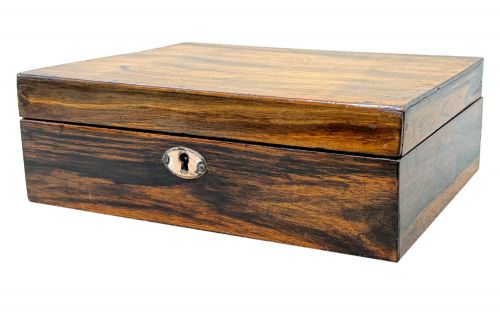


Coromandel Wood Jewellery Box
A coromandel wood jewellery box is a heavy, richly figured container designed to house precious trinkets and travel dressings.
Coromandel Wood Jewellery Box
The version most commonly met on this page is the Victorian dressing or jewellery box, often featuring brass binding and intricate mother-of-pearl inlay. Early Victorian and mid-century examples dominate the selection, showing the heavy timber's enduring appeal for portable wealth and personal keepsakes.
Beyond standard jewellery storage, these objects often double as stationery cases or scent bottle caskets, reflecting the multifaceted uses required by nineteenth-century owners. Anglo-Indian and Aesthetic Movement stylistic influences appear among the standard English forms, adding regional carving and varied decorative motifs.
How they were made
Makers utilised dense coromandel wood, celebrated for its dark, striated grain, as the primary carcass material for these boxes. This timber was frequently paired with polished brass for corner mounts, escutcheons, and structural reinforcement.
Interior fitments incorporated luxurious textiles such as velvet to protect delicate items, alongside contrasting mother-of-pearl inlay set directly into the wood. Vanity cases further integrated cut glass bottles and metal fittings to create secure, multi-layered compartments.
Many vanity cases include secret spring-loaded drawers hidden beneath the velvet lining, designed to outsmart Regency pickpockets.
What varies in quality
The distinction between standard pieces and the finest work rests upon the depth of the timber's figuring and the precision of the brass or mother-of-pearl inlay. Superior examples display seamless mitring and rich, uninterrupted grain patterns across every surface.
Fittings dictate the upper tier of quality, where complete sets of original cut glass bottles, hallmarked silver components, and complex internal mechanisms elevate the piece. The intricacy of the fitted interior and the presence of working keys further separate utilitarian boxes from high-status presentation items.
H Mitchell·Asprey
The Coromandel Wood Jewellery Box Glossary
- Coromandel
- A dense, heavily figured tropical hardwood native to Southeast Asia, prized for its dark brown colour and striking black grain. It was widely used by nineteenth-century cabinet makers for luxury boxes.
- Escutcheon
- A flat plate of brass or metal surrounding a keyhole, designed to protect the surrounding wood from wear. On these boxes, they often feature engraved detailing.
- Tantalus
- A locking drink or scent bottle cabinet that displays its contents while keeping them secure from unauthorized access. In this context, it refers to caskets housing specialised glass bottles.
- Veneer
- A thin slice of superior wood applied over a secondary timber carcass to provide a decorative exterior surface. Coromandel was frequently utilised in this manner due to its scarcity and weight.
Coromandel Wood Jewellery Box: Frequently Asked Questions
How do I date a coromandel box?
Dating relies heavily on stylistic cues, hardware types, and internal materials. Early Victorian and Regency examples often feature simpler brass inlay, whereas later Victorian pieces embrace complex brass binding and Aesthetic Movement motifs.
Assay marks on silver components or retailer signatures inscribed on velvet linings provide precise chronological markers. Comparing the complexity of the internal mechanisms also helps narrow the decade of production.
What is the difference between a dressing box and a jewellery box?
A dressing box typically contains a portable writing slope, compartments for cosmetics, and a suite of cut glass bottles for travelling. These items were designed to service a gentleman or lady's daily grooming routine.
Jewellery boxes focus more narrowly on partitioned trays and velvet-lined compartments specifically shaped for rings, necklaces, and brooches. Many surviving examples blur these boundaries by combining both fitted trays and bottle sections.
How should I care for coromandel wood?
Maintain stable humidity levels to prevent the dense tropical timber from splitting or warping over time. Keep the box away from direct sunlight to preserve the rich contrast of the dark grain.
Apply a microcrystalline wax sparingly to nourish the polished surface without building up residue. Dust the brass mounts and mother-of-pearl inlays gently with a dry, soft cloth.
Are original keys common with these boxes?
Original working keys are occasionally preserved with nineteenth-century pieces, though many survive without them due to centuries of displacement. Locks were intricate for their era, often securing multiple hidden drawers simultaneously.
A box retaining its working key commands greater interest among collectors because it confirms the original locking mechanism remains fully operational.