
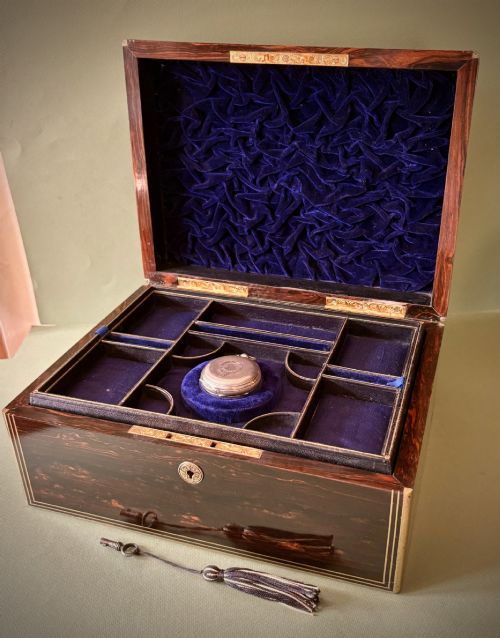


Coromandel Vanity Case
A coromandel vanity case brings tactile luxury to the dressing table with its rich timber and fitted interior.
What They Are
A coromandel vanity case combines the functions of a travelling dressing box, a jewellery box and a gentleman's or lady's case. You are looking at Victorian pieces designed for personal grooming and storage during travel or daily domestic use.
The version you are most likely to meet on this page is the Victorian travelling vanity case, usually dated between eighteen thirty and eighteen eighty. These rectangular boxes house fitted interiors designed to hold bottles, trays and personal items securely.
The evidence shows forms identified interchangeably as dressing boxes, jewellery boxes, and vanity cases. They originate from the nineteenth century, reflecting the craftsmanship of the Victorian era.
How They Were Made
These pieces are constructed from coromandel wood, a dense and heavily grained exotic timber valued for its dark stripes and warm lustre. Workshops combined this durable wood with brass mounts and escutcheons to reinforce corners and secure lids.
Interior fittings utilise materials such as velvet for lining, alongside sterling silver, cut crystal and glass for bottles and jars. Master craftsmen fitted these elements precisely into compartmentalised wooden trays to prevent movement during travel.
Retail Price Guide 2026
Typical UK retail prices for coromandel vanity case, calculated from the Sellingantiques database of over a million retail prices indexed since 2003. This retail price guide relies exclusively on Sellingantiques data; no external sources or auction records are used, so the figures do not describe the wider market.
Listings span the Victorian period from eighteen thirty to eighteen eighty, pairing coromandel wood with brass, velvet, sterling silver and cut crystal.
What Varies in Quality
Quality rests in the grain pattern of the coromandel wood and the complexity of the fitted interior. Finer examples display symmetrical timber figure and robust brass hardware that maintains structural integrity over decades of use.
The standard of internal fittings also separates tiers of production, from simple fabric linings to elaborate arrangements featuring matched sets of cut crystal bottles with sterling silver lids. Working keys and intact internal trays elevate the historical completeness of a piece.
Asprey·Mappin Brothers
The Coromandel Vanity Case Glossary
- Coromandel wood
- A dense, heavy exotic timber from Southeast Asia featuring rich dark brown colouring and striking black grain stripes. It was frequently used for high-end Victorian luxury boxes.
- Dressing box
- A portable box fitted with compartments for toiletries, cosmetics and jewellery used during travel. These pieces often included secret drawers and folding writing surfaces.
- Cut crystal
- High-clarity glass shaped with geometric facets that refract light and enhance sparkle. It appears on the stoppers and bodies of bottles housed inside vanity cases.
- Escutcheon
- A protective brass plate surrounding a keyhole. On these cases, it prevents the surrounding coromandel wood from splitting when the key is turned.
- Fitted interior
- An internal wooden frame divided into precise slots and compartments. It holds glass bottles, silver items and jewellery securely in place.
Frequently Asked Questions
How were these boxes used?
Victorian travellers used these cases to transport personal grooming equipment, perfumes, brushes and jewellery safely. The fitted interior kept fragile glass bottles from colliding.
At home, they sat on dressing tables to keep valuables and cosmetics organised. Many include working locks and secret compartments to secure precious items.
How do you date a coromandel case?
Dating relies on stylistic details, construction methods and materials recorded from the Victorian period. Pieces on this page span the decades between eighteen thirty and eighteen eighty.
Changes in brass hardware, lock mechanisms and interior fabric choices help narrow down the decade of manufacture. Hallmarks on silver bottle caps provide the most precise chronological markers.
Are keys usually included?
Some surviving examples retain their original working key, while others do not. Working locks add to the historical completeness of the piece.
Collectors appreciate functional locks because the boxes were designed to secure valuable jewellery and silver during transit. Replacement keys are sometimes fitted by later custodians to restore functionality.