


Commercial Display Counter
These commercial display counter pieces are practical retail fixtures designed to showcase merchandise, holding the history of high street trade in glass and timber.
Commercial Display Counter
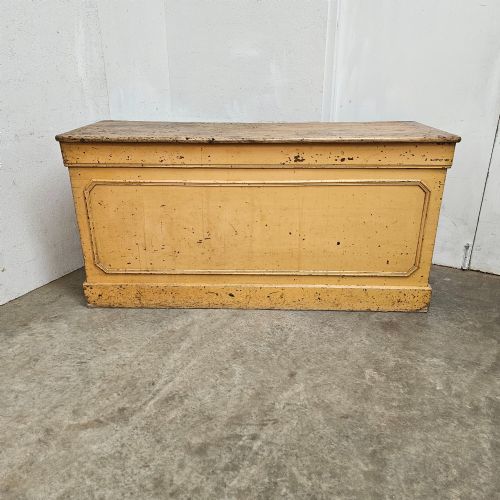
A commercial display counter serves as the primary transaction and presentation surface in traditional retail spaces, ranging from long serving units to tabletop display cabinets.
The pieces appearing here span from the Victorian period through the Edwardian era and into the Art Deco style of the 1930s, reflecting the evolution of shop interiors.
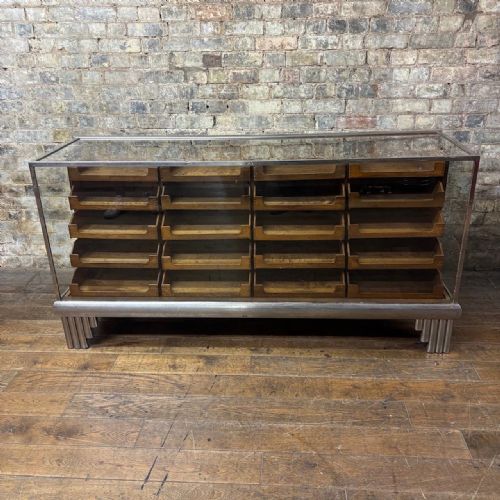
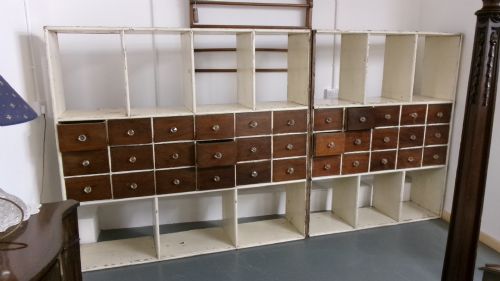
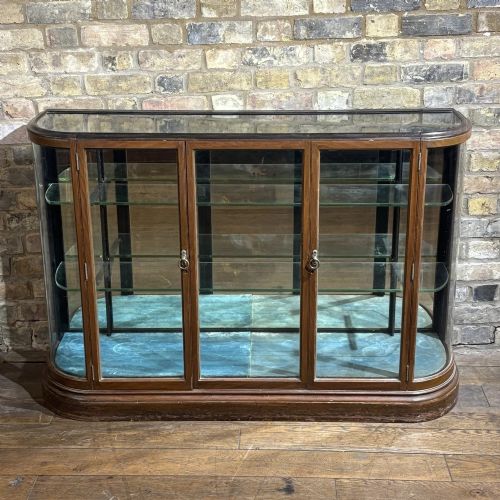
Forms include haberdashery counters with banks of drawers, chemist fittings, bow-end cabinets, and dedicated confectionary display cases built for brands like Fry and Rowntree.
Materials and construction
Construction relies heavily on timber frames of mahogany, oak, and pine, paired with glazed panels to protect goods while keeping them visible to customers.
Metal components such as brass, chrome, aluminium, and bronze provide structural framing and decorative trim, particularly in later interwar examples.
Interiors often incorporate mirrored glass, velvet linings, and specialised hardware like needle drawers or paper roll dispensers suited to specific trades.
Materials span traditional timbers like oak, mahogany, and pine, alongside industrial metals including brass, chrome, aluminium, and bronze.
What separates examples
Quality rests in the integrity of the original glazing, the precision of specialised drawer mechanics, and the survival of makers' branding or sign-writing.
Finer examples show sophisticated cabinetmaking in curved bow-ends, pentagonal geometries, and robust framing rather than purely utilitarian construction.
Dudley & Co·Mackenzie's·John Stow Ltd of Bradford·Manoah Rhodes & Sons Ltd·F. Sage & Co. London·Ermen & Roby·Saml. Elliott & Sons·Pollards
The Commercial Display Counter Glossary
- Haberdashery counter
- A shop fitting featuring multiple shallow drawers, originally designed for ribbons, threads, and small textiles. These units prioritize compartmentalised storage beneath a glass display top.
- Bow end
- A curved cabinet termination that softens the rectangular profile of a counter. This shape allows better circulation in narrow shop layouts while improving visibility.
- Chemist shop fitting
- Specialised cabinetry from nineteenth and early twentieth-century apothecaries. They often incorporate banks of small drawers and labelled compartments for medicines and dry goods.
- Toleware
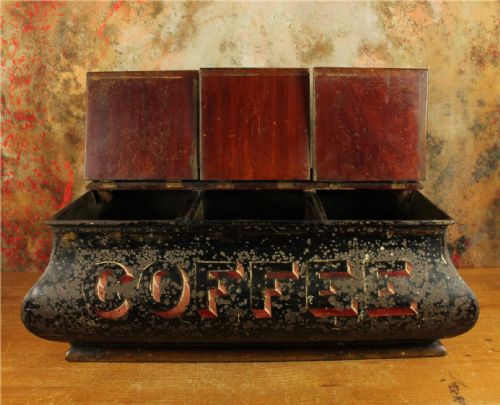
- Painted or japanned metalware produced in tin. These pieces are frequently found in the form of storage boxes or decorative containers associated with commercial interiors.
- Advertising cabinet
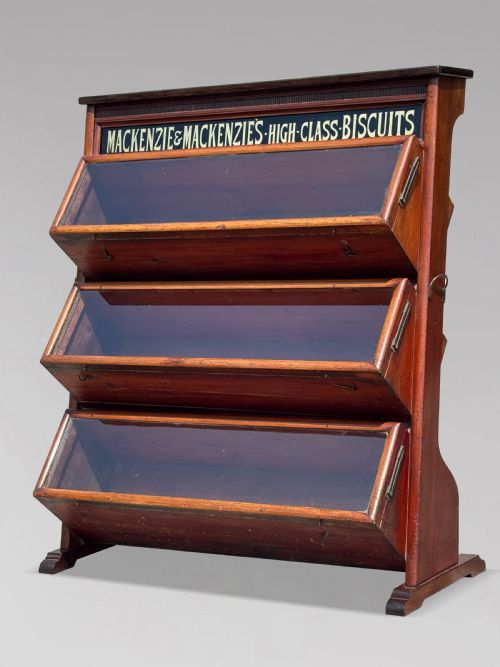
- A countertop display unit produced for specific confectionary or manufacturing brands. They incorporate maker logos or sign-writing to promote goods directly at the point of sale.
Commercial Display Counter: Frequently Asked Questions
What were commercial display counters used for?
These fixtures operated as the central hub of nineteenth and twentieth-century shops, serving both to store inventory and present goods securely to customers.
Retailers utilised the glass tops and upper sections for visual merchandising while keeping stock organised in underlying drawers and shelves.
How do I date a shop counter?
Dating relies on observing stylistic markers, such as heavy Victorian mahogany construction, Edwardian proportions, or the streamlined metal framing typical of 1930s Art Deco design.
Original maker plates, specialised hardware, and branded sign-writing also help anchor pieces to specific decades.
Can I use a haberdashery counter at home?
These cabinets adapt well to modern residential interiors, functioning as kitchen islands, sideboards, or storage chests for collections.
The shallow drawers prove useful for organising smaller items while the glass surfaces provide display space.
What is the difference between a counter and a display cabinet?
Counters are traditionally built at standing height to facilitate customer transactions and face-to-face retail service across the top surface.
Display cabinets often focus entirely on containment and visual presentation, either as countertop units or freestanding floor-standing furniture.