
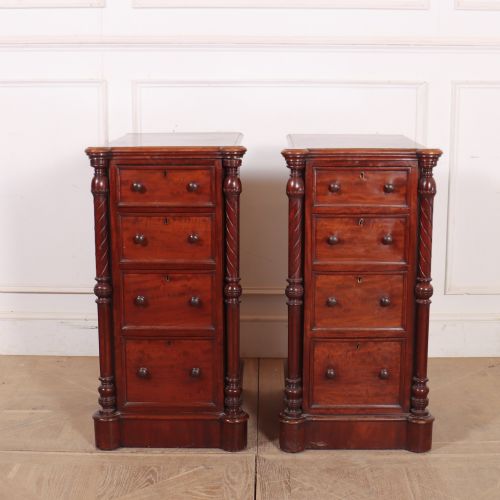


Column Bedside Cabinet
A column bedside cabinet brings classical architectural form and discreet bedside storage together in a compact piece of furniture.
Column Bedside Cabinet
A column bedside cabinet takes its design cues from classical architecture, often featuring cylindrical forms or columned corners that elevate standard bedside storage into a statement piece. These items appear across the nineteenth century, including Victorian, Regency, and William IV periods, alongside continental examples.
Most pieces on this page take the form of single cupboards, cylindrical stands, or matched pairs, constructed from dense hardwoods with inset marble tops. The architectural silhouette gives the furniture a vertical emphasis while concealing internal space for a chamber pot or night necessities.

How they were made
Cabinetmakers built these pieces using solid timbers and veneers such as mahogany, walnut, burr elm, satinwood, and oak, frequently housing them within circular or rectilinear carcasses. Selected woods provide rich grain patterns that complement turned columns and recessed panel doors.
Many cabinets incorporate inset marble slabs to the top surface, providing a durable and water-resistant ledge for lamps and water jugs. Details like ebony line inlay, brass mounts, and concealed drawer pulls complete the architectural finish.
Some nineteenth-century cylinder cabinets hide round secrets behind curved doors that require a gentle turn to reveal their contents.
What varies in quality
Quality rests upon the selection of timber and the precision of the architectural elements, such as smoothly turned columns and tightly fitted door panels. Higher grade examples employ superior veneers and substantial marble tops without structural compromise.
The integration of functional elements, including well-fitted doors and drawers that move smoothly within cylindrical or curved carcasses, distinguishes finer workshop production from simpler utility pieces.
The Column Bedside Cabinet Glossary
- Pot cupboard
- A small bedside cabinet originally designed to house a chamber pot behind a single door. These practical items often double as lamp tables today.
- Commode
- A low cabinet or chest of drawers, frequently used in French and continental interiors as a bedside or side table. The term covers various enclosed storage forms.
- Pedestal cabinet
- A freestanding piece of furniture built on a vertical column or plinth base. This form supports the cylindrical or square body of the cabinet above.
- Cylinder cabinet
- A piece featuring a rounded, circular body that conceals interior shelving or storage. The curved profile requires specialised joinery.
- Line inlay
- Thin strips of contrasting wood inserted into the primary timber surface to create geometric borders. Regency pieces frequently employ this decorative technique.
Column Bedside Cabinet: Frequently Asked Questions
What is a column bedside cabinet?
A column bedside cabinet is a small, enclosed piece of bedroom furniture influenced by classical architecture, featuring cylindrical bodies or columnar supports.
These cabinets provide discreet storage while serving as a decorative bedside table or lamp stand.
Were these cabinets made in pairs?
Many nineteenth-century cabinets were produced as matching pairs to flank a bed symmetrically. Pairs often exhibit identical timber graining and architectural detailing.
Single examples also appear frequently, reflecting different historical bedroom layouts.
Why do some cabinets have marble tops?
Marble tops provided a durable, water-resistant surface for placing washbasins, water jugs, or heavy lamps. This practical addition protects the wood beneath from moisture.
White or veined marble slabs are typical on French and continental nineteenth-century pieces.
How do I identify a Regency period cabinet?
Regency cabinets often display classical architectural proportions, clean neoclassical lines, and contrasting timber details like ebony line inlay. These pieces date from the early nineteenth century.
They emphasise structural columns and restrained ornamentation compared to later Victorian designs.