


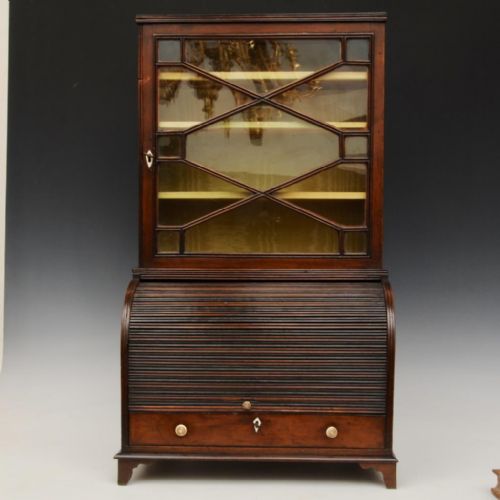
Regency Cylinder Cabinet
A regency cylinder cabinet brings clever concealed storage and clean neoclassical lines to a room, offering a rolling shutter that hides a fitted writing interior.
Regency Cylinder Cabinet
A regency cylinder cabinet sits among refined forms designed to conceal papers and writing paraphernalia beneath a curved wooden rolling shutter. These pieces date principally from the nineteenth century, including the Regency period proper alongside early Victorian interpretations and later nineteenth-century examples.
The objects listed under this description vary from compact bedside cupboards and circular pot stands to larger bureau bookcases and miniature furniture. Buyers most frequently encounter flame mahogany and rosewood variants, alongside pieces incorporating brass inlay or faux marble tops.
Makers and workshops of the period occasionally drew inspiration from notable figures, producing cylinder desks and secretaire cabinets that reflect high design standards of English Regency furniture. The forms bridge the gap between utilitarian storage and elegant neoclassical display.
Materials and construction
Cabinet makers utilised richly figured timbers such as flame mahogany, rosewood, and pollard oak to create striking visual movement across curved surfaces. The distinctive cylinder front itself requires precise joinery, formed from thin vertical slats glued to a flexible canvas backing so the shutter rolls smoothly within recessed tracks.
Decoration relied on contrasting veneers, brass inlay, and polished marble tops rather than heavy carving, aligning with the restrained aesthetic of the period. Interior fittings often include small drawers and pigeonholes constructed from secondary softwoods, demonstrating careful craftsmanship out of sight.
Period assignments span the nineteenth century, highlighting Regency design alongside early Victorian manufacturing.
Assessing quality and execution
Quality reveals itself in the selection of timber veneers, particularly the symmetry and matching of flame mahogany or rosewood across the curved cylinder front. Superior examples maintain a smooth, effortless action in the rolling shutter, whereas lesser pieces suffer from sticking tracks or warped slats due to moisture or poor initial construction.
The refinement of the interior fittings and the precision of any brass inlay distinguish ambitious workshop output from more utilitarian production. Proportion also plays a vital role, with finer cabinets exhibiting balanced vertical lines and harmonious secondary woods within the concealed desk compartments.
The Regency Cylinder Cabinet Glossary
- Cylinder top
- A curved, quarter-circle wooden shutter that slides back into the body of a desk or cabinet to cover the writing surface and pigeonholes. This clever mechanism keeps private papers out of view when closed.
- Flame mahogany
- A veneer cut from the branch forks of the mahogany tree, displaying a distinctive feather-like flame pattern. Cabinet makers prized this figure for its dramatic visual impact on primary surfaces.
- Secretaire
- A piece of furniture containing a drawer or compartment that folds down to reveal a writing desk fitted with small drawers and pigeonholes. It combines the utility of a desk with the storage of a cabinet.
- Pollard oak
- Oak timber taken from pollarded trees, yielding dense, swirling clusters of growth rings known as burr. This material creates a mottled, highly decorative surface texture.
Regency Cylinder Cabinet: Frequently Asked Questions
How do I operate the cylinder top?
The curved wooden shutter runs on concealed tracks recessed into the sides of the cabinet. Pulling the integrated handle guides the slatted tambour smoothly upward and backward into the upper carcass.
Regular use requires a clean track free from dust or wax buildup. Gentle handling ensures the fabric backing of the tambour slats remains intact over decades of operation.
Where were these cabinets placed originally?
These pieces served multiple functions in homes of the nineteenth century, appearing in private libraries, drawing rooms, and bedrooms. Compact versions acted as bedside cupboards or pot stands for household essentials.
Larger secretaire cabinets and bureau bookcases provided dedicated writing space in reception rooms where a full-sized desk proved too intrusive.
How do I distinguish Regency from Victorian?
Regency pieces generally lean toward restrained neoclassical proportions, often featuring precise brass inlay and architectural mahogany veneers. Early Victorian examples tend to display heavier mouldings and slightly more robust proportions while retaining similar forms.
Examining secondary woods and interior construction methods helps clarify the transition between periods. Maker signatures or attribution styles also provide useful context for dating.
What is the difference between a desk and a cabinet?
A cylinder desk focuses primarily on providing a pull-out or fixed writing surface beneath the rolling shutter. A cabinet prioritises enclosed storage space such as shelves, cupboards, or bookcases, sometimes incorporating a writing compartment as a secondary feature.
Many nineteenth-century pieces blur these definitions, functioning simultaneously as display storage and personal writing furniture.