



Cobalt Blue Glass Salts
Cobalt blue glass salts are rich vessels that bring depth to a table, combining deep coloured glass with bright metal mounts.
Cobalt Blue Glass Salts
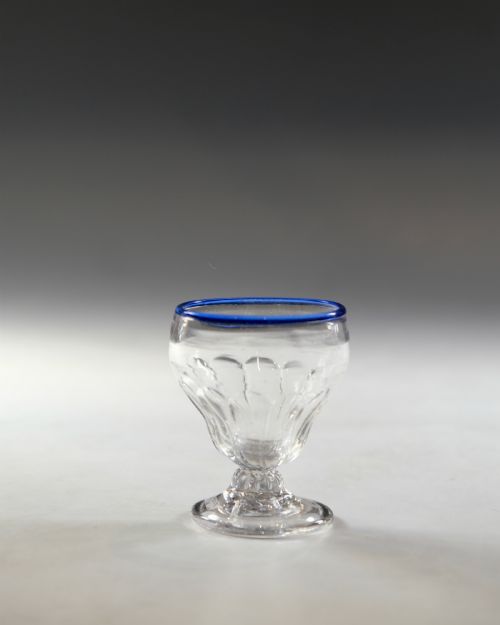
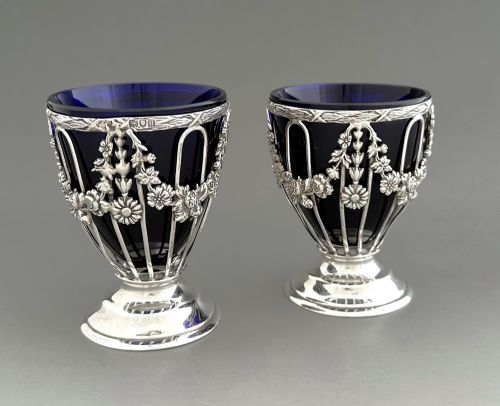
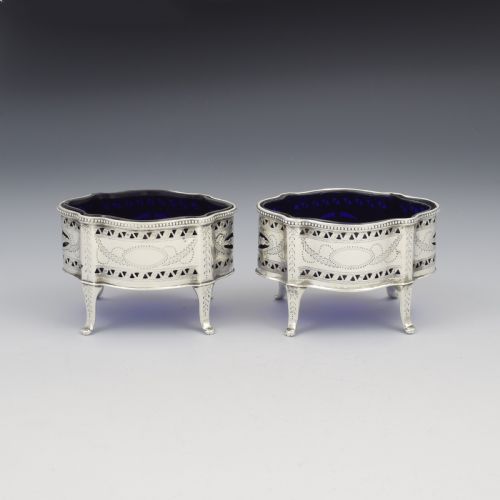
Cobalt blue glass salts take several forms on this page, appearing as standalone open vessels, liner inserts within pierced silver frames, and complete cruet sets. These table salts and salt cellars serve to hold condiment portions alongside meals, shifting from Georgian bonnet glasses and boat shaped table salts to Victorian and Edwardian iterations.
The pieces span the eighteenth century, the Victorian era, the Edwardian period, and the nineteen thirties, representing Georgian, Georgian Revival, and Art Deco styles. Most frequently, buyers encounter Victorian sterling silver and silver plated designs fitted with cobalt blue glass liners alongside earlier lead glass examples.
Materials and construction
Makers formed the vibrant vessels using cobalt glass and lead glass, often combining the deep blue material with sterling silver or silver plate. Metalwork techniques on these items include wirework, piercing, and overlay work to secure or encase the glass.
The blue glass bodies were blown or moulded into shapes such as double ogee bowls, boat forms, and cylindrical condiment pots. These glass inserts fit neatly into pierced or solid silver frames created during the Georgian, Victorian, and Edwardian periods.
Listings span the eighteenth century, the Victorian era, the Edwardian period, and nineteen thirty, incorporating sterling silver, silver plate, and opaline glass.
Assessing quality
Quality rests in the crispness of the metalwork, distinguishing finely pierced silver frames and neat wirework from simpler cast or plated alternatives. The weight of the silver and the clarity of the cobalt glass determine the calibre of each piece.
The relationship between the glass liner and its metal mount dictates standard execution, where a snug and purposeful fit indicates careful assembly. Complete sets matched with original spoons or multiple matching cellars show greater cohesion than assembled groups.
The Cobalt Blue Glass Salts Glossary
- Cobalt glass
- A deep blue glass coloured by the addition of cobalt oxide during manufacturing. It provides the striking hue characteristic of these condiment vessels.
- Salt cellar
- An open vessel used to hold salt on the dining table before the invention of the spring action salt shaker. They frequently feature glass liners held within silver frames.
- Monteith
- A bowl with a scalloped rim, traditionally used for cooling wine glasses or serving as a grand table piece. Some examples incorporate blue glass elements.
- Cruet set
- A collection of small bottles or pots for holding condiments like mustard, salt, and pepper, often housed in a matching frame. These sets combine silver plate and coloured glass.
- Silver plate
- A base metal coated with a thin layer of silver through electroplating or older techniques. It offers the appearance of solid silver at a different tier of production.
Cobalt Blue Glass Salts: Frequently Asked Questions
What are cobalt blue glass salts?
These are small decorative vessels designed to hold salt at the dining table, combining rich blue glass with metal mountings.
They appear as open salt cellars, liners inside pierced silver frames, and components of larger cruet sets across various historical periods.
How were salt cellars used?
Dinners used open salt cellars to hold loose salt, which guests pinched or spooned onto the edge of their plates.
Servers paired them with small condiment spoons to manage portions during meals before shakers became common.
How do I clean cobalt glass?
Clean cobalt blue glass gently using warm water and mild soap, avoiding harsh abrasives that might scratch the surface.
Take care to separate glass liners from silver mounts before washing to protect both materials from damage.
Are the glass liners removable?
Many silver frames on this page feature openwork or wirework designs that allow the cobalt glass liner to lift out.
This construction made cleaning and refilling the salt cellars practical for everyday dining use.
How do I date these items?
Dating relies on hallmarks stamped into the silver mounts, stylistic cues from periods like the Georgian and Victorian eras, and manufacturing techniques.
Items without silver mounts look to the glass form and colour depth to place them within the eighteenth, nineteenth, or twentieth centuries.