



Classical Style Candlesticks
These classical style candlesticks bring architectural form and gilded metalwork into a room, drawing on ancient Greek and Roman motifs.
Classical Style Candlesticks
When you search for classical style candlesticks, you encounter tall branched candelabra, column forms, and figural pieces designed to hold taper candles or adapted later into table lamps. The selection spans the Georgian, Regency, and Victorian eras, alongside later nineteenth-century interpretations and twentieth-century revivals.
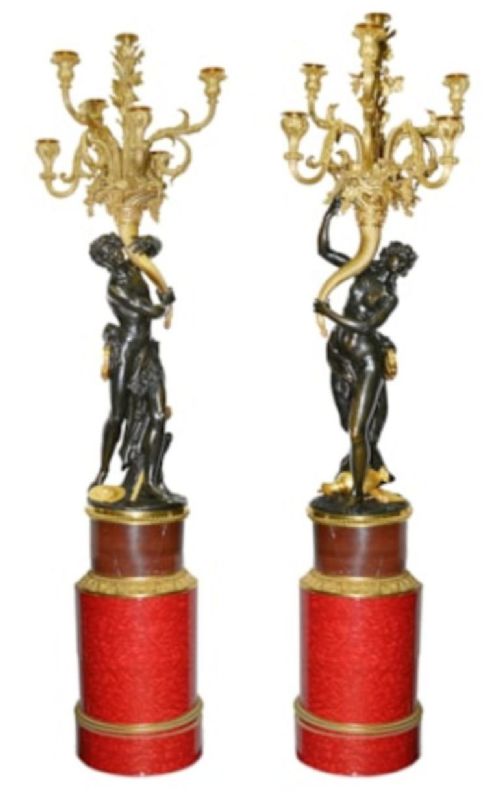
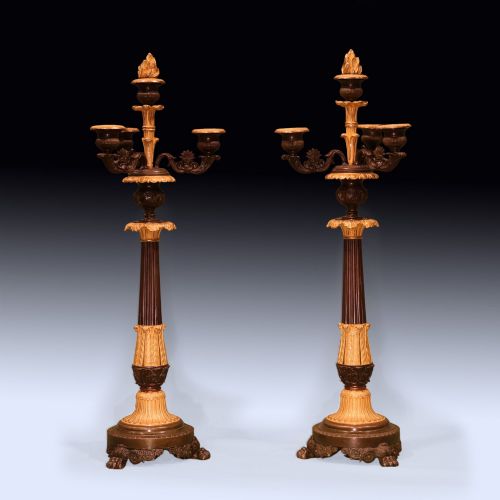
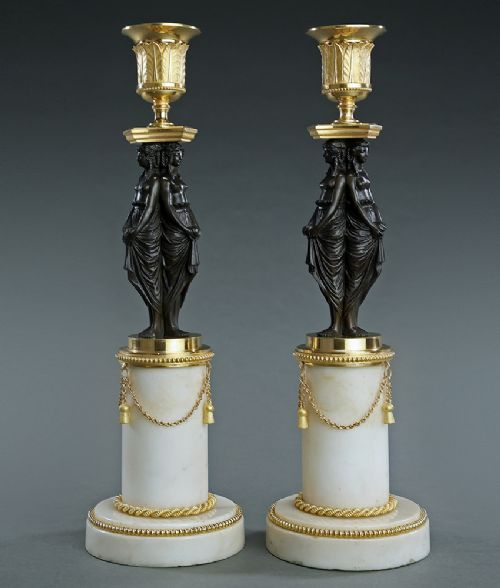
French Empire and Louis XVI designs dominate the selection, often featuring patinated bronze bodies contrasted against bright ormolu mounts. English brass and silver examples, alongside Grand Tour souvenirs and Swedish Empire pieces, appear frequently across the periods.
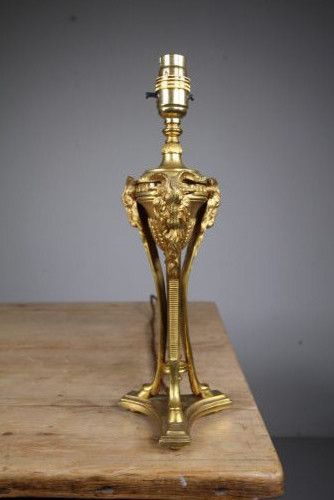
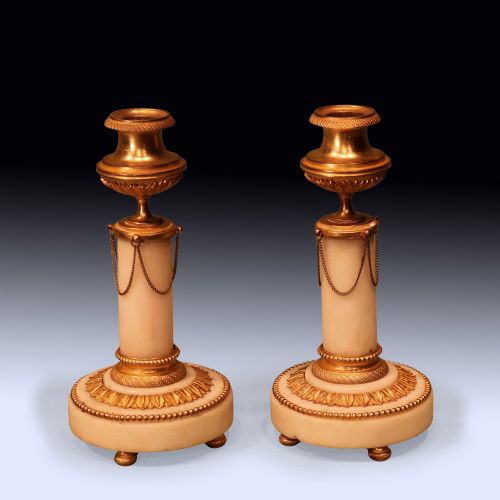
Many pairs incorporate white or dark marble bases, caryatids, rams' heads, and putti figures borrowed directly from antiquity. These lighting devices served formal dining tables and drawing rooms, carrying heavy neoclassical ornament into domestic interiors.
Materials and Technique
Foundry work relies heavily on cast bronze and brass, finished with mercury gilding to create ormolu surfaces or patinated with dark chemical treatments. Ormolu sections provide crisp, chased detail against the smooth, dark depths of patinated bronze or cast iron.
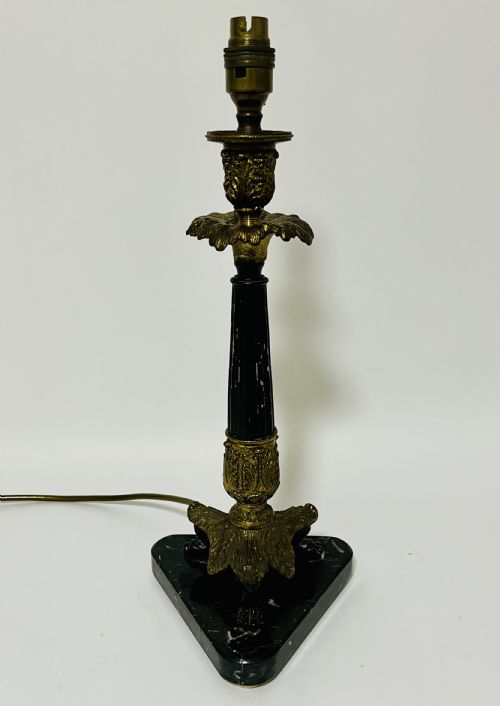
Stonework enters the construction through turned white or variegated marble bases that anchor the heavy metal shafts. Silver and silver-plated copper appear in Georgian and Edwardian iterations, hammered and soldered into classical column shapes.
Some nineteenth-century makers could not resist adding zodiac symbols and rams' heads to ordinary dinner lighting.
Craftsmanship and Finish
The crispness of the chasing separates superior metalwork from softer, later castings where surface details blur. Hand-finishing determines whether the ormolu retains sharp highlights and deep recesses.
The integration of multiple materials defines the upper tier, where bronze, marble, and gilt mounts fit together with absolute precision rather than loose mechanical joins.
The Classical Style Candlesticks Glossary
- Ormolu
- Gilded bronze produced by applying a mercury and gold amalgam to a bronze base and heating it. This technique creates a durable, warm golden surface characteristic of French furniture and lighting.
- Caryatid
- A sculpted female figure serving as an architectural support instead of a column. These figures frequently form the main shaft of classical candlesticks.
- Grand Tour
- A nineteenth-century cultural journey through Europe undertaken by young upper-class men to collect art and antiquities. Souvenirs often included miniature bronzes and classical candlesticks.
- Patinated bronze
- Bronze that has been treated with chemical solutions to alter its surface colour to brown, green, or near-black. This dark finish creates contrast against bright gilt mounts.
- Neoclassical
- A style spanning the eighteenth and nineteenth centuries that revived the architectural and decorative motifs of ancient Greece and Rome. It relies on symmetry, columns, and classical urns.
Classical Style Candlesticks: Frequently Asked Questions
How do I identify a Grand Tour piece?
Grand Tour pieces typically date from the nineteenth century and use classical architectural ruins or mythological figures as their main subjects. They often combine patinated bronze with marble bases, reflecting souvenirs purchased during European travels.
These items prioritise decorative storytelling and classical accuracy over utilitarian lighting. Their casting quality can vary depending on whether they were made in Italian workshops or French foundries.
Were these candlesticks converted to lamps?
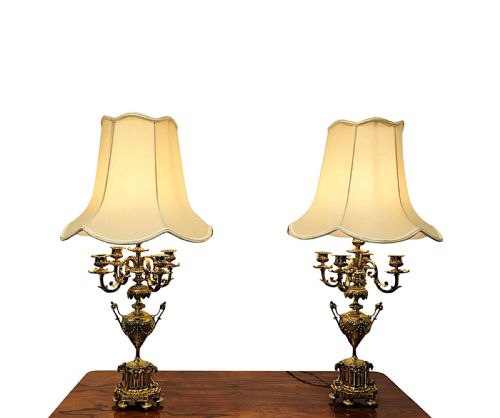
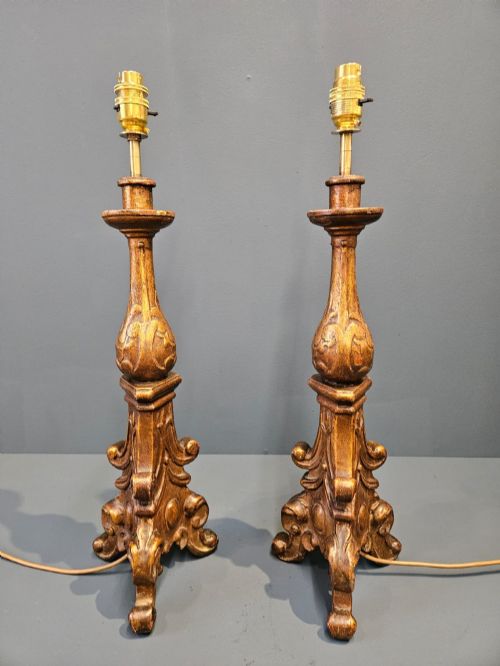
Many nineteenth-century candelabra and candlesticks show later wiring adaptations for electricity. These conversions usually run cables through the central stem or branch sockets without altering the antique metalwork.
Buyers often choose between keeping them as candleholders or using them as table lamps with fabric shades. Reversible wiring methods ensure the original structure remains intact.
What is the difference between ormolu and brass?
Ormolu consists of cast bronze treated with a gold-mercury mixture to produce a brilliant, warm gilt finish. Brass is an alloy of copper and zinc that maintains a solid yellow metallic colour throughout.
Ormolu belongs primarily to high-end French and Regency decorative items, while brass appears across domestic English candlesticks. The surface texture and weight generally distinguish the two materials.
How should I clean gilded metal surfaces?
Dusting with a soft, dry microfibre cloth removes surface particles without wearing down thin gilding. Avoid using abrasive metal polishes, water, or chemical solvents that strip the historical finish.
Preserving the original patina maintains the object's character and historical integrity. Professional conservation is recommended for heavily tarnished or structurally compromised pieces.