


Classical Porcelain Mantel Urns
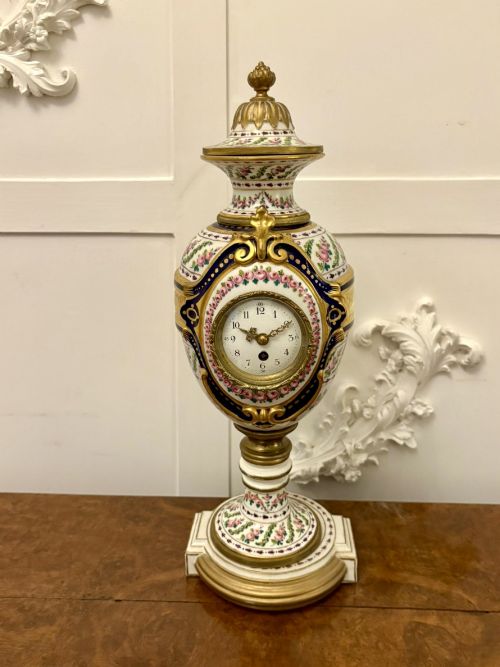
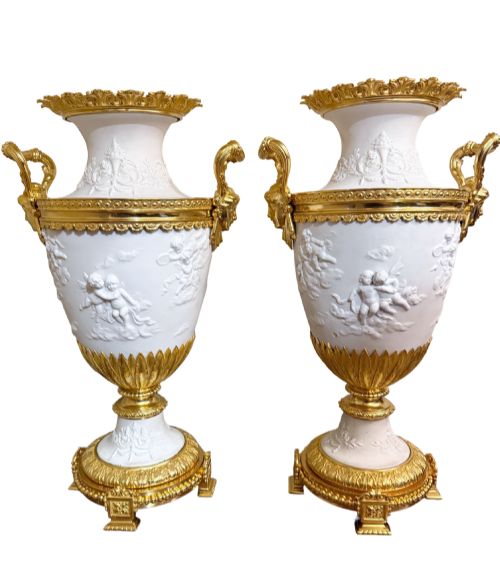
Classical porcelain mantel urns are grand decorative ornaments and garniture sets that bring formal symmetry and hand-painted artistry to a fireplace.
Classical Porcelain Mantel Urns
Classical porcelain mantel urns comprise decorative vases, lidded vessels, and clock garniture sets designed to display on a mantelpiece. When searching for classical porcelain mantel urns, you will encounter pieces primarily from the nineteenth century, including Victorian examples and specific decades such as eighteen eighty and eighteen ninety.
The selections span French Neoclassical, Empire, and Rococo Revival styles alongside specific regional forms like Old Paris, Italian Naples Capodimonte, Minton, KPM, and Vienna. Many items appear in balanced pairs or three-piece garnitures meant to frame a central clock.
Makers and origins heavily reflect French Sevres influence, alongside German and English manufactories. Forms range from monumental lidded vases with ormolu mounts to hand-painted mantel clock combinations.
How They Were Made
These urns utilise hard-paste porcelain formed into graceful vessel shapes and finished with intricate hand-painted decoration. Artisans applied enamel pigments to the ceramic body before firing to achieve lasting colour.
Metal mounts in gilt bronze, ormolu, brass, and gold leaf frame the ceramic bodies. These cast metal fittings provide structural handles, bases, and decorative collars that complement the porcelain.
Thomas Steel painted porcelain fruit so convincingly that eighteenth-century guests reportedly tried to pluck the grapes straight off the mantel.
What Varies in Quality
Quality rests in the precision of the hand-painted artistry and the crispness of the gilt bronze or ormolu mounts. Finer pieces display detailed figural or floral brushwork combined with heavily chased metalwork.
The weight and refinement of the hard-paste porcelain body also distinguish standard production from exceptional pieces. Superior garnitures show harmonious scale across paired vases and central clock components.
Minton·KPM
The Classical Porcelain Mantel Urns Glossary
- Garniture
- A set of matching decorative vessels, usually three or five pieces designed to display together on a mantelpiece.
- Ormolu
- Cast brass that has been mercury-gilded to produce a rich gold finish, commonly used for mounts on nineteenth-century urns.
- Hard-Paste Porcelain
- A durable ceramic material fired at high temperatures, providing a smooth, dense white body suitable for detailed enamel painting.
- Sevres Style
- Decorative output inspired by the famous French royal manufactory, characterised by rich colours, gilding, and classical painted panels.
Classical Porcelain Mantel Urns: Frequently Asked Questions
How do I display a garniture set?
Place the central clock or tallest urn directly in the middle of the mantelpiece. Position the matching side vases symmetrically on either side to maintain visual balance.
Ensure adequate space around each piece so the gilt bronze mounts and hand-painted details remain fully visible.
What is a mantel clock garniture?
A mantel clock garniture is a matched set consisting of a clock flanked by two matching vases or urns. They were designed as a unified decorative scheme for the main fireplace.
Each component shares identical stylistic traits, such as Sevres style painting or ormolu mounts.
How do I identify nineteenth-century pieces?
Examine the style indicators such as French Neoclassical, Empire, or Rococo Revival motifs. Nineteenth-century pieces frequently employ hard-paste porcelain combined with cast ormolu mounts.
Look closely at the hand-painted enamel work and baseline manufacturing traits characteristic of Victorian production.
Are these urns purely decorative?
Most classical porcelain mantel urns serve as ornamental showpieces rather than functional vessels. Lidded versions and garnitures were created specifically to elevate domestic interior aesthetics.
Their substantial weight and delicate gilt bronze or enamel work make them unsuited for everyday handling or holding liquids.