
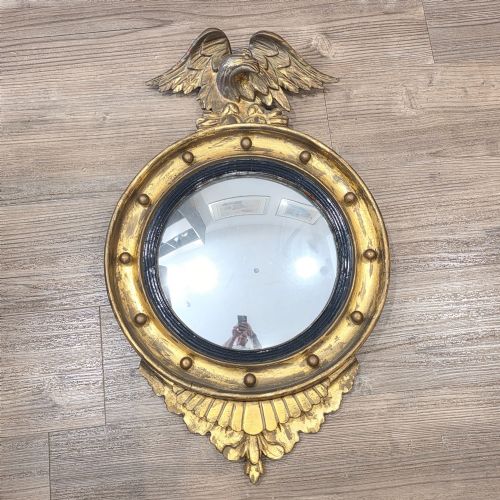
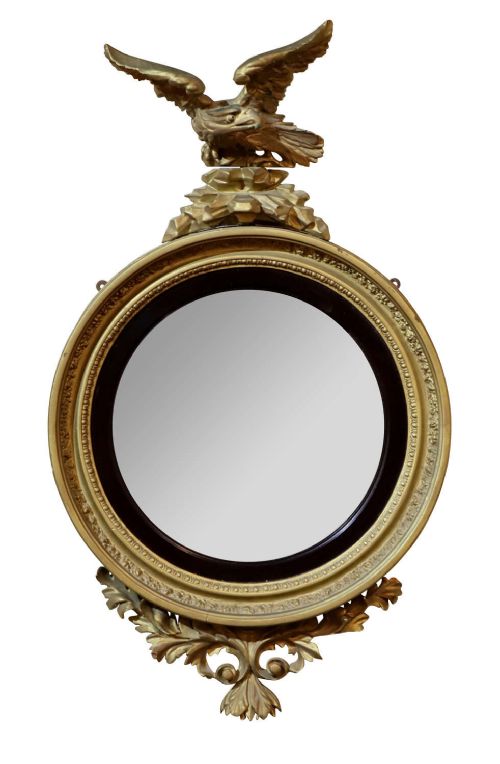
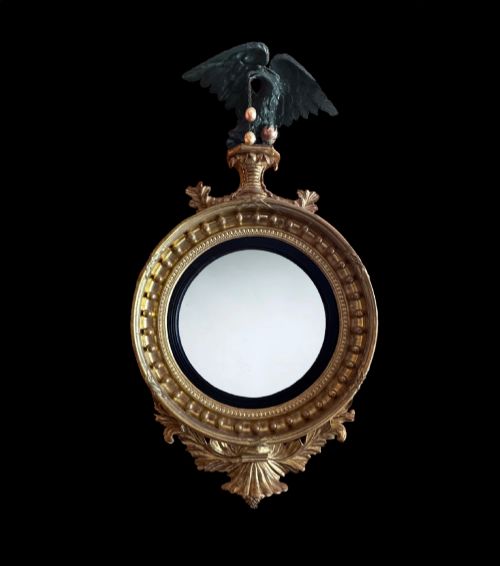
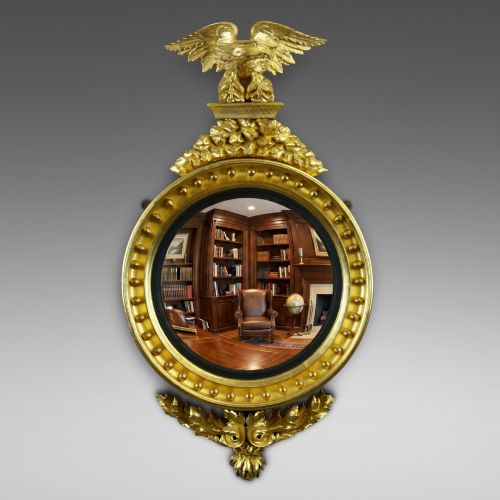
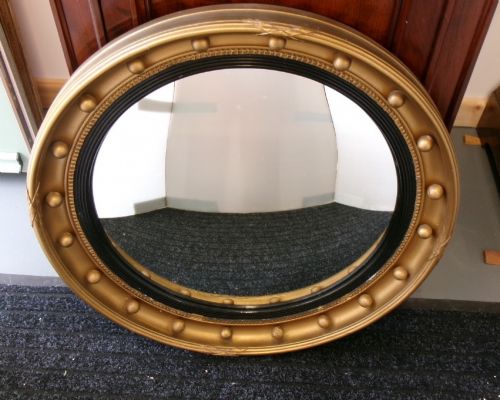

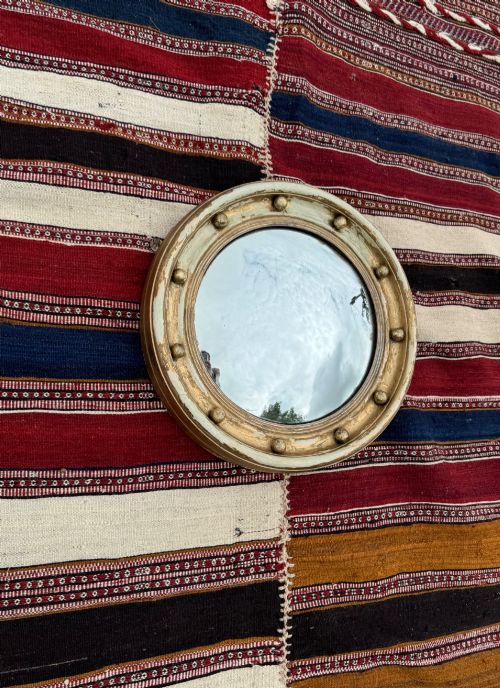

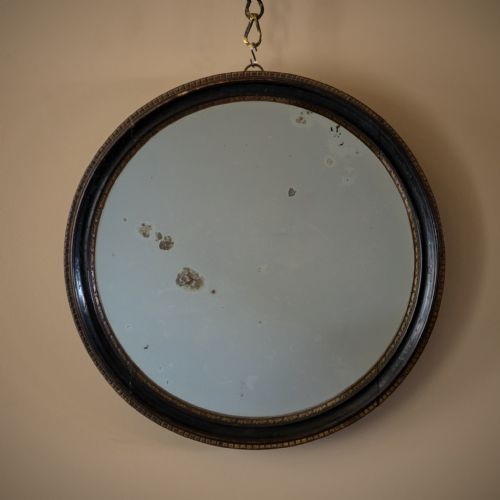

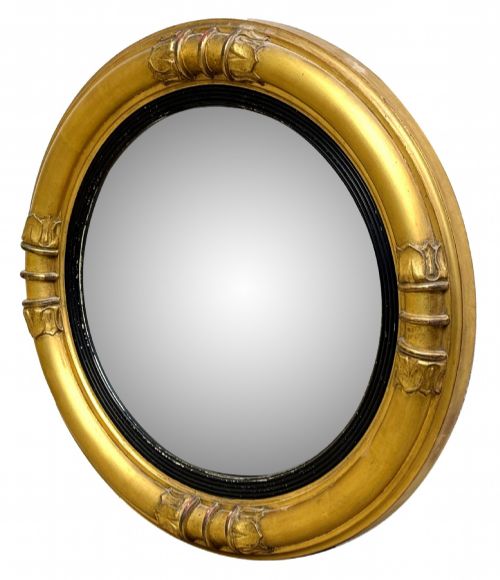
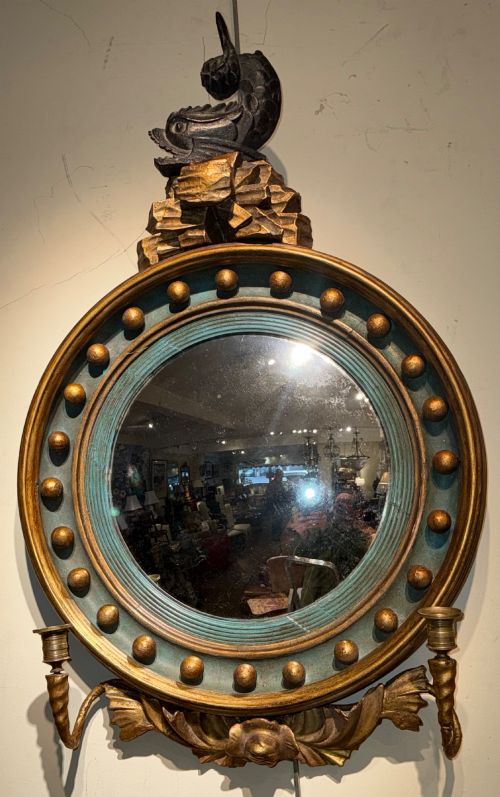
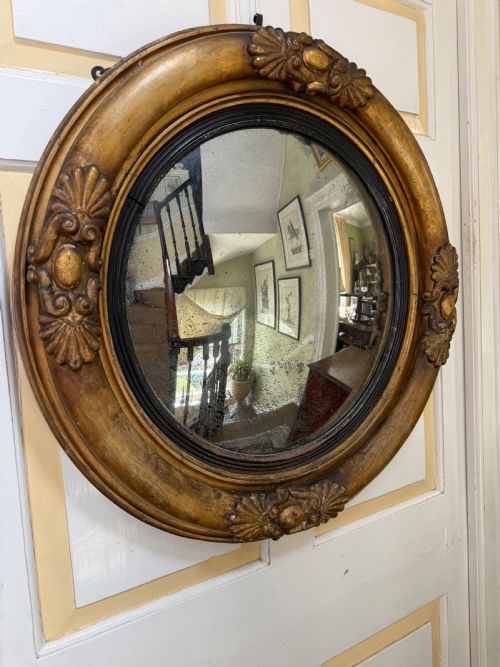


Circular Giltwood Mirror
A circular giltwood mirror brings concentrated light and a deep, curved reflection into a room, framed in brilliant gold.
What a circular giltwood mirror is
When you search for a circular giltwood mirror, you are looking at convex and flat wall glasses set into round frames of carved, gilded wood. The most common form on this page is the convex mirror, which gathers the whole room into its curved surface.
The evidence shows these pieces span the Georgian, Regency, nineteenth-century, and Victorian periods. Regency examples frequently feature ebonised wood details alongside the gold finish.
Origins range from English workshops to Italian centres, including Florentine designs and eagle-mounted Regency wall mirrors. They serve as striking focal points in halls, overmantles, and principal rooms.
How they were made
Makers constructed the frames using carved wood and applied gesso, which accepted layers of gold leaf to create the characteristic giltwood surface. Ebonised wood trim was often introduced for contrast.
The distinctive curved glass of the convex mirrors required specialised blowing and cooling techniques to achieve an even, distortion-free reflection. Heavy timber backboards secured the glass and protected the frame.
Retail Price Guide 2026
Typical UK retail prices for circular giltwood mirror, calculated from the Sellingantiques database of over a million retail prices indexed since 2003. This retail price guide relies exclusively on Sellingantiques data; no external sources or auction records are used, so the figures do not describe the wider market.
Convex mirrors were once called banker's mirrors because their wide field of vision allowed shopkeepers to keep an eye on all their customers at once.
What varies in quality
Quality rests in the crispness of the carved detail and the depth of the gilding over the gesso ground. Finely modelled ornaments, such as the cresting on eagle-mounted pieces, show superior craftsmanship.
The clarity and condition of the original glass plate distinguish better examples from those with later replacements. The integrity of the foundational wood structure also dictates the enduring stability of the frame.
The Circular Giltwood Mirror Glossary
- Giltwood
- Wood that has been coated with thin sheets of gold leaf over a prepared gesso ground. This technique creates a luminous, warm metallic finish.
- Convex glass
- Curved glass that projects outward, capturing a wide-angle, panoramic reflection of the interior space. It was a defining feature of Regency wall mirrors.
- Gesso
- A plaster mixture applied to wood frames to provide a smooth, absorbent surface for gilding and fine carving. It allows for crisp decorative details.
- Ebonised wood
- Timber treated to imitate ebony, providing a dark, contrasting border often seen alongside giltwood elements in Regency pieces.
- Overmantle
- A large mirror designed specifically to hang above a fireplace mantelpiece. These pieces anchor the visual weight of the hearth.
Frequently Asked Questions
Where should I hang a convex mirror?
These pieces work best opposite a window or in a hallway, where they can capture and project light across the entire space.
Because the curved glass shrinks the view, hanging them at eye level ensures you can appreciate the reflected room detail clearly.
How do I date a Regency mirror?
Look for characteristic design elements such as ebonised reeded inner bezels, ball-turned frames, and carved crests like eagles. The construction of the backboards and the type of gilding also offer clues to the period.
Many pieces from this era date from around eighteen hundred to eighteen thirty, reflecting the classical tastes of the time.
Are giltwood frames solid gold?
No, giltwood consists of a wood base, such as pine or hardwood, covered in a thin layer of genuine gold leaf applied over gesso. This method gave the luxurious appearance of solid gold without the prohibitive weight and cost.
Over the centuries, this delicate surface acquires a soft patina that reveals hints of the red or white ground beneath.
How do I clean a giltwood frame?
Giltwood is extremely delicate and water can easily damage both the gold leaf and the underlying gesso. Dust the frame gently with a soft, dry brush rather than using any liquid cleaners.
Keep the mirror out of direct sunlight and damp environments to preserve the integrity of the gilded surface and the wooden structure.