
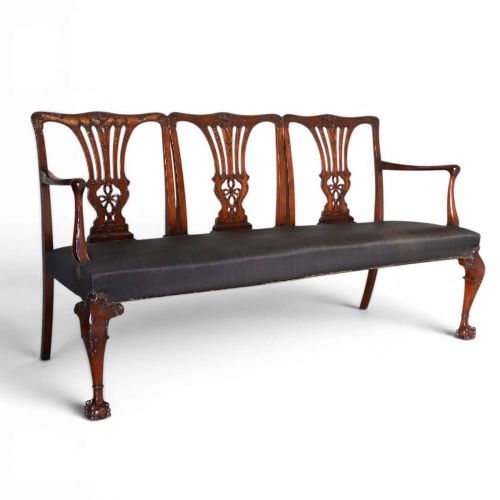


Chippendale Chair Back Bench
A chippendale chair back bench unites the distinctive pierced splats of eighteenth-century seating with the generous proportions of a settee.
Chippendale Chair Back Bench
When you search for a chippendale chair back bench, you are looking at extended seats that adopt the iconic splat-back design of single dining chairs into a continuous multi-seat frame. These pieces appear in forms described variously as settees, sofas, and double or triple-back benches.
The examples most commonly encountered on this page date from revival periods including the Edwardian era and Victorian decades, alongside genuine eighteenth-century pieces. Makers working in these later periods drew heavily on George II and Georgian styles to create seating designed for principal rooms.
Materials across these listings remain remarkably consistent, centred primarily on solid mahogany framing. Many examples incorporate upholstered seats finished in fabric, velvet, or standard upholstery to complement the carved woodwork.
Construction and materials
The construction of a chippendale chair back bench relies heavily on dense, durable mahogany capable of supporting intricate pierced splats and carved top rails. Cabinetmakers shaped the timber to form continuous backrests that echo the geometry of individual dining chairs joined together.
Upholstery techniques varied according to the period of manufacture, ranging from drop-in pad seats found in earlier models to fully upholstered platforms finished in velvet or patterned fabric on later revival pieces.
Some Edwardian makers adapted these grand seating forms specifically to serve as end-of-bed furniture for putting on shoes.
Judging quality in chair back benches
Quality in a chippendale chair back bench is determined by the crispness of the carved detail along the top rail and the complexity of the pierced splats. Superior pieces display deep, manual carving that remains sharp and well-defined across every section of the backrest.
The structural integrity of the joined uprights and the choice of mahogany figure also dictate the tier of the piece. Master craftsmen selected timber with rich grain patterns and ensured the arm supports and leg junctions remained robust without excessive secondary bracing.
The Chippendale Chair Back Bench Glossary
- Chippendale Style
- A design classification inspired by the eighteenth-century furniture maker Thomas Chippendale, characterised by ribbon-back or pierced splats, carved top rails, and cabriole legs.
- Splat
- The vertical wooden strip running through the centre of a chair back, which in these benches is pierced and shaped into intricate geometric or scroll patterns.
- George II Revival
- A late nineteenth and early twentieth-century design movement that reinterpreted the heavy architectural forms and carved mahogany details of the mid-eighteenth century.
- Ladderback
- A chair or settee back constructed with a series of horizontal arched slats resembling the rungs of a ladder, occasionally seen in antique seating variants.
Chippendale Chair Back Bench: Frequently Asked Questions
What is a chair back bench?
A chair back bench is an extended seat where the backrest is constructed by joining multiple chair backs together in a single horizontal frame. This creates the visual effect of several dining chairs arranged side by side.
These pieces typically function as settees or sofas in drawing rooms, hallways, and large bedrooms, offering extended seating while retaining the formal appearance of individual chairs.
How do I date a mahogany settee?
Dating a mahogany settee involves examining the construction methods of the frame, the wear on the timber, and the style of the carving. Eighteenth-century pieces display hand-cut joinery and aged patination, whereas revival pieces from the Victorian and Edwardian eras show machine assistance and nineteenth-century upholstery techniques.
Comparing the specific revival style, such as George II or Edwardian Chippendale, helps narrow down the decade of manufacture when physical markers overlap.
Where should I place a double back bench?
A double or triple back bench suits large hallways, landings, or living rooms where the carved backrest can be viewed without being obscured against a wall. Their open splat design allows light to pass through, making them visually lighter than solid-backed sofas.
They also serve effectively as end-of-bed seating in spacious master bedrooms when upholstered to match the surrounding textiles.