
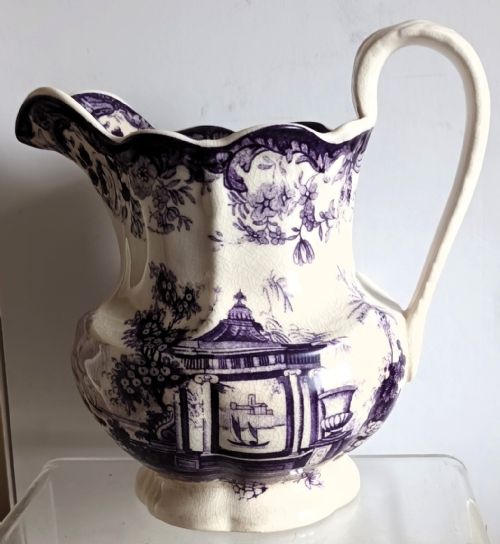


Chinoiserie Ceramic Ewer
These chinoiserie ceramic ewer pieces bring European interpretations of East Asian design into nineteenth century interiors through bold transfer printing and sculptural forms.
Chinoiserie Ceramic Ewer
A chinoiserie ceramic ewer combines domestic utility with imaginative eastern motifs that fascinated collectors during the Georgian, Victorian, and Edwardian eras. Buyers seek these items for their striking visual presence, often finding them as individual pitchers or paired within larger jug and basin wash sets.
The selections recorded here span from the late Georgian period through the nineteenth century and into the twentieth. You encounter robust ironstone alongside refined porcelain, decorated with magenta transfer work, cobalt blue grounds, and red scale patterns.
How they were made
Potters shaped these vessels using durable ironstone or delicate porcelain, often forming complex shapes with grotesque handles and faceted bodies. Artisans applied rich glazes, enamel colours, and gold leaf highlights to define the oriental scenes.
Transfer printing allowed workshops to apply intricate patterns onto the ceramic surface before firing. Skilled hands then hand-painted supplementary details in enamel and gilt over the glaze.
The documented periods stretch from the Georgian era through the nineteenth century to Edwardian times.
What varies in quality
Quality rests in the crispness of the transfer print and the ambition of the vessel form. Sculptural elements like grotesque handles show the modeller's skill, while cobalt blue grounds and gold leaf application reveal the workshop's investment in rich materials.
Early nineteenth century examples demonstrate particular depth in their red scale patterns and magenta tones. The weight of the ironstone and the balance of the jug and basin set dictate the standing of a piece within its period.
Masons Ironstone
The Chinoiserie Ceramic Ewer Glossary
- Ewer
- A large jug with a wide spout and a curved handle, traditionally used for holding water. These vessels often form part of a wash set.
- Chinoiserie
- European artistic style that reflects Chinese and East Asian motifs. Artisans used imaginative landscapes and figures on ceramics.
- Ironstone
- A patented heavy earthenware developed in England. It offers durability and mimics the qualities of Chinese porcelain.
- Transfer print
- A method of decorating ceramics by pressing a paper design onto the glazed surface from an engraved copper plate. This technique allowed complex scenes to be reproduced consistently.
Chinoiserie Ceramic Ewer: Frequently Asked Questions
What is a chinoiserie ceramic ewer?
A chinoiserie ceramic ewer is a handled vessel decorated with European interpretations of East Asian motifs. These pieces function as decorative objects or as part of wash basin sets.
Potters produced them in ironstone and porcelain during the Georgian and Victorian eras. Their designs incorporate cobalt blue grounds, red scale patterns, and oriental scenes.
How were these ewers used?
These vessels served practical washing purposes in bedrooms when paired with matching basins. They held water for personal hygiene before indoor plumbing became standard.
Over time, their striking appearance turned them into decorative display items. Collectors now place them on sideboards or mantelpieces to showcase their transfer prints.
How do I date a ceramic ewer?
Dating relies on material composition, maker marks, and stylistic indicators. Ironstone examples often point to the nineteenth century, while specific colour palettes like magenta transfer suggest Georgian origins.
Form also guides attribution, as grotesque handles and faceted bodies align with particular decades. Comparing the glaze and transfer clarity helps narrow down the period of production.
Are jug and basin sets complete?
Many listings present the ewer alongside its original basin as a matching set. These combinations survived together because families preserved them as functional bedroom suites.
Individual jugs also appear independently of their basins. Both formats reflect the ceramic output of nineteenth century English potteries.