


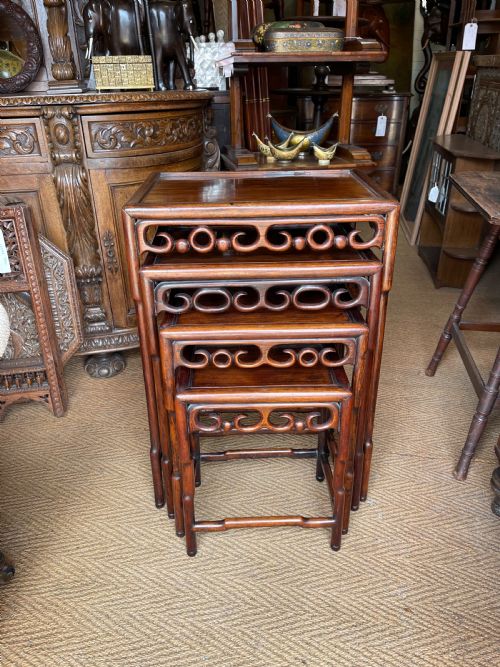
Chinese Hardwood Nest Tables
Chinese hardwood nest tables are practical sets of graduated occasional tables that slide neatly together to save floor space.
Chinese Hardwood Nest Tables
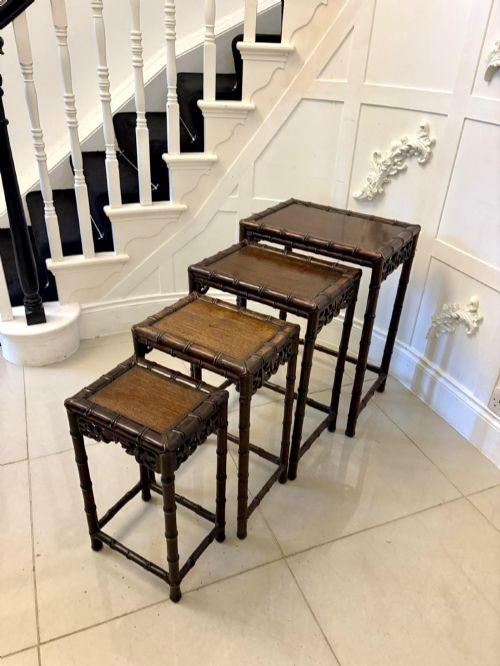
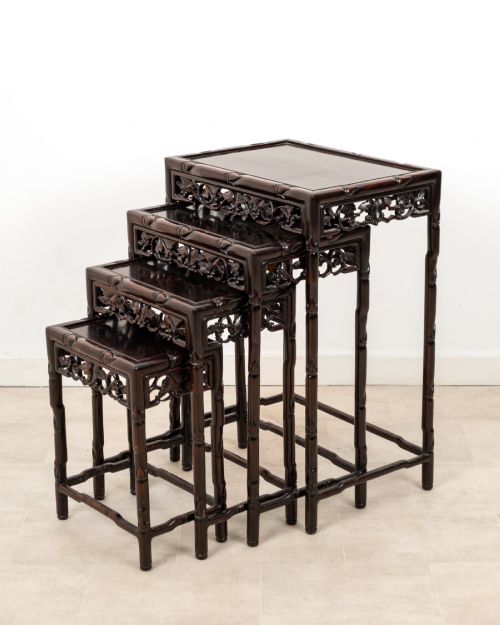
Chinese hardwood nest tables are multi-tiered sets of occasional tables designed to slide neatly beneath one another when not in use. You are most likely to encounter sets of four graduated tables originating from the nineteenth century or around nineteen hundred.
The form appears in various configurations, including coffee tables, side tables, and quartetto sets. These pieces reflect traditional Chinese craftsmanship adapted for both domestic utility and export markets during the late Qing dynasty and Edwardian periods.
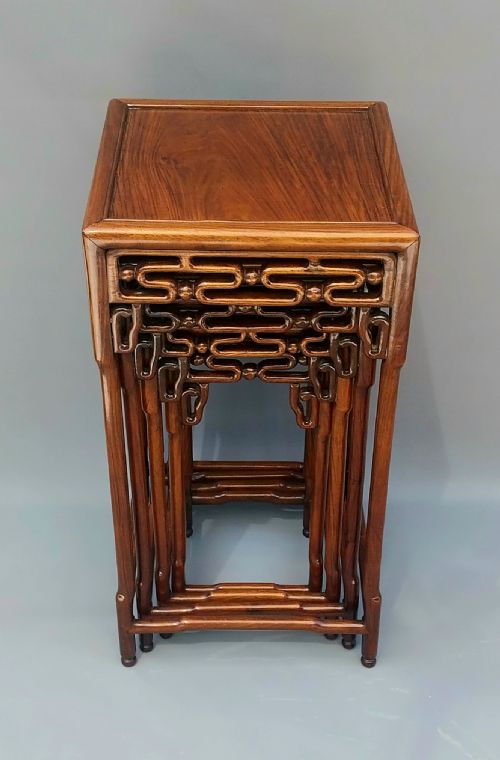
Makers utilised dense timbers to create these space-saving suites, which served diverse household functions from holding tea to displaying ornaments. Their enduring appeal lies in the clever engineering that allows multiple surfaces to occupy the footprint of a single table.
Materials and construction
Construction relies heavily on dense timbers such as rosewood, hongmu, padouk, and huanghuali wood, selected for their strength and rich grain patterns. Some examples incorporate burrwood panels or glass inserts to add textural contrast to the primary frame.
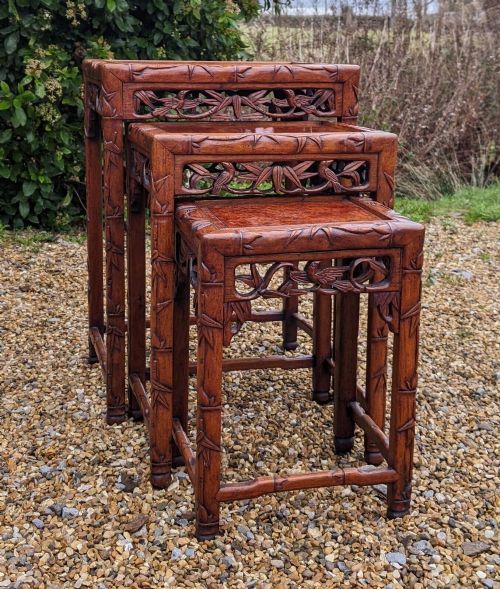
Joinery methods prioritize tight fitting and stability without relying on modern fasteners, allowing the timber to handle seasonal humidity changes. Carved ornamentation, faux bamboo turnings, and subtle moulding details are worked directly into the solid wood structure.
Listings feature pieces constructed from rosewood, hongmu, huanghuali wood, padouk, and burrwood.
Assessing quality
Quality reveals itself in the density and grain selection of the timber, with superior pieces showing exceptional natural colour and figuring. The weight and rigidity of the individual tables indicate how densely the wood was harvested and seasoned.
Finishing touches separate standard examples from finer ones, particularly the crispness of hand-carved motifs and the smoothness with which the graduated tables slide into one another. Precision in the joinery ensures that all tiers align harmoniously when stacked.
The Chinese Hardwood Nest Tables Glossary
- Hongmu
- A traditional Chinese term applied to various dense, heavy hardwoods, often translated as red wood. It encompasses several heavy timber species prized for dark colour and durability.
- Quartetto
- A nineteenth-century term specifically denoting a set of four graduated tables designed to nest together. The word derives from musical terminology indicating a group of four.
- Graduated
- Describing a set of tables where each tier is fractionally smaller than the previous one, allowing them to slide sequentially beneath the largest table. This sizing enables compact storage.
- Chinoiserie
- European artistic interpretation and imitation of Chinese and East Asian decorative arts, popular across various historical periods. It appears in furniture decoration and surface styling.
Chinese Hardwood Nest Tables: Frequently Asked Questions
How were these tables used originally?
These tables served primarily as versatile occasional surfaces for serving tea, holding decorative objects, or writing letters in a reception room. Individual tiers could be pulled out around a room as needed and then stacked away together.
Their modular nature made them particularly useful in smaller parlours or sitting rooms where permanent furniture clutter needed to be minimised during social gatherings.
What is the difference between hongmu and rosewood?
Hongmu is a general Chinese category for dense, heavy hardwoods with deep red or brown tones, whereas rosewood refers to specific timber families grown globally. In antique listings, the terms frequently overlap or describe similar heavy, figured woods.
Both materials provide the structural heft and grain clarity required to build durable, slender table legs that support stacking weight.
How do I care for antique hardwood tables?
Maintain these tables by keeping them away from direct heat sources and sudden humidity shifts, which can cause dense timbers to split. Dust them regularly with a soft, dry cloth and avoid silicone-based polishes.
Applying a traditional beeswax occasionally helps nourish the wood surface and preserve the natural sheen of the grain over time.
Are all sets made of four tables?
While sets of four represent the most common configuration found in nineteenth and early twentieth-century pieces, nests of two or three tables also occur. The number of tiers corresponds directly to the graduating sizes required to fit neatly under the master table.
Checking the dimensions helps clarify whether a set is complete or if intermediate tiers are missing from the stack.