
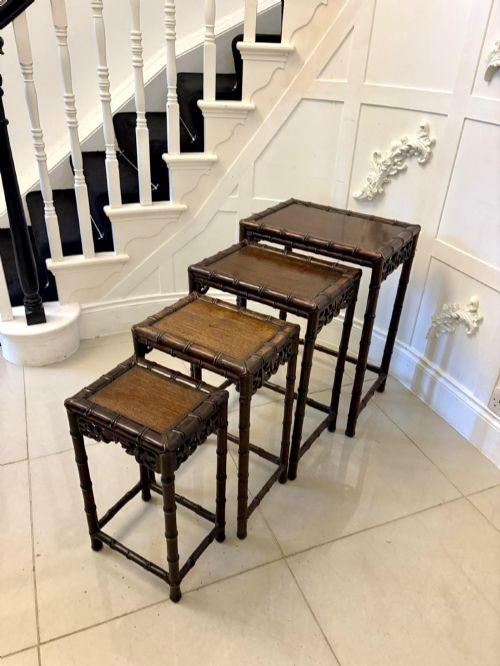
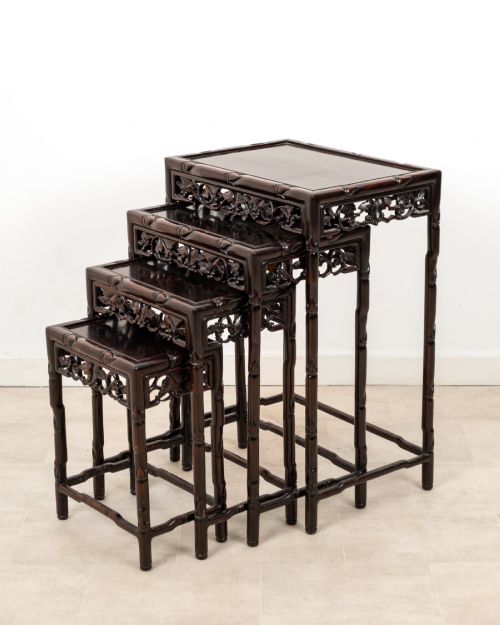
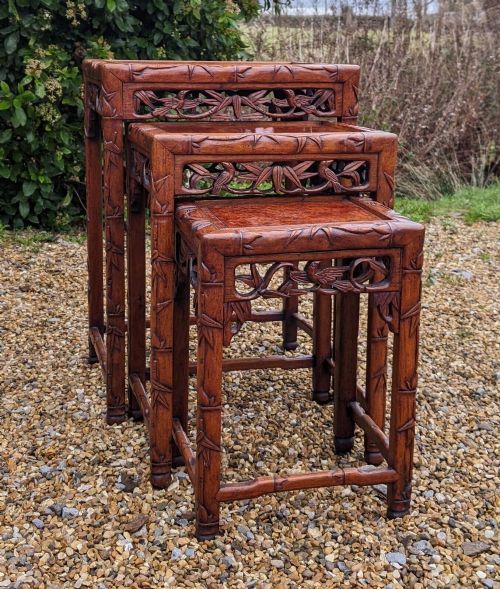


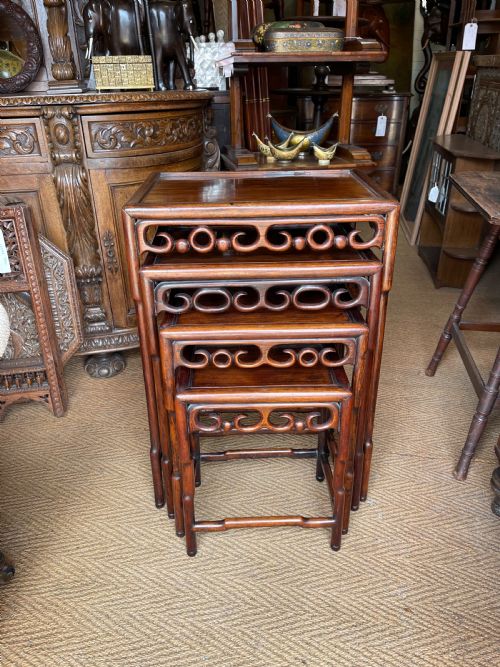

Bamboo Carved Nest Tables
These bamboo carved nest tables are versatile graduating sets from the nineteenth century and the Edwardian period, prized for their space-saving ingenuity.
Bamboo Carved Nest Tables
Bamboo carved nest tables comprise sets of graduating occasional or side tables designed to slide neatly beneath one another when not in use. The examples seen here primarily take the form of nests of four tables, alongside occasional and coffee table formats.
Most pieces date from the nineteenth century and around nineteen hundred, encompassing Qing Dynasty and Chinese Export styles. Buyers frequently encounter sets made from dense Asian hardwoods rather than actual bamboo botanical material.
Originating to serve functional domestic needs in compact spaces, these sets display remarkable adaptability. A single nest provides multiple independent surfaces for tea, display or writing, which then consolidate into the footprint of the largest single table.
How they were made
Craftsmen utilised heavy timbers such as huanghuali wood, hongmu and general rosewood to construct these durable graduating frames. The material choice ensures structural integrity across the slender legs and supporting rails required for tables that slide together.
Surface treatment frequently incorporates carving that imitates natural bamboo stems and nodes, creating the faux bamboo aesthetic seen across several nineteenth-century pieces. Joinery techniques allow each table in the quartet to scale down proportionally to fit precisely inside the next.
One persistent nineteenth-century carver clearly preferred the appearance of bamboo knots over plain wood, transforming sturdy hardwood into botanical deception.
What varies in quality
Quality rests significantly on the choice of timber and the natural grain expression visible across the tops of the tables. Superior sets display exceptional colour and grain depth within the hardwood, elevating the visual impact of the nested arrangement.
The crispness of the carving defines the upper tier of craftsmanship, particularly where artisans render faux bamboo jointing or intricate oriental motifs. Consistency in proportion across all four graduating tables ensures the nest functions harmoniously as a unified suite.
The Bamboo Carved Nest Tables Glossary
- Huanghuali wood
- A prized fragrant hardwood native to China known for its rich colour and distinctive grain patterns. It forms the material base for some of the finest occasional tables.
- Hongmu
- A category of dense, heavy Asian hardwoods used in traditional Chinese furniture making. It translates literally to red wood and provides exceptional structural durability.
- Quartetto
- A traditional term for a matching set of four small tables designed to nest together. The word reflects nineteenth-century terminology for occasional furniture.
- Chinoiserie
- European decorative style reflecting Chinese artistic influences. Pieces carrying this label incorporate oriental motifs adapted by Western or export workshops.
- Faux bamboo
- Carved wood styled to replicate the segmented appearance of real bamboo canes. This technique demands precise chisel work to imitate natural botanical nodes.
Bamboo Carved Nest Tables: Frequently Asked Questions
What are bamboo carved nest tables?
These pieces consist of sets of four graduating tables designed to slide one beneath another to save floor space. They function as occasional, coffee or side tables.
The majority date from the nineteenth century and around nineteen hundred, executed in hardwood with detailed carving mimicking bamboo or traditional oriental styles.
How were nest tables used historically?
Historically, households deployed the individual tables across a room for serving tea, holding books or displaying decorative objects when entertaining guests. They offered flexible surface area without permanent bulk.
When the gathering concluded or space was required, the smaller tables slid sequentially back into the frame of the largest piece for compact storage.
Are these tables made of real bamboo?
Despite the descriptive style, most examples seen here are constructed from dense Asian hardwoods such as huanghuali, hongmu or rosewood rather than actual bamboo plant material. Craftsmen carved the wood to resemble bamboo stems.
A small number of pieces feature faux bamboo framing specifically shaped and knotted to replicate the botanical form through carpentry.
How do you distinguish nineteenth-century sets?
Nineteenth-century and Edwardian pieces are identified through timber selection, construction methods and stylistic markers such as Qing Dynasty or Chinese Export design traits. The weight of the hongmu or hardwood provides a clear indicator.
Examination of the joinery and the specific graduating proportions of the four tables helps date the suite to the 1800s or around 1900.