
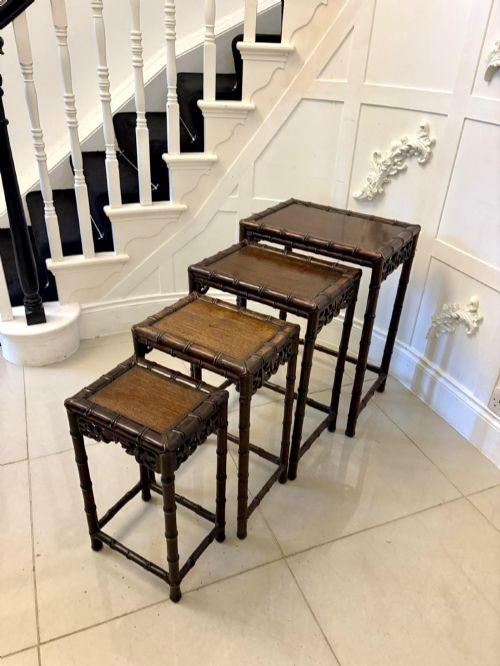
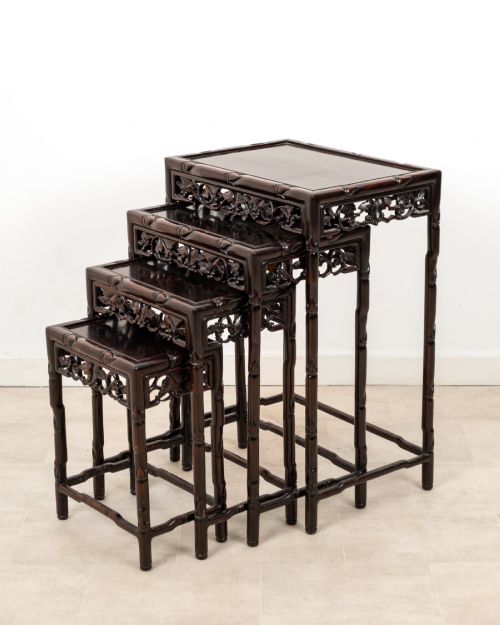
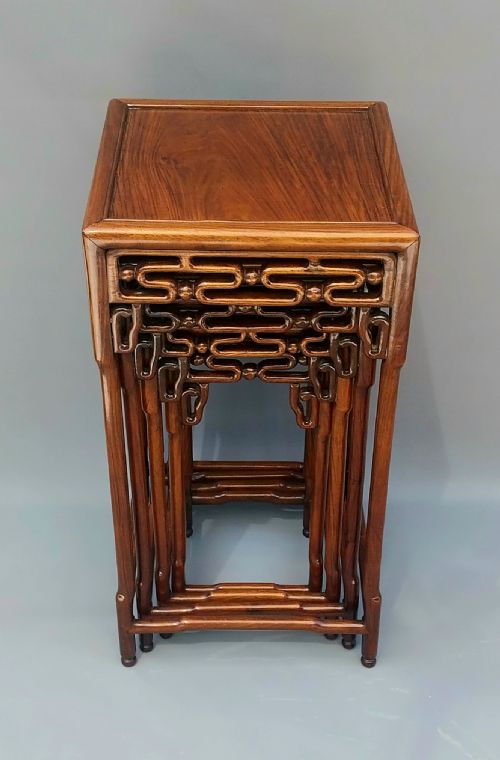
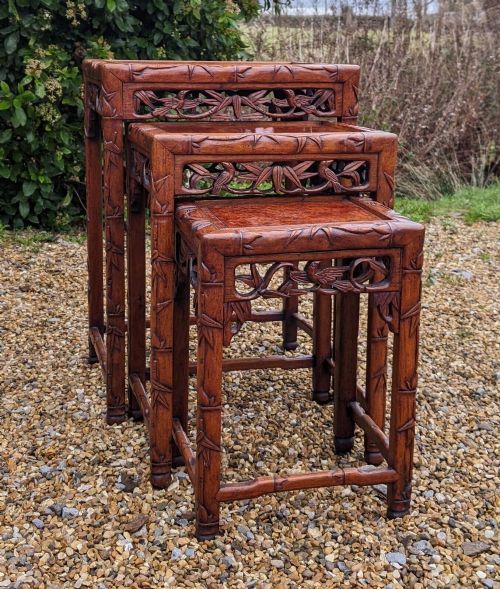


Oriental Nested Side Tables
Oriental nested side tables offer a practical tiered design in hardwood or lacquer, sliding together compactly when floor space matters.
Oriental Nested Side Tables
Oriental nested side tables comprise sets of three or four graduated tables designed to slide neatly beneath one another. When you search for oriental nested side tables, you encounter pieces primarily from the nineteenth century, the Edwardian era, and the early decades of the twentieth century.
The dominant forms span traditional Chinese hardwood constructions in rosewood, hongmu, and huanghuali alongside European interpretations featuring black lacquer and Chinoiserie decoration. Most examples follow a standard configuration of four pieces, though sets of three appear regularly across Victorian and later periods.
Materials and Technique
Cabinetmakers utilised dense Asian hardwoods including hongmu, rosewood, and huanghuali, valuing their weight and distinctive natural grain. These timbers allowed for intricate hand-carving along the apron and legs, frequently depicting flora, fauna, or figural scenes.
Alternative workshops applied gold leaf, burrwood panels, and boulle-work to black lacquer surfaces in the Chinoiserie taste. Tables built in the Queen Anne or Art Deco styles combined traditional Oriental motifs with contemporary European structural lines.
Distinction in Craft
Quality rests in the precision of the graduating dimensions and the smoothness of the sliding action between frames. Superior sets maintain structural rigidity across all four tables without excessive looseness in the joints.
The depth and crispness of the hand-carved details or the integrity of the lacquered surface distinguish finer examples. Grain selection in rosewood and hongmu further separates standard production pieces from exceptional workshop outputs.
The Oriental Nested Side Tables Glossary
- Hongmu
- A dense, dark tropical hardwood traditionally favored in Chinese furniture making for its rich colour and heavy weight. It is often translated simply as red wood.
- Chinoiserie
- The European interpretation and imitation of Chinese artistic traditions and motifs, popular in furniture decoration throughout the eighteenth, nineteenth, and early twentieth centuries. It typically incorporates lacquer work and gilt detailing.
- Quartetto
- A set of four small tables designed to fit together, a term frequently applied in nineteenth-century British records. These sets served versatile functions as occasional tea or side tables.
- Boulle-work
- An elaborate form of marquetry utilising brass and tortoiseshell inlaid into dark grounds, occasionally seen on nineteenth-century Chinoiserie lacquer tables.
Oriental Nested Side Tables: Frequently Asked Questions
How were oriental nested side tables used historically?
These tables served primarily as versatile furniture for entertaining, allowing hosts to deploy individual surfaces for tea or writing as guests required.
When not in use, the smaller tables slid entirely beneath the largest frame to occupy minimal floor space in the drawing room.
How do I tell Chinese export pieces from European Chinoiserie?
Chinese export pieces typically rely on carved native hardwoods like hongmu or rosewood with traditional joinery and motifs.
European Chinoiserie examples generally feature painted lacquer, gilt decoration, and styles influenced by contemporary periods such as Queen Anne or Art Deco.
Can these tables support heavy daily use?
Solid hardwood sets built from rosewood or hongmu possess substantial structural strength suited for holding books, lamps, or everyday objects.
Lacquered or delicate carved surfaces benefit from more careful placement to protect the decorative finish from knocks and scratches.
What is the difference between a set of three and four?
Sets of four represent the most common configuration in traditional Chinese furniture, offering a greater range of graduated sizes.
Sets of three appear more frequently in later Edwardian or specific stylistic interpretations like Art Deco and Queen Anne.