


Asian Carved End Tables
These asian carved end tables bring dense rosewood, huali and traditional carving into nineteenth-century domestic spaces.
Asian Carved End Tables
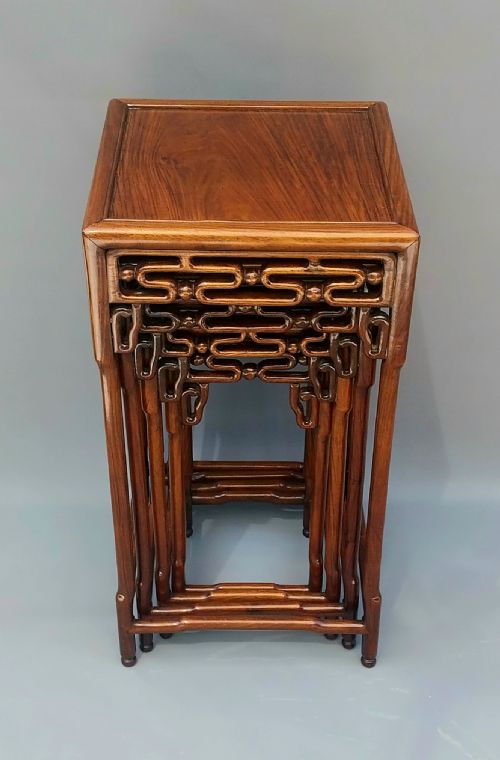
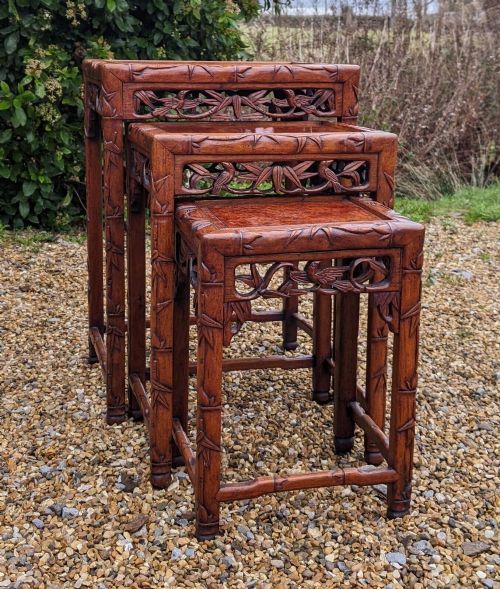
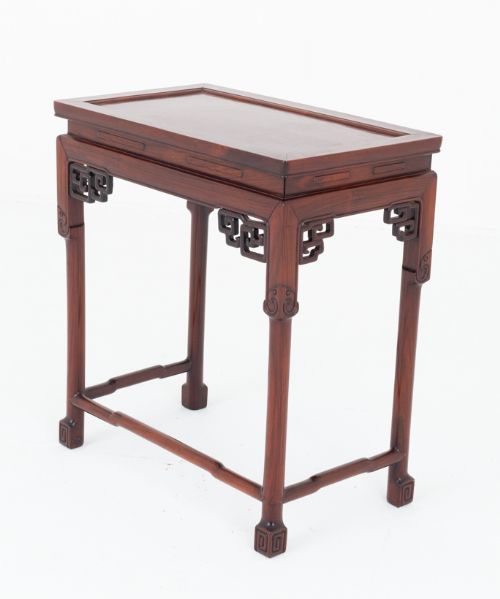
Asian carved end tables appear primarily as nests of four graduated tables, side tables, and low kang or opium tables originating from the nineteenth and early twentieth centuries. These pieces carry Chinese Export and Qing Dynasty styles, shifting from compact quartetto sets designed to slide together to sturdy occasional surfaces.
Buyers seeking these forms encounter dense hardwood constructions shaped for utilitarian placement beside seating or along walls. The selection spans traditional Chinese forms alongside occasional Victorian imports and Indian red lacquer work.
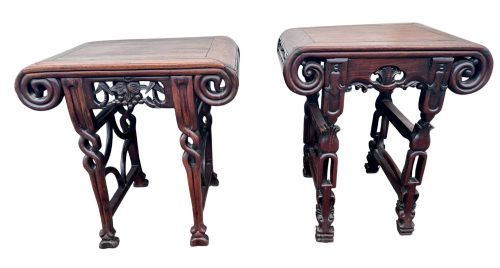
Nests of four tables dominate the selection, offering functional versatility through graduated sizes that nest beneath the largest top. Alongside these, low scroll-end tables and pairs of hardwood stools provide alternative surfaces for compact rooms.
Construction and Materials
The makers utilise dense Asian hardwoods, specifically hongmu, huanghuali and huali wood, alongside selected rosewood and amboyna veneers. These heavy timbers provide the structural stability necessary for intricate surface carving without warping.
Cabinetmakers execute traditional joinery to frame panels of carved hardwood, occasionally integrating marble inserts into rosewood frames. Surfaces receive detailed chisel work along apron rails and scroll ends, following Qing Dynasty aesthetic conventions.
Listings span the nineteenth century into the 1930s, recording hardwood, rosewood, huali wood, and amboyna across side tables, altars, and nests.
Judging Quality
Quality rests upon the density and grain visibility of the hardwood, where superior huanghuali and hongmu display rich natural figuring beneath the carved decoration. Finer pieces demonstrate crisp, deep relief work on aprons and legs rather than shallow mechanical scoring.
Proportion and structural integrity dictate the standing of a set, particularly in nests where all four graduated tables must slide smoothly and sit level. The selection of timber grain across matching surfaces distinguishes workshop production from standard export stock.
The Asian Carved End Tables Glossary
- Hongmu
- A dense, dark tropical hardwood favoured in traditional Chinese cabinetmaking for its weight and fine grain. It forms the primary structure of many nineteenth-century nests.
- Kang table
- A low domestic table traditionally used on a heated brick bed in northern China for dining or writing. These low surfaces translate easily into modern coffee table usage.
- Quartetto
- A matched set of four graduated tables designed to nest together in a space-saving stack. This form became popular in nineteenth-century British and export interiors.
- Scroll-end
- A structural terminal where the ends of a table top or stretcher curve outward in a decorative scroll. This detail characterises many low nineteenth-century forms.
Asian Carved End Tables: Frequently Asked Questions
What is a kang table used for?
A kang table serves as a low surface originally placed on sleeping platforms for serving tea or writing.
Today, buyers utilise these low proportions as coffee tables in contemporary reception rooms.
How do I care for rosewood tables?
Protect dense hardwoods from direct sunlight and sudden temperature shifts to prevent timber movement.
Apply occasional natural wax to maintain the sheen on the carved surfaces.
Are nested tables stable?
Graduated nesting tables rely on precise dimensional reduction to fit securely within the primary frame.
Heavier hardwood construction ensures each smaller table remains balanced during daily use.