
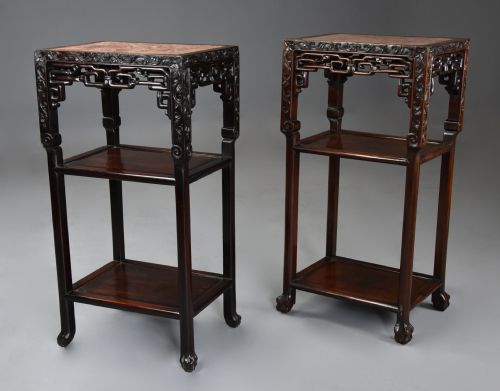
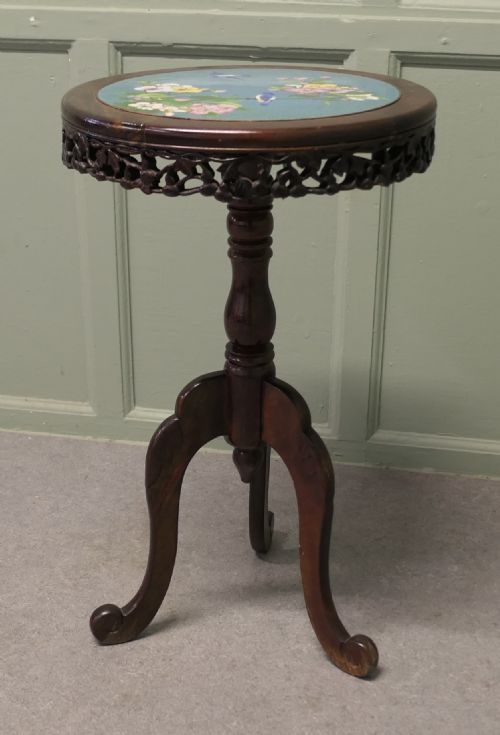


Chinese Floral Carved Stand
A chinese floral carved stand brings structured botanical display indoors, offering carved timber and marble surfaces designed for plants and urns.
Chinese Floral Carved Stand
A chinese floral carved stand serves primarily as a raised platform for plants, vases, and jardiniere displays within a room. When you examine this selection, you encounter plant stands, jardiniere stands, and urn stands alongside wine and lamp tables.
The pieces span the nineteenth and early twentieth centuries, drawing on Victorian tastes and Chinese export traditions. Makers utilised periods ranging from the Qing Dynasty and Chinese Republic era up to the Victorian epoch.
Hardwood forms predominate, frequently paired with inset marble tops or decorated with mother-of-pearl and lacquer. Buyers meet matched pairs and single pedestals, showing both traditional Chinese carving styles and British Victorian adaptations.
Materials and construction
Construction relies upon dense timbers such as hardwood, rosewood, mahogany, and ebonised wood, providing the structural strength needed for heavy stone inserts. Artisans shaped these woods into carved stands, pedestals, and occasional tables using traditional joinery.
Surface decoration incorporates marble tops, cloisonné enamel, cinnabar lacquer, and paint, alongside inlaid mother-of-pearl and gold lip shell details. These contrasting textures define the visual character of each piece.
Listings feature items dated from the nineteenth century up to 1920, including Victorian, Qing Dynasty, and Chinese Republic periods.
Judging execution
Quality rests in the crispness and depth of the floral carving across the hardwood frame. Superior examples display sharply defined relief work on the legs and aprons, whereas lesser versions show softer, shallower detailing.
The integration of inset materials determines the tier of the piece. Tightly fitted marble tops and precise cloisonné enamel panels demonstrate a higher standard of workshop assembly than simpler wooden surfaces.
The Chinese Floral Carved Stand Glossary
- Hardwood
- Dense, durable timber selected for structural integrity and fine carving. This material forms the primary framework for most oriental pedestals.
- Cloisonne
- Enamelwork technique using metal wire partitions on a base. It appears on decorative tabletops and vessels.
- Jardiniere
- Large ornamental pot or planter designed for flowers. These stands support such heavy vessels safely.
- Marble top
- Stone slab inset into a wooden surface to resist moisture from plants. This feature adds cooling texture and weight.
- Mother of pearl
- Iridescent inner shell layer used for inlay work. Artisans apply it to create shimmering floral motifs.
Chinese Floral Carved Stand: Frequently Asked Questions
What is a chinese floral carved stand used for?
These pieces were built to elevate heavy ceramic planters, vases, and urns above floor level. Their sturdy timber frames and stone tops protected household surfaces from damp earth and water.
Today, they function as lamp tables, display pedestals, and side tables in living spaces. Their compact footprints make them useful for holding decorative objects in tight corners.
How do I identify the age of these stands?
Dating relies upon material composition, finish types, and stylistic indicators recorded across the nineteenth and early twentieth centuries. Victorian pieces often show British ebonised finishes, while Qing Dynasty examples display traditional hardwood carving.
Construction methods also provide clues regarding age, such as hand-cut joinery and natural patina on the wood. Examining the wear patterns on the feet helps distinguish older items from later reproductions.
How should I care for a hardwood stand?
Maintain the timber by dusting with a soft, dry cloth and avoiding excessive moisture. Direct sunlight can fade lacquered surfaces and dry out rosewood over time.
Apply occasional appropriate wax polish to nourish the wood and preserve the carved details. Protect the marble top from acidic liquids that might etch the polished stone surface.
What is the difference between a jardiniere stand and a plant stand?
Jardiniere stands generally feature heavier load-bearing construction to support large, water-filled ceramic planters. Their platforms are often round or square with reinforced aprons.
Plant stands encompass a broader range of lighter pedestals and urn holders. Both categories utilise carved wooden frames, sometimes enhanced with stone or enamel panels.