


Charles Johnson Payne Snaffles
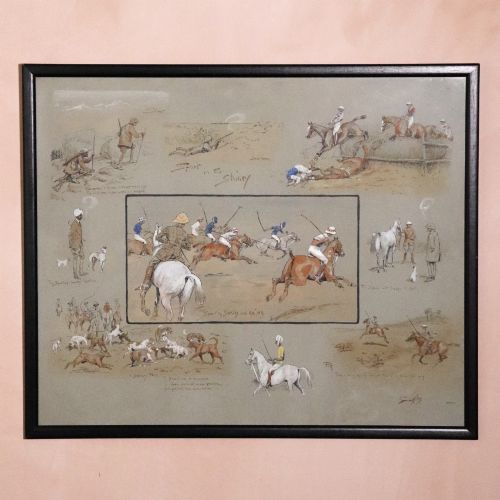
Charles Johnson Payne Snaffles prints and watercolours capture military life, hunting and racing with humour, showing the distinct hand of a great sporting artist.
Charles Johnson Payne Snaffles
When you search for Charles Johnson Payne Snaffles, you look for original prints, watercolours and printed cards depicting British sporting art and military subjects. These pieces span the early twentieth century, particularly the decades from nineteen hundred to nineteen fifty.
Buyers meet framed prints and original watercolour paintings on paper, often housed in oak frames with glass. The subjects range from fox hunting and horse racing scenes to military life in colonial outposts.
Works such as hunting sequences and character studies reflect Edwardian and early twentieth century British sporting art. The selection includes individual framed artwork alongside printed Christmas cards and limited edition prints.
Materials and Technique
The works utilise paper as the primary medium for both watercolour paintings and printed editions. Artists and publishers mounted these pieces behind glass within wooden frames, frequently utilising oak and gilt finishes.
Watercolour and gouache provide the pigment for unique paintings, while prints utilise fine lines and hand-colouring. Framing materials from the period safeguard the paper against environmental wear.
The recorded timeline of works spans from nineteen hundred through to nineteen fifty, encompassing print and watercolour mediums.
Assessing Quality
Quality rests upon the distinction between an original watercolour painting and a massed printed edition, though hand-finished prints carry significant regard. The crispness of the line work and the preservation of pigment vibrancy on paper determine the visual strength of each piece.
Framing choices also dictate the overall character, with period oak frames and glass maintaining the historical integrity of the artwork better than later replacements. The directness of the artist's touch in watercolour works separates standard prints from master examples.
Charles Johnson Payne Snaffles
The Charles Johnson Payne Snaffles Glossary
- Watercolour
- A painting method where fine pigment is mixed with water-soluble binders on paper. These original works show the direct brushwork of Charles Johnson Payne Snaffles.
- Gouache
- An opaque water-based paint that provides solid colour and bright highlights. It appears alongside watercolour in many of the artist's original pieces.
- Gilt
- A gold leaf or gold-coloured application used on frames. It adds a decorative metallic border around the artwork.
- Oak Frame
- A sturdy wooden housing constructed from oak to protect the paper within. Many period pieces retain these original surrounds.
- Limited Edition
- A restricted run of prints numbered in sequence. These editions offer collectors a recognised count of total impressions.
Charles Johnson Payne Snaffles: Frequently Asked Questions
Are these Snaffles pieces original?
The selection includes both original watercolour paintings and original printed works produced during the early twentieth century. Each listing specifies whether the piece is a unique painting or a period print.
Buyers find distinct titles reflecting military campaigns, hunting fields and racing circuits. These works carry the characteristic signature style of the artist.
How should I frame a Snaffles print?
Period oak frames with glass match the traditional aesthetic of these sporting and military works. Preserving original framing helps maintain the historical context of the piece.
Ensure conservation-grade materials are used if re-framing to protect the paper from light damage and moisture over time.
What subjects did Snaffles paint?
The artist focused heavily on British sporting art, including fox hunting, horse racing and point-to-point steeplechases. Military life in colonial settings also forms a major part of his output.
Titles often combine humorous captions with detailed observations of horses, dogs and soldiers in the field.
How do I date a Snaffles artwork?
Dating relies on recorded production years associated with specific prints and watercolours, spanning from nineteen hundred to nineteen fifty. Stylistic elements and publishing details on the paper assist in placement.
Printed cards and limited editions from later decades also appear in the historical record alongside early twentieth-century watercolours.