


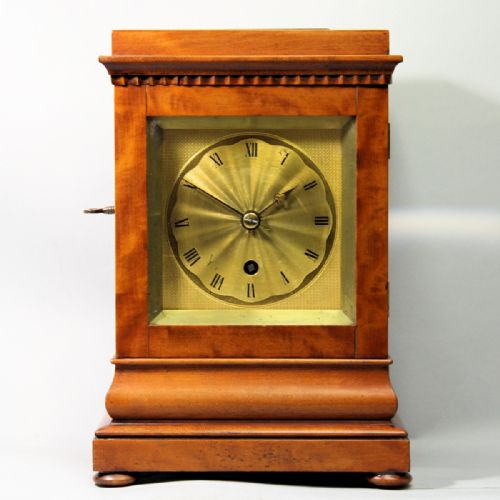


Chain Fusee Table Clock
A chain fusee table clock is a precise timekeeper driven by a coiled spring and a fine steel chain, prized by collectors for its clever mechanism and handsome desk presence.
Chain Fusee Table Clock
When you search for a chain fusee table clock, you encounter impressive mechanical timepieces housed in compact wooden or metal cases designed for rooms and libraries. These domestic horological instruments date primarily from the eighteenth and nineteenth centuries, spanning periods from Georgian and Regency eras through to the Victorian age.
You are most likely to meet mantel clocks and bracket clocks featuring single or double chain fusee movements housed within architectural, figural or classical cases. London makers dominate the evidence, often signing their dials or movements with established city addresses.
Materials and construction
Clockmakers constructed these movements using brass and steel, pairing them with delicate metal chains that wrapped around conical fusee pulleys to equalise the power of the mainspring. Cases rely heavily on dense timbers such as mahogany and satinwood, frequently paired with ebonised wood details.
Gilt bronze, ormolu, and plain bronze provide rich metalwork encasements often styled in Regency, Rococo Revival, or Egyptian Revival designs. Enamel dials and protective glass panels complete the fabrication of these complex table timepieces.
Judging quality in fusee timepieces
Quality rests in the crispness of the chased ormolu and bronze mounts, alongside the selection of timber used for the wooden bodies. Finer examples show meticulous hand engraving on the gilded dials and signed movements from known makers.
The sophistication of the case architecture, such as intricate library clock designs with multiple glass panels, separates standard production from exceptional pieces. The integration of automation or complex striking mechanisms adds further mechanical distinction.
SOMERSALL LONDON·Goldsmiths & Silversmiths London·Barraud & Lund London·Payne London·FB Adams London·Fisher Braithwaite·Perigal & Duterrau·Baetens London·FATTON ELEVE DE BREGUET LONDON·Bently & Beck London·Payne & Co London
The Chain Fusee Table Clock Glossary
- Fusee
- A conical pulley used in mechanical clocks to maintain an even pull as the mainspring unwinds. This clever device ensures consistent timekeeping power from a fully wound spring down to its last turn.
- Chain fusee
- A miniature steel link chain that connects the spring barrel to the fusee cone instead of a traditional gut line. It represents a refined mechanical standard in British horology.
- Ormolu
- Gilt bronze produced by applying a mercury and gold amalgam to a bronze base. This technique creates a rich golden finish characteristic of decorative Regency and Victorian metalwork.
- Bracket clock
- A portable household clock originally designed to sit on a wall bracket or table. Many examples feature sturdy carrying handles and striking mechanisms.
- Library clock
- A freestanding table clock, often fitted with glass panels that expose the inner movement. These pieces suited the quiet study spaces of nineteenth-century homes.
Chain Fusee Table Clock: Frequently Asked Questions
What is a chain fusee table clock?
A chain fusee table clock is a mechanical timepiece that uses a conical pulley and a tiny steel chain to regulate the force of the mainspring. This mechanism ensures the clock keeps accurate time as the spring runs down.
These portable clocks were built for domestic interiors, appearing as bracket clocks, mantel clocks, and library clocks on desks and side tables throughout the eighteenth and nineteenth centuries.
How do I wind a chain fusee clock?
Winding requires a specialised key inserted into the dial to tension the mainspring via the fusee chain. Care must be taken not to overwind the movement.
Because these mechanisms are delicate and historically significant, consulting a professional horologist for handling instructions is advisable.
Where were these clocks made?
The pieces recorded here originate primarily from British workshops, with a heavy concentration of London makers signing the dials and movements. Provincial towns are also represented by specific regional clockmakers.
Design influences span domestic Georgian styles through to French-inspired Rococo Revival and Egyptian Revival aesthetics popular during the nineteenth century.
How do I identify the period of a clock?
Dating relies on stylistic clues in the case design, such as Regency brass inlay, Victorian ebonised wood, or elaborate Rococo ormolu mounts. Signatures on the dial or movement often point to active working dates of known London makers.
Materials like satinwood and mahogany, combined with specific architectural forms, help narrow down the decade of manufacture.