


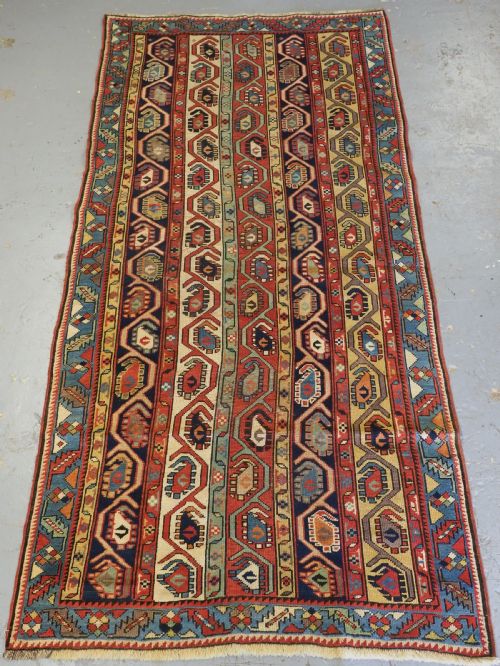


Caucasian Boteh Runner Rug
A caucasian boteh runner rug brings geometric structure and repeated seed motifs into a hallway, offering centuries of regional weaving heritage.
Caucasian Boteh Runner Rug
When you search for a caucasian boteh runner rug, you encounter long, narrow floor coverings originating from the Caucasus region and north-west Persia during the late nineteenth and early twentieth centuries. These pieces typically display linear formats designed for corridors, featuring repeated almond-shaped boteh motifs arranged in rows or diagonal stripes. The pieces available here span specific weaving traditions from the Gendje, Karabagh, Shirvan, and Kazak regions, dating between 1880 and 1900.
The aesthetic relies heavily on tribal geometry combined with expressive, colourful pattern work. You find both strict diagonal layouts and multicoloured fields where individual boteh motifs carry distinctive flame or floral details. Such rugs served practical insulation purposes in nomadic and village homes while expressing the specific regional identities of their weavers.
How they were made
The construction of a caucasian boteh runner rug relies entirely on wool foundations and pile, often utilising hand-spun wool for the yarn. Weavers knotted these floor coverings by hand on vertical looms, building dense structures designed to withstand heavy foot traffic. The tactile quality of the pile stems directly from this traditional hand-spinning process.
Colour comes from natural dyes applied to the wool before weaving, producing rich hues that settle into varied tonalities over time. The interaction between hand-spun yarn and natural dyestuffs gives these runners their characteristic depth of colour, particularly visible in striped or colourful boteh arrangements.
Some nineteenth-century weavers dotted flaming boteh motifs across the field as if the entire rug was caught in a gentle, woolen breeze.
What varies in quality
Quality in a caucasian boteh runner rug rests upon the precision of the tribal drawing and the crispness of the geometric layout. Examples featuring well-defined diagonal arrangements or scarce striped boteh designs demonstrate superior design execution by the weaver. The clarity of the individual motifs dictates how successfully the repeating pattern holds the eye across a long format.
Another measure of quality involves the vibrancy and preservation of the natural dyes used across the field. Runners displaying strong, harmonious colour combinations with minimal muddying show superior material selection and dye preparation during production. The integrity of the hand-spun wool pile further separates robust examples from those with heavy wear.
The Caucasian Boteh Runner Rug Glossary
- Boteh
- A stylised almond, pear, or flame-shaped motif of ancient Persian origin that symbolises life and eternity. It appears repeatedly across the field of these regional runners.
- Gendje
- A town and weaving district in the southern Caucasus known for producing distinctive runners and long rugs with geometric patterns. Pieces from this region often feature colourful boteh designs.
- Karabagh
- A mountainous region in the southern Caucasus famous for varied tribal rug production. Karabagh runners frequently utilise striped or diagonal boteh layouts.
- Kazak
- A term applied to rugs woven by various tribal groups in the western Caucasus, characterised by bold geometric designs and saturated natural colours. Kazak pieces often share stylistic traits with Gendje weaving.
- Natural Dyes
- Colourants derived from plants, insects, and minerals rather than synthetic chemicals. These dyes produce complex, muted tones that age gracefully within the wool pile.
Caucasian Boteh Runner Rug: Frequently Asked Questions
Where should I place a runner rug?
These narrow formats work best in hallways, corridors, and narrow entryways where their linear geometry guides movement through a space.
They also function effectively in galley kitchens or beside beds, adding warmth and texture to transitional areas without overwhelming the room.
How do I identify a Gendje runner?
Gendje pieces typically present as elongated formats with crisp geometric drawing and structured borders. Look for characteristic colour combinations and neatly arranged rows of boteh motifs.
Regional attribution often rests on specific border arrangements and the particular saturation of the natural dyes employed.
Are natural dyes easy to spot?
Natural dyes reveal themselves through subtle variations in shade along a single strand of wool, known as abrash. This tonal shift occurs because hand-dyed batches take colour with slight irregularities.
Synthetic dyes tend to appear uniform and flat across the entire surface of the rug, lacking the organic depth found in nineteenth-century examples.
How do I care for antique wool rugs?
Regular gentle vacuuming without a beater bar prevents dust accumulation in the wool pile. Professional cleaning should be undertaken sparingly by specialists in antique textiles.
Using a quality underlay prevents slipping and reduces friction between the floorboards and the handmade foundation.