







Carved Mahogany Toilet Glass
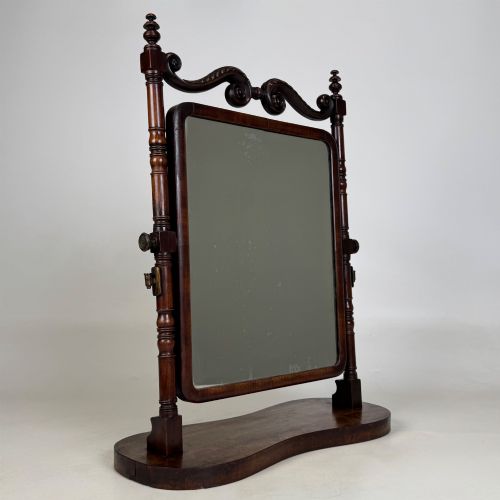
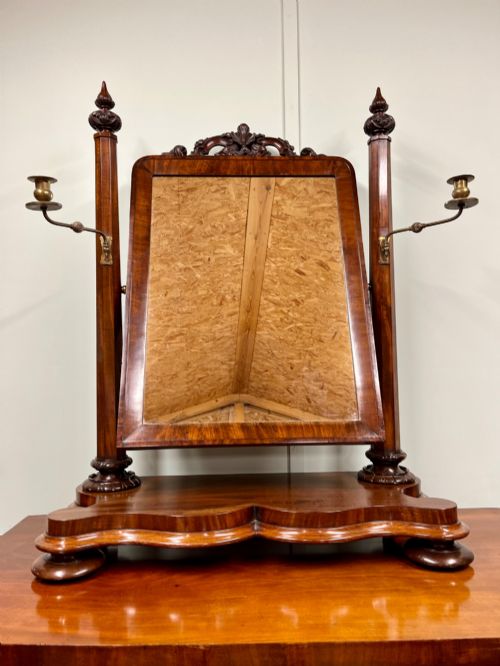
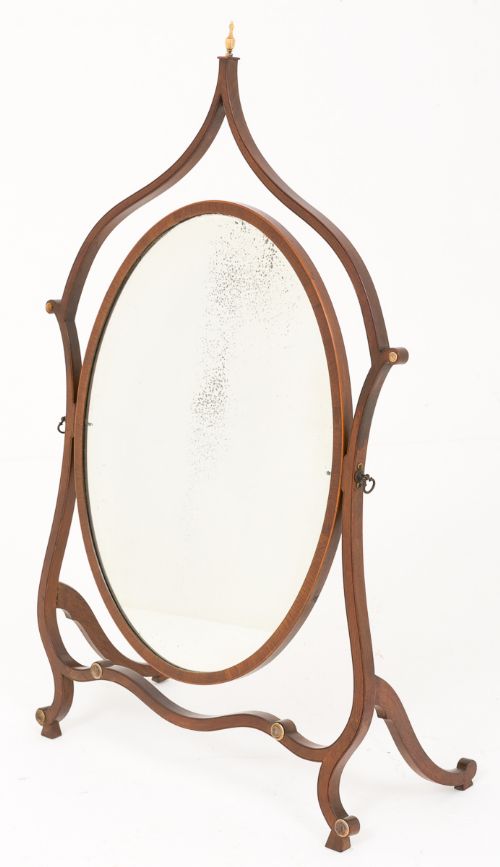
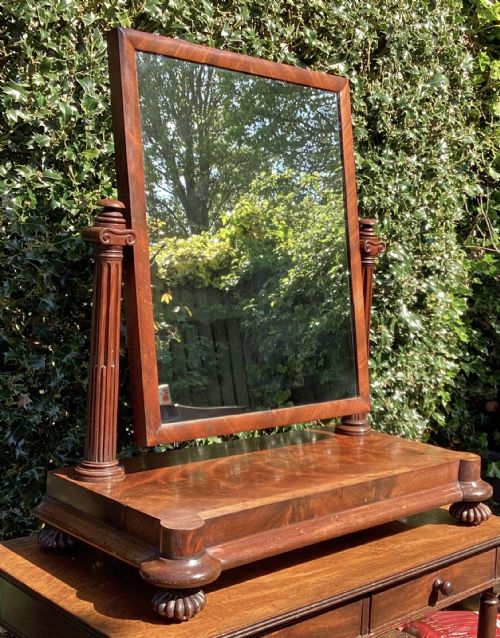
These carved mahogany toilet glass examples offer a tabletop mirror surface mounted on a swivelling frame, ideal for any chest of drawers.
Carved Mahogany Toilet Glass
A carved mahogany toilet glass brings a functional tabletop dressing mirror to a bedroom chest or surface, pivoting within upright supports. The forms on this page span the Georgian, Regency, and Victorian periods, alongside specific styles like Hepplewhite and William IV.
Most pieces date from the nineteenth century, including specific years such as 1850, 1860, 1890, and the mid-eighteenth century around 1750. These encompass dressing tables, vanity mirrors, and cheval mirrors alongside standard tabletop glass.
Makers and regional workshops utilised mahogany, flame mahogany veneer, walnut, and red walnut, often pairing the timber with brass fittings and marble tops. The surviving examples demonstrate how bedroom furnishings evolved across different design eras.
Materials and Construction
Makers constructed these frames from solid mahogany and flame mahogany veneer, occasionally employing walnut or red walnut. Timber selection defined the visual weight and grain pattern of the finished mirror stand.
The mirror plates hang between upright supports using brass pivot screws, allowing the glass to tilt at various angles. Marble tops appear on heavier Victorian iterations to provide a stable, decorative base for the swivelling frame.
Carved Mahogany Toilet Glass Retail Price Guide 2026
Typical asking prices for carved mahogany toilet glass among the pieces listed under this phrase on Sellingantiques today, from the lower quarter to the upper quarter. They describe what is for sale here now, not the wider market.
Distinguishing Quality in Construction
Superior examples exhibit refined serpentine shaping and precise joinery in the timber frame rather than plain, heavy boards. The depth of the mahogany grain and the crispness of any carved detailing mark the distinction between standard production and finer cabinet work.
The integration of original brass hardware and well-proportioned support arms influences the overall integrity of the piece. Heavier iterations incorporate marble bases, where the quality of the stone slab and its fit within the mahogany structure elevate the piece.
Gillow
The Carved Mahogany Toilet Glass Glossary
- Toilet Glass
- A portable mirror designed to sit upon a dressing table or chest of drawers. These pieces incorporate a swivelling plate mounted within a wooden frame.
- Swing Mirror
- A mirror plate hung on pivots between two vertical posts to tilt back and forth. This mechanism allows the user to adjust the reflection angle.
- Flame Mahogany Veneer
- A thin layer of timber sliced from the point where branches join the main tree, creating a fiery, undulating grain pattern. Cabinet makers applied this to display decorative surfaces on prominent parts of the frame.
- Serpentine Front
- A curved furniture front featuring a convex centre flanked by concave curves. This contour appears on Georgian dressing mirror bases.
- Cheval Mirror
- A full-length freestanding mirror supported on four legs with a vertical frame. These tall glass panels allow a complete view of attire.
Carved Mahogany Toilet Glass: Frequently Asked Questions
Where should I place a toilet glass?
These mirrors suit placement on top of a bedroom chest of drawers, sideboard, or dedicated dressing table. Their compact tabletop footprint allows them to sit securely on existing furniture surfaces.
Because they feature swivelling frames, position the piece at a height where the tilting mirror plate provides a comfortable angle for daily use.
How do I date a mahogany mirror?
Dating relies on observing the timber choice, structural form, and secondary woods used in the construction. Georgian and Regency pieces often display lighter framing and serpentine shaping, while Victorian iterations can be heavier and include marble tops.
Hardware details like brass pivot screws and the thickness of the mirror glass further assist in placing a piece within the eighteenth or nineteenth century.
Can I adjust the angle of the mirror?
The glass plate hangs between two vertical uprights on brass pivot screws or pins. Tightening or loosening these side fixtures lets you tilt the mirror surface to the desired angle.
Original hardware moves smoothly while holding the adjusted position firmly in place.