
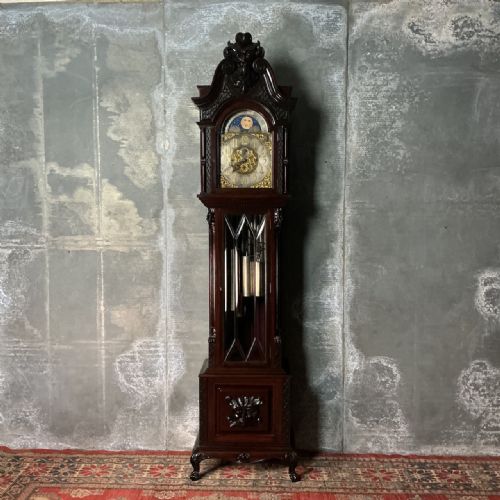

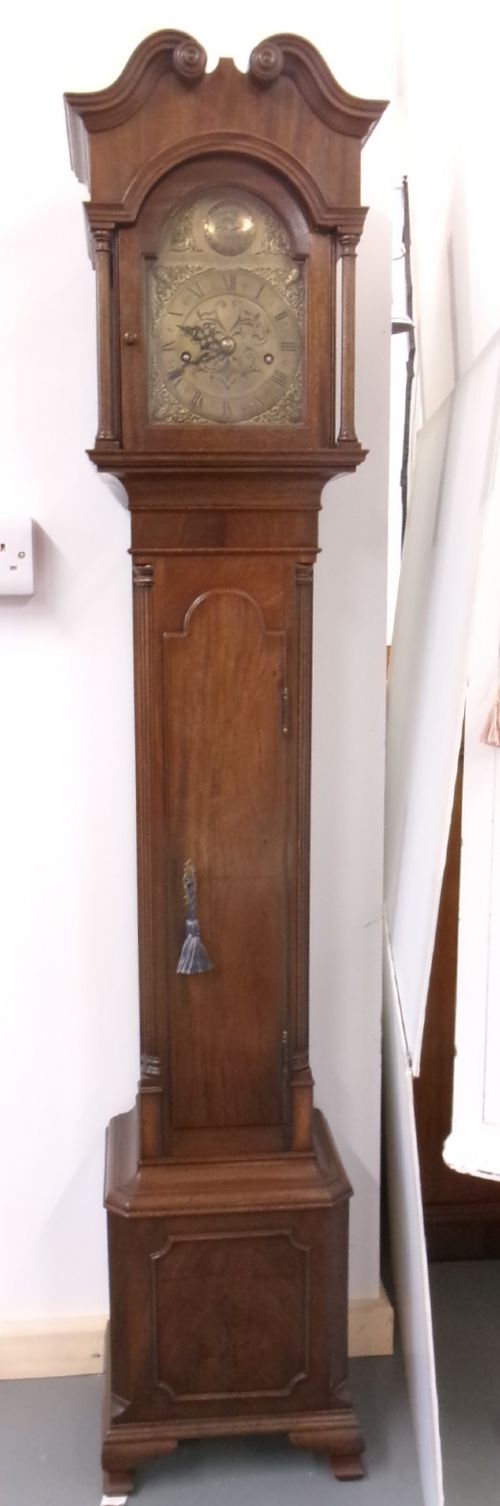
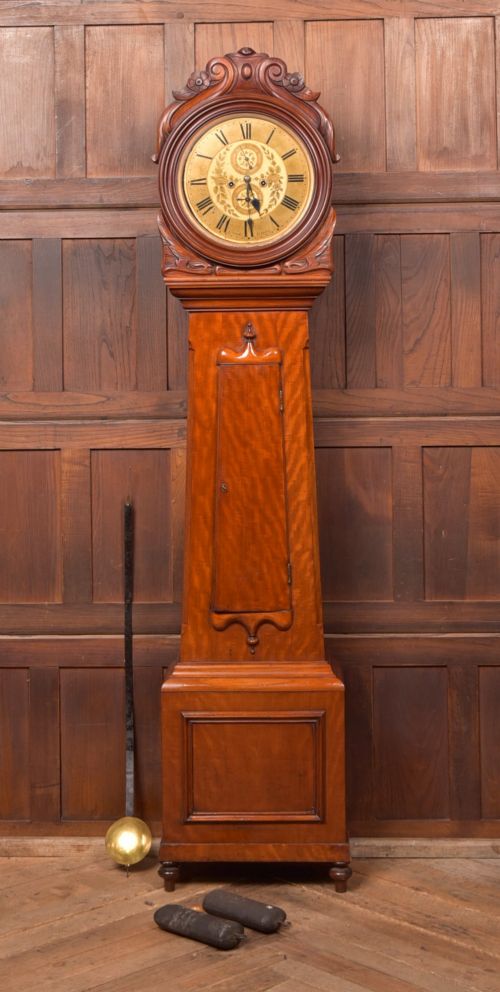


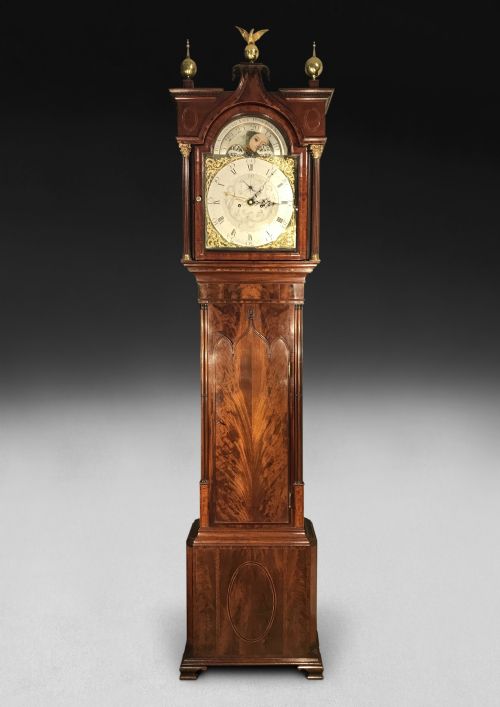


Carved Mahogany Floor Clock
A carved mahogany floor clock stands as a commanding focal point for any room, marrying monumental scale with meticulous cabinetwork.
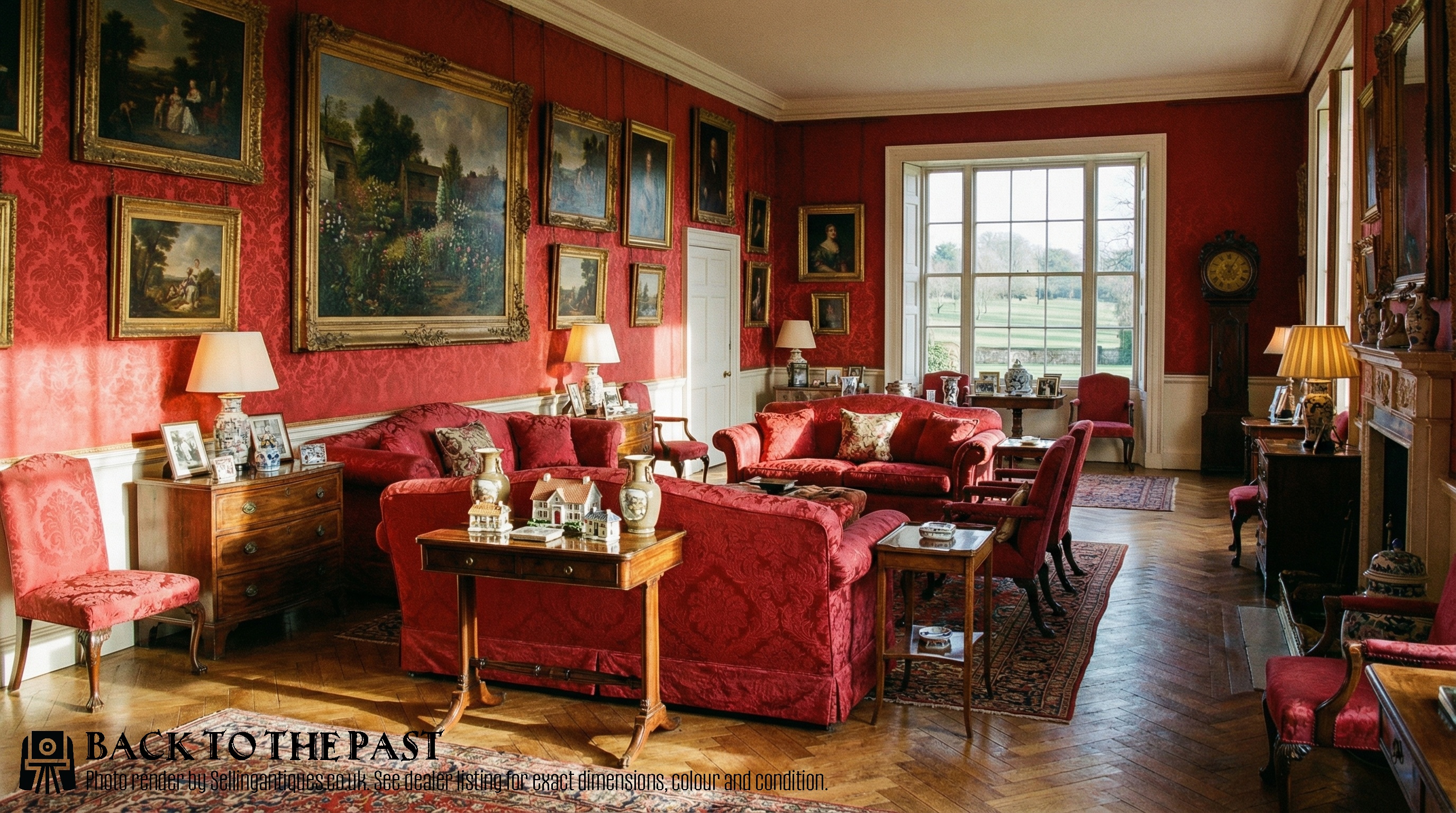
Carved Mahogany Floor Clock
A carved mahogany floor clock encompasses tall case timepieces housing pendulum movements, most frequently encountered in George III, Victorian, and Edwardian formats. These pieces range from grand monumental specimens down to more compact grandmother and granddaughter clocks suited for domestic spaces.
Makers utilised rich timber variants, pairing solid mahogany cases with brass dials, painted metal faces, and glass access doors. Regional variations appear across England, Scotland, and Wales, with Edinburgh and London horologists contributing distinct dial configurations and musical movements.
The selection here moves from early Georgian penny moon examples to quarter chiming musical pieces from the twentieth century. Buyers encounter both robust full-sized longcase clocks and attenuated revival styles drawing on Chippendale motifs.
Materials and Construction
Cabinetmakers constructed these floor clocks primarily from mahogany and oak, often employing brass for movement plates, dials, and bezel rings. Painted metal dials and silvered chapter rings provide the visual interface for steel hands driven by weight-driven or spring-driven mechanisms.
Carving was executed by hand directly into the dense mahogany timbers, yielding decorative flourishes on hoods, trunk doors, and plinths. Glazed apertures permit visibility of the swinging pendulum, while brass or steel dial components display regional engraving and signature work.
Listings feature mahogany floor clocks spanning the Georgian, Victorian, and Edwardian eras, utilising brass, glass, and painted metal.
Assessing Quality
Quality rests in the harmony between the cabinetwork and the sophistication of the internal movement. Heavy carved details, secondary timber selection, and the presence of signed brass or painted dials elevate certain pieces above standard production.
Andrew Thom·Henry Smith·King of Ratcliff Highway·G Brown Edinburgh·Price Evans of Salop
The Carved Mahogany Floor Clock Glossary
- Longcase clock
- A tall pendulum clock housed in a wooden case designed to stand directly on the floor. These pieces are frequently referred to as grandfather clocks.
- Grandmother clock
- A smaller variant of the longcase clock, typically measuring under six feet in height. They gained popularity during the Edwardian period and early twentieth century.
- Penny moon
- A revolving disc showing the phases of the moon, painted with two moons against a starry sky. This complication sits within the arch of the dial.
- Fusee
- A conical pulley used in spring-driven clocks to maintain equal force on the train as the mainspring unwinds. This mechanism ensures more accurate timekeeping.
- Drumhead
- A circular dial housing that sits atop the trunk of specific Scottish longcase clocks. The shape resembles a drum viewed from the side.
Carved Mahogany Floor Clock: Frequently Asked Questions
How do I tell a grandfather clock from a grandmother clock?
Grandfather clocks are the standard full-sized longcase clocks, generally standing over six feet tall and possessing substantial proportions. Grandmother clocks are noticeably smaller, scaled down for more modest domestic rooms while retaining the same mechanical layout.
This miniaturisation requires fine cabinetry work to maintain correct architectural proportions in a reduced footprint.
Where were these floor clocks made?
Makers and cabinetmakers worked across England, Scotland, and Wales, with notable regional centres in London, Edinburgh, and provincial towns. Scottish pieces often display distinct dial shapes, such as the drumhead formation.
Regional clockmakers frequently sourced movements and dials independently from the cabinetmakers who built the mahogany cases.
How do I care for a mahogany floor clock?
Position the clock away from direct sunlight and heat sources to protect the mahogany timber and prevent wood splitting. Ensure the case stands level on a firm floor so the pendulum swings evenly.
Regular professional servicing keeps the brass and steel movement functioning correctly without straining the original components.