
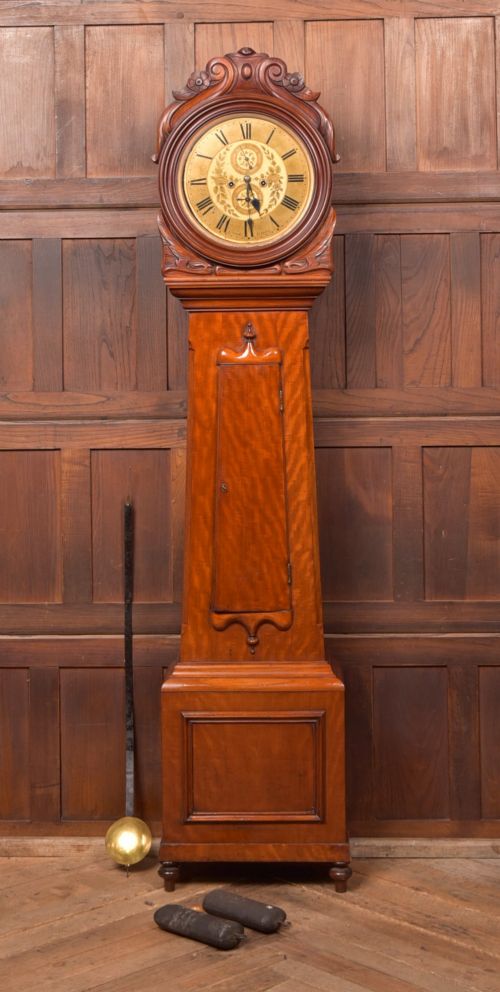


Carved Mahogany Clock Case
A carved mahogany clock case brings warmth and architectural presence to a room, housing the intricate mechanics of a longcase or bracket timekeeper.

Carved Mahogany Clock Case
A carved mahogany clock case is primarily encountered in longcase and grandfather forms, spanning periods from early Georgian to the twentieth century. These tall housings protect delicate movements while serving as substantial pieces of domestic furniture.
Makers often utilised rich timbers such as burr mahogany, frequently incorporating brass dials, painted metal faces, and glass viewing panels. Regional variations appear across England, Scotland, and Wales, each region bringing distinct proportions and carving details to the form.
Revival styles, including Chippendale and Georgian revivals, sit alongside pieces from the nineteenth and early twentieth centuries. Buyers frequently encounter musical longcase clocks and drumhead variants among these listings.
Assessing quality in carved mahogany clock cases
Quality rests in the crispness of the timber carving and the depth of the mahogany grain. Superior examples display harmonious proportions across the hood, trunk, and base, with finely fitted doors and original brass hardware.
The integration of movement and housing distinguishes exceptional pieces, particularly in monumental or musical longcase clocks where the cabinet accommodates complex chime barrels and heavy weights without strain.
Some provincial makers proudly signed their brass dials, ensuring their names outlived the original ticking.
Andrew Thom·Henry Smith·King of Ratcliff Highway·G Brown, Edinburgh·Price Evans of Salop·Maples and Co of London
The Carved Mahogany Clock Case Glossary
- Longcase clock
- A tall, floor-standing pendulum clock enclosed in a wooden housing, commonly known as a grandfather clock.
- Dial
- The visible face of the clock where time is indicated, often constructed from brass or painted metal.
- Dial face
- The surface bearing the numerals and hands, frequently signed by the maker.
- Fusée
- A conical pulley used in spring-driven clocks to maintain even power as the mainspring unwinds.
- Hood
- The upper section of a longcase clock that encloses the dial and movement, often featuring glass panels.
Carved Mahogany Clock Case: Frequently Asked Questions
What is a carved mahogany clock case?
A carved mahogany clock case is the wooden enclosure designed to protect and display a clock movement, most commonly associated with tall longcase and grandfather clocks.
These housings combine architectural woodwork with decorative carving, utilising mahogany timber alongside brass and glass elements.
How do I date a clock case?
Dating relies on stylistic clues, including the shape of the hood, the presence of inlay, and the type of wood finish used by the cabinetmaker.
Periods span from Georgian origins through Victorian revivals to early twentieth-century examples, each displaying characteristic proportions and decorative motifs.
Where were these clock cases made?
These housings originated in workshops across Britain, with distinct regional styles emerging from English, Scottish, and Welsh makers.
Local cabinetmakers and established firms produced these pieces, occasionally signing the dial or movement housed within.
How should I place a longcase in a room?
A longcase requires a stable, level floor and adequate vertical clearance to accommodate its height safely away from direct heat sources.
Positioning the piece against a secure wall allows the pendulum and weights to operate without obstruction while displaying the carved wood grain.