


Carved Claw Foot Stool
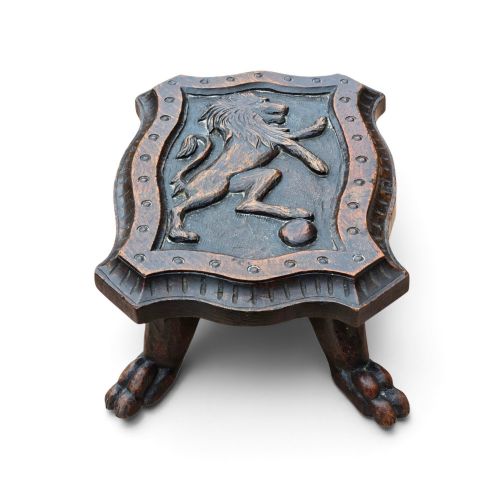
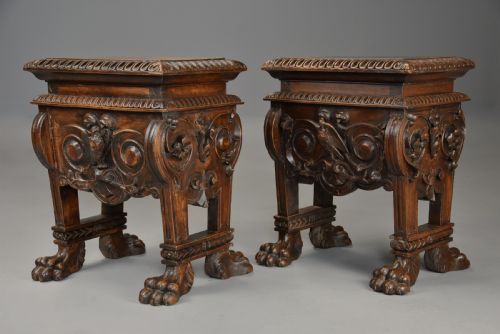
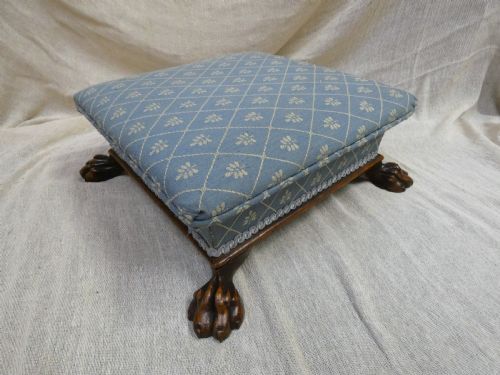
These carved claw foot stool examples are robust low seats resting on animal or mythical paws, offering period charm and tactile comfort.
Carved Claw Foot Stool
A carved claw foot stool sits low to the floor, built primarily as a footstool, piano stool, or dressing stool across various historical periods.
The selections span the 17th century through to the Art Deco era, encompassing regional pieces from Ireland, Scotland, and Italy alongside English works.
Most items on show adopt revivalist aesthetics, with Georgian, Queen Anne, and Chippendale styles heavily represented alongside standard Victorian productions.
Materials and construction
Frames rely on dense hardwoods such as mahogany, walnut, rosewood, and oak, carved directly to form the signature feet.
Upholstery varies from patterned damask and velvet to plain fabric and textile coverings secured over the wooden foundations.
Brass elements appear occasionally as decorative accents or hardware supporting the revolving and piano stool mechanisms.
Judging quality and execution
Quality rests in the sharpness and depth of the wood carving, particularly the articulation of the claws, balls, and paws.
Timber selection dictates overall merit, where richly grained walnut or figured mahogany elevates the piece above plain oak or secondary woods.
Cohesion between the period style of the frame and the quality of the textile upholstery determines the integrity of the piece.
The Carved Claw Foot Stool Glossary
- Cabriole leg
- A furniture leg that bends outward in a convex curve and tapers inward in a concave curve, ending in a carved foot. This form mimics the shape of an animal's limb.
- Claw-and-ball foot
- A furniture foot depicting an animal's talon gripping a spherical object. It frequently appears on 18th-century and revivalist seating.
- Damask
- A reversible figured fabric woven on a jacquard loom with patterns formed by contrasting warps and wefts. It provides a formal textured surface for antique seating.
- Piano stool
- An adjustable seat designed for keyboard players, often featuring a revolving top mechanism. These pieces date largely from the 19th century.
- Ottoman
- A low upholstered seat or bench without a back or arms. Larger examples function as footrests or casual seating.
Carved Claw Foot Stool: Frequently Asked Questions
What is a carved claw foot stool used for?
These low seats function primarily as footrests before armchairs or sofas, while specialised forms serve musicians at pianos or sitters at dressing tables.
Their compact size allows them to move easily around a room to provide extra casual seating when required.
How do I identify the period of a carved claw foot stool?
Dating relies on examining the timber species, the sharpness of the hand-carved details, and the construction methods visible underneath.
Revival pieces from the 19th century frequently imitate earlier Georgian or Queen Anne motifs, so secondary wood types and tool marks help clarify the actual date of manufacture.
How do I care for antique upholstery?
Protect delicate textiles such as velvet and damask from direct sunlight to prevent fading and fibre degradation over time.
Gentle vacuuming with a soft brush attachment removes surface dust without stressing the historic fabric or internal stuffing.
Are these stools suitable for daily use?
Most solid hardwood frames remain structurally stable for everyday sitting or resting feet, provided the joints stay firm.
Pieces with delicate mahogany carving or revolving mechanisms benefit from mindful handling to preserve their historical integrity.