
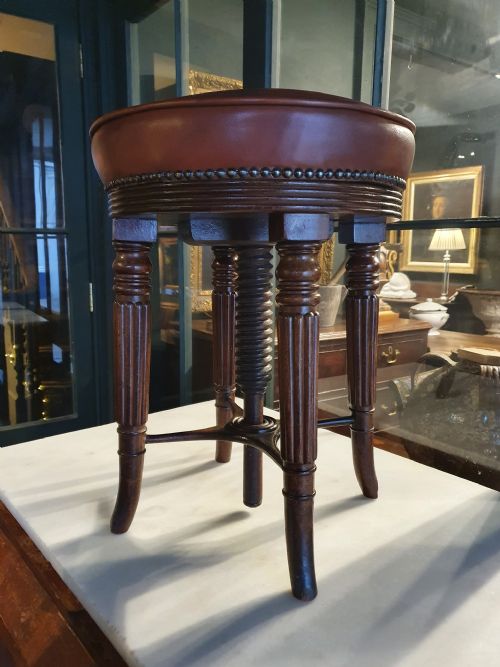
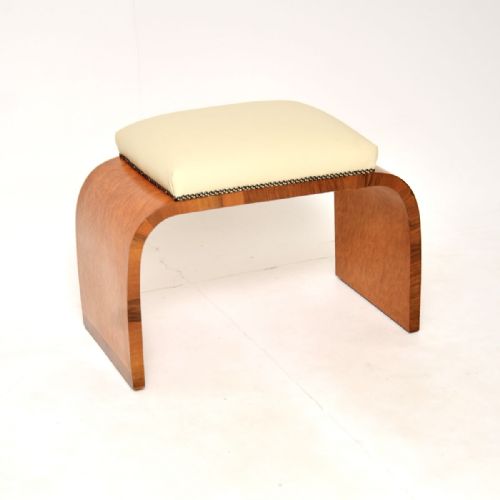


Leather Vanity Stool
A leather vanity stool offers a functional seat for a dressing table while bringing period charm to a room.
Leather Vanity Stool
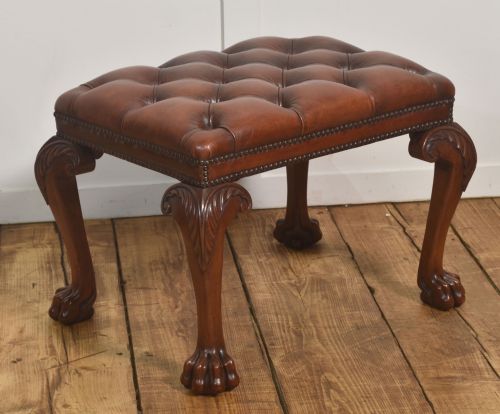
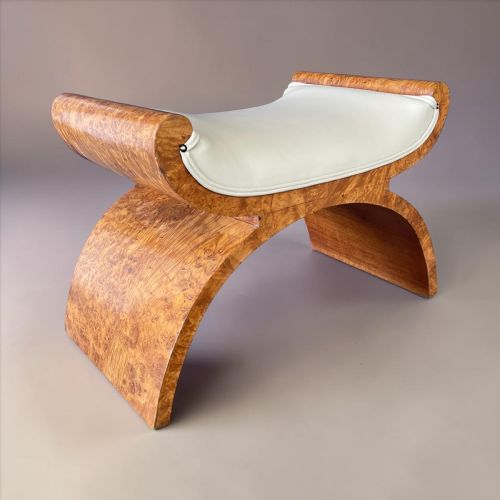
A leather vanity stool is a compact seat designed primarily for dressing tables, piano use, and occasional seating. The selections found here span several distinct periods including the Victorian era, the Edwardian period, and the Art Deco movement.
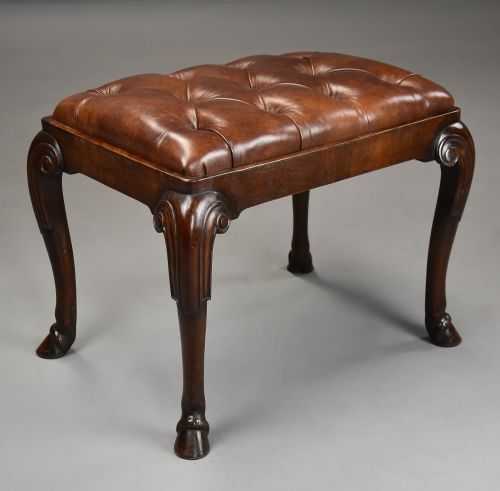
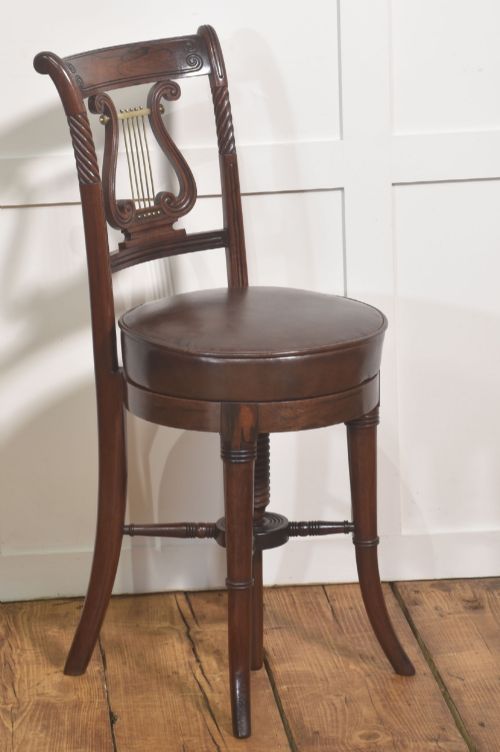
Most examples take the form of small stools, dressing chairs, and piano stools with leather upholstery. You will encounter straightforward rectangular forms alongside revolving models, X-framed supports, and pieces featuring cabriole legs.
Makers utilised various woods to build the frames, pairing traditional mahogany and walnut with birds Eye maple and yew. The resulting pieces function equally well as dressing table stools, piano seats, and low footstools.
Materials and construction
Frames are constructed from solid hardwoods including mahogany, walnut, burr walnut, and yew wood, often shaped with carved cabriole legs or X-frame supports. Joinery relies on traditional woodworking techniques suited to each specific period style.
Seats feature leather upholstery fastened over padding, sometimes complemented by adjustable mechanisms for piano and dressing stools. Brass fittings frequently appear on revolving mechanisms and adjustable height components.
Listings feature frames built from mahogany, walnut, burr walnut, birds Eye maple, and yew wood across multiple eras.
Assessing quality and craftsmanship
The distinction between standard examples and finer pieces lies in the choice of cabinet timber and the crispness of frame carving. Burr walnut and birds Eye maple require greater skill in selection and preparation than plain woods.
Engineering mechanisms on adjustable or revolving stools demonstrate the underlying standard of manufacture. Smooth operation and sturdy brass components indicate superior workshop production.
Harry and Lou Epstein
The Leather Vanity Stool Glossary
- Cabriole leg
- A furniture leg that curves outward and then tapers inward, mimicking an animal's leg. This style is frequently seen on Victorian and Queen Anne revival pieces.
- Birds Eye maple
- Afigured timber featuring small circular markings that resemble tiny eyes. It provides a highly decorative surface on Art Deco frames.
- X-framed
- A structural base formed by two intersecting members shaped like the letter X. This configuration offers both rigidity and visual weight beneath the seat.
- Revolving mechanism
- A mechanical assembly allowing the seat to spin freely. These are commonly integrated into piano and dressing stools for convenience.
Leather Vanity Stool: Frequently Asked Questions
How do I choose the right height?
Consider the height of your dressing table or piano to ensure comfortable clearance beneath the surface. Adjustable models offer flexibility if exact measurements are difficult to match.
Non-adjustable stools require careful measuring of both the seat height and the user's seating preference.
Can I use a piano stool at a dressing table?
Many piano stools share identical dimensions and stylistic qualities with dressing table stools. Revolving and adjustable variants function particularly well in both roles.
Check the seat mechanism to ensure it meets your daily functional requirements for sitting and grooming.
How do I care for antique leather?
Keep leather upholstery clean by dusting gently and avoiding direct exposure to strong sunlight or heat sources. Proper conditioning helps maintain the suppleness of the material over time.
Avoid using harsh chemical cleaners that might strip the natural finish from the surface.
Are these stools suitable for daily use?
Solid hardwood frames and sturdy leather upholstery make these traditional pieces durable enough for regular daily seating. Routine use helps develop a natural patina on both the wood and the leather.
Ensure joints remain tight and stable if the stool supports frequent movement or shifting weight.