
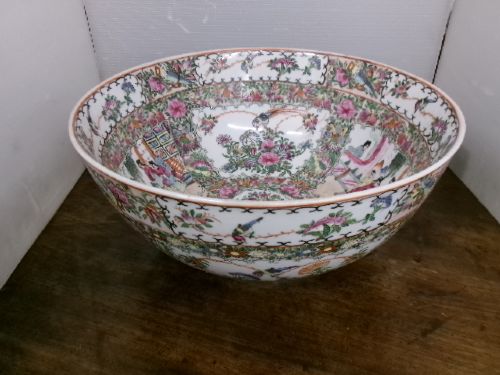
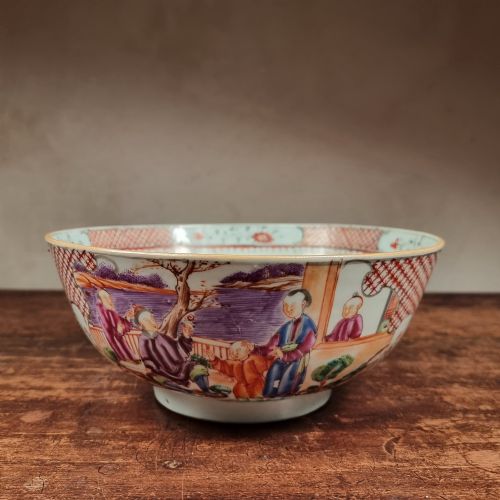


Canton Famille Rose Basin
These canton famille rose basin pieces are large, vibrant vessels shaped in porcelain and painted by hand for export.
Canton Famille Rose Basin
A canton famille rose basin search brings up substantial vessels created in China for international markets, spanning the nineteenth century and the Qing Dynasty. You will most frequently meet large punch bowls, jardinieres, and centrepiece bowls finished in elaborate overglaze enamels.
The forms range from deep circular punch bowls and expansive medallions to lobbed rectangular bowls and heavy decorative vessels. Many of these pieces arrive mounted in gilt bronze or ormolu, reflecting their adaptation for Western interiors during the nineteenth century.
How they were made
Makers shaped these vessels from white porcelain before applying rich overglaze enamels and hand-painted details. Artisans utilised gold leaf and gilt work to accent the intricate floral and figural scenes across the surface.
Listings feature porcelain vessels spanning the eighteenth and nineteenth centuries, alongside twentieth-century examples.
What varies in quality
Quality rests in the precision of the hand-painted brushwork and the complexity of the figural or botanical scenes. Finer examples display meticulous detail across every panel, while simpler pieces rely on repeating motifs.
The weight and finish of the porcelain body, alongside the crispness of the gilt accents and ormolu mounts, separate standard production from superior items.
The Canton Famille Rose Basin Glossary
- Famille rose
- A palette of opaque overglaze enamels dominated by pink or rose colours, introduced during the Qing Dynasty. This technique allowed artists to achieve subtle tonal gradations in floral and figural painting.
- Canton
- A major port in southern China from where vast quantities of porcelain were exported to Europe and America. Much of the decoration on these wares was applied in workshops located in the city itself.
- Ormolu
- Gilded bronze mounts applied to furniture, clocks, and porcelain vessels. French and English craftsmen frequently added these decorative metal fittings to Chinese export bowls during the nineteenth century.
- Punch bowl
- A large, deep bowl designed for mixing and serving communal drinks at gatherings. These vessels formed a central part of trade between China and the West.
- Jardiniere
- An ornamental pot or basin intended to hold growing plants or flowers. In Chinese export porcelain, these items were often heavily potted to support substantial foliage.
Canton Famille Rose Basin: Frequently Asked Questions
What are canton famille rose basins used for?
These large porcelain vessels served practical and decorative functions in historic homes, frequently holding punch at gatherings or acting as centrepieces on dining tables. Today, collectors utilise them as striking decorative bowls or jardinieres within domestic interiors.
Because of their robust size and vibrant hand-painted surfaces, they sit well on large tables, sideboards, or plant stands without requiring additional ornamentation.
How do I date a canton porcelain bowl?
Dating relies on examining the characteristics of the porcelain body, the style of the overglaze enamels, and the nature of any metal mounts. Pieces associated with the Qing Dynasty or nineteenth century typically exhibit specific hand-painted motifs and heavier potting.
Comparing the complexity of the rose medallion panels and the brilliance of the gilding helps place the piece within the broader export timeline.
What is the difference between rose medallion and canton porcelain?
Canton porcelain is a broad term for wares decorated in the southern Chinese port, encompassing various figural and floral styles. Rose medallion is a specific sub-style featuring distinct panels filled with figures, birds, and flowers, arranged symmetrically around a central medallion.
Both styles utilise the characteristic pink enamel palette, but rose medallion pieces present a more densely compartmentalised surface design.
How should I display a large antique bowl?
Large export bowls require stable, level surfaces such as heavy sideboards, low tables, or specialised stands that can support their substantial weight and diameter. Keeping them away from high-traffic edges prevents accidental knocks.
Allowing natural light to fall across the surface highlights the intricate hand-painted details and the metallic lustre of the gilt leaf.