


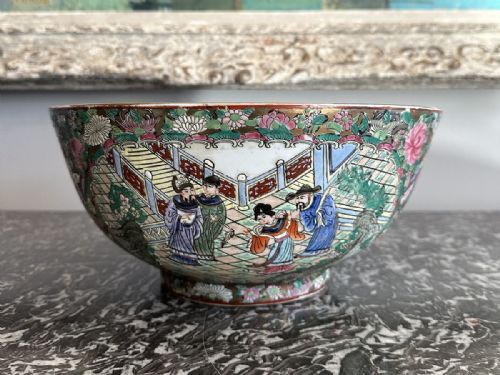


Chinese Enamel Punch Bowl
A chinese enamel punch bowl is a large ceramic vessel made for communal drinking, prized for its vibrant palette and scale.
Chinese Enamel Punch Bowl
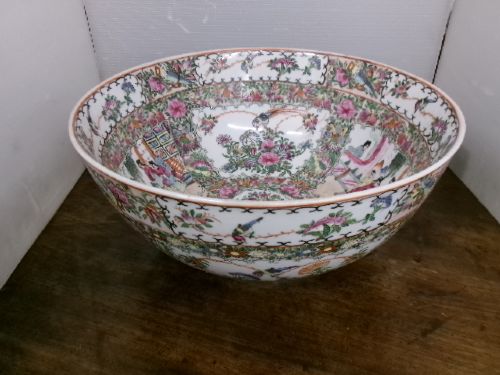
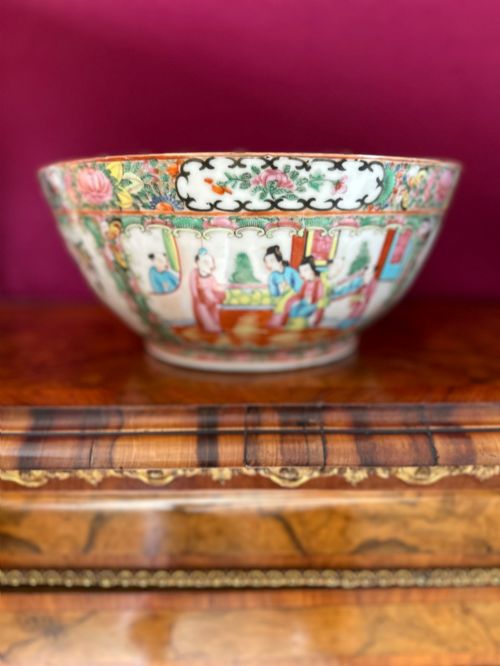
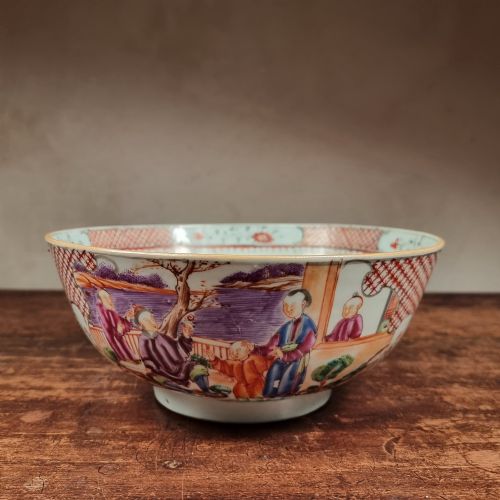
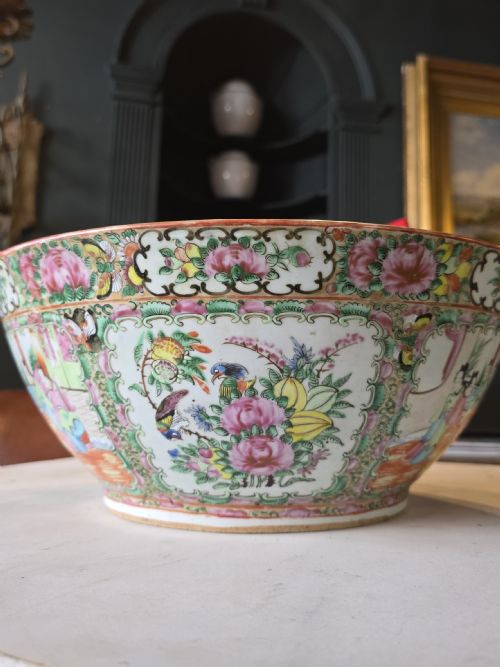
A chinese enamel punch bowl is a wide, deep vessel designed historically for mixing and serving communal drinks at social gatherings. The examples found here span the eighteenth and nineteenth centuries, with a strong representation of nineteenth century production. Most pieces encountered on this page belong to the Cantonese Famille Rose or Rose Medallion traditions.
These porcelain forms originate primarily from China, often created for export markets, alongside European interpretations such as French nineteenth century production and eighteenth century London decoration. The decorative schemes typically employ hand painted overglaze enamel, cobalt blue motifs, and gilt highlights. Collectors seek these pieces for their generous dimensions and detailed figurative or floral scenes.
Materials and technique
The foundation of every piece is hard paste porcelain, shaped into large bowls designed to hold substantial volume. Artisans applied hand painted overglaze enamel directly to the fired ceramic surface, utilising distinct palettes dominated by rose pinks, greens, and golds. Gilding and gold leaf often accent the rim and intricate panels.
Many items incorporate detailed figurative motifs, butterflies, and floral borders executed with fine brushwork. Certain pieces demonstrate specialised western adaptation, including eighteenth century London decoration on imported porcelain or nineteenth century French manufacture in imitation of eastern export styles.
Object forms documented here include large punch bowls, decorative bowls, and specific Cantonese Famille Rose and Rose Medallion variants.
Evaluating the standard
Scale and proportion also influence the standing of a vessel, particularly among large punch bowls exceeding standard dimensions. The clarity of the porcelain body underneath the glaze and the intentional integration of butterfly or medallion motifs contribute to a more resolved composition.
James Giles decorated·Samson Of Paris
The Chinese Enamel Punch Bowl Glossary
- Famille Rose
- A major palette of Chinese ceramic enamels introduced in the eighteenth century, distinguished by opaque pink or purple of colloidal gold alongside a range of soft opaque colours. This coloration dominates the decorative surfaces of nineteenth century Cantonese export wares.
- Overglaze enamel
- Pigments applied to a previously fired and glazed ceramic body before undergoing a secondary, lower temperature kiln firing to fix the colours. This technique permits a wide spectrum of bright hues on the exterior and interior of the bowl.
- Rose Medallion
- A specific style of Chinese export porcelain decoration featuring distinct alternating panels of figures and birds, flowers or butterflies, arranged around a central medallion. These panels are densely filled with colourful enamel details.
- Armorial style
- Ceramic decoration incorporating European family crests, coats of arms, or heraldic devices painted onto Chinese export porcelain blanks. Such pieces were custom ordered by foreign clients during the eighteenth and nineteenth centuries.
- Hard paste porcelain
- A true porcelain composed of kaolin and petuntse, fired at high temperatures to produce a dense, vitrified, and white body. This material forms the durable substrate for all genuine export punch bowls.
Chinese Enamel Punch Bowl: Frequently Asked Questions
How were chinese enamel punch bowls used?
These large vessels were placed at the centre of dining tables or social assemblies to mix and serve communal alcoholic punches during the eighteenth and nineteenth centuries. Guests would ladle the liquid directly from the bowl into smaller drinking cups.
Over time, as dining fashions shifted, many of these bowls transitioned from active hospitality use to decorative display objects placed on sideboards or tables to showcase their intricate enamel work.
How do I date a nineteenth century bowl?
Dating relies on examining the specific characteristics of the porcelain body, the intensity of the enamel colours, and the style of the hand painted motifs. Nineteenth century Cantonese pieces often feature denser Rose Medallion panels and brighter pink overglaze enamels compared to earlier eighteenth century equivalents.
Additionally, any recorded provenance, dealer notes, or historical attribution stamped or written on the base helps narrow the decade of production between eighteen eighty and nineteen forty.
Can I use these bowls for serving food?
While these antique vessels were originally designed for holding liquids and punch, modern use for serving food is generally discouraged. The historic overglaze enamels and potential lead content in older pigments are not suited for contact with acidic or consumable items today.
Preserving the integrity of the hand painted surfaces and gilding requires keeping the interior dry and utilising the bowl strictly for decorative display within the home.
What is the difference between Canton and export porcelain?
Canton porcelain refers specifically to items decorated in the port city of Canton for the western export market, typically characterised by vibrant Famille Rose palettes and bustling figurative scenes. Chinese export porcelain is a broader term encompassing all ceramics manufactured in China specifically for shipment to European and American buyers.
Many Canton pieces form a prominent subset of this wider export trade, sharing similar hard paste porcelain bodies but distinguished by their specific regional painting styles.