

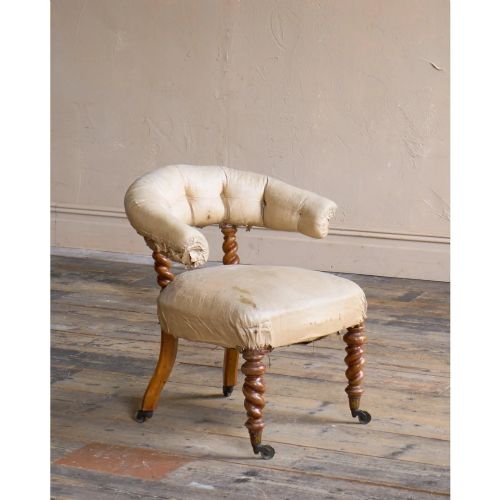
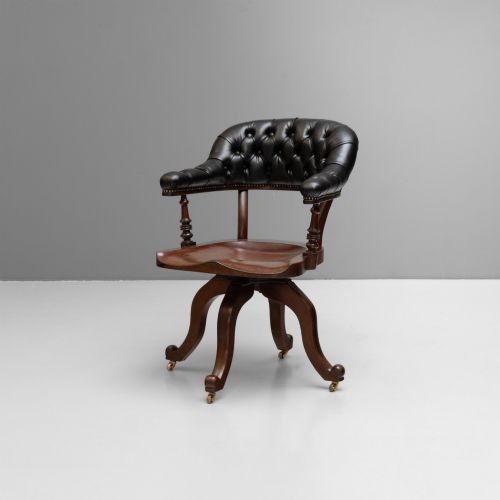
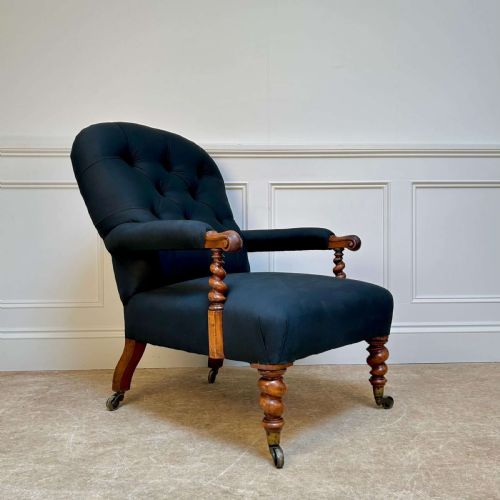
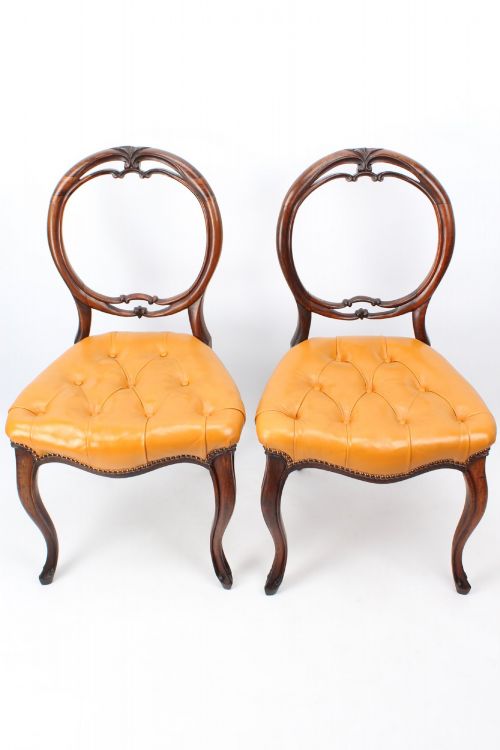
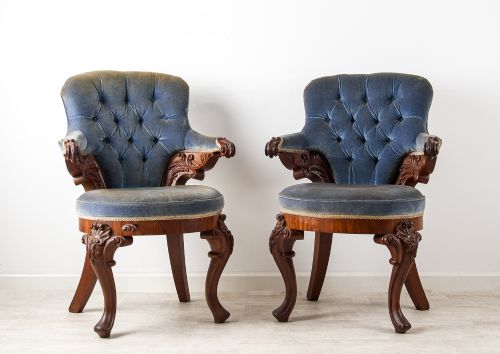
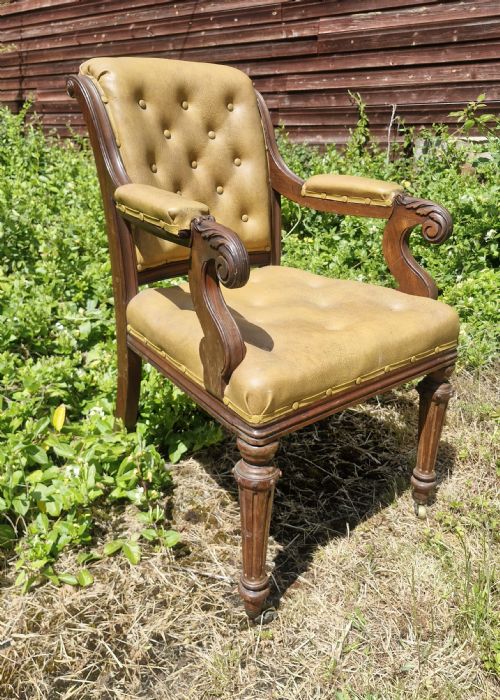
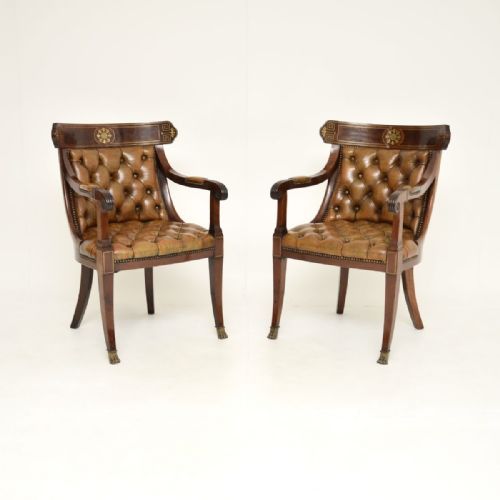
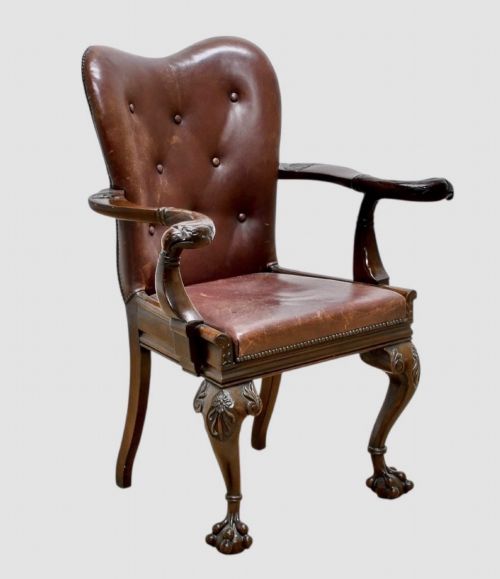

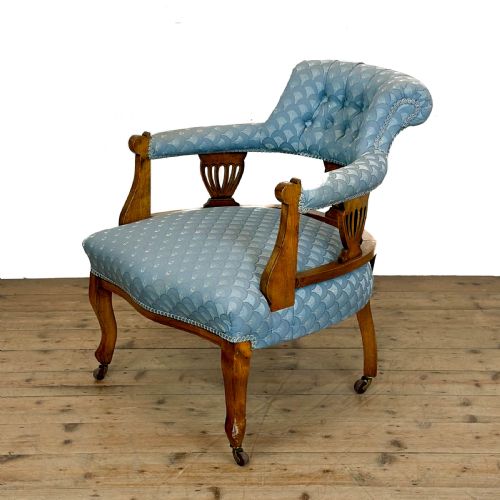

Button Backed Desk Chair
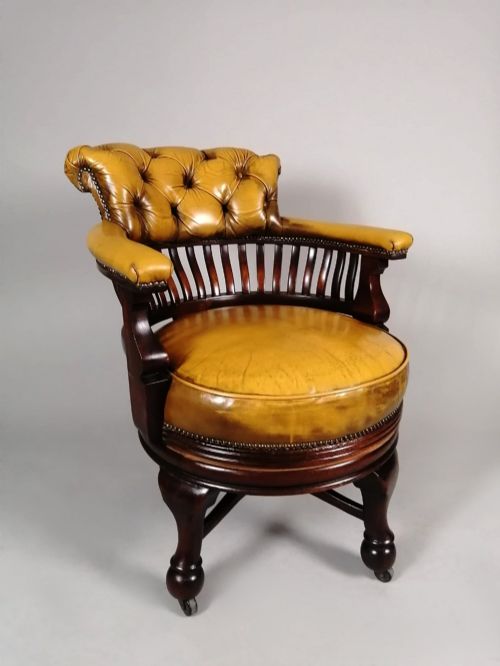
A button backed desk chair brings solid nineteenth-century timber and deep leather upholstery to a study, offering genuine support during long hours at a writing table.
Button Backed Desk Chair
A button backed desk chair sits firmly within the nineteenth-century tradition of study and library seating, drawing upon Victorian, Regency, and William IV design. These pieces combine substantial timber frames with practical swivel mechanisms or sturdy fixed legs suited to writing tables.
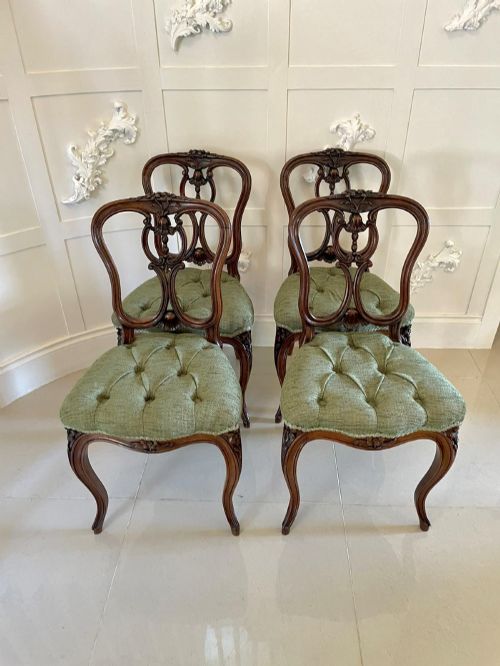
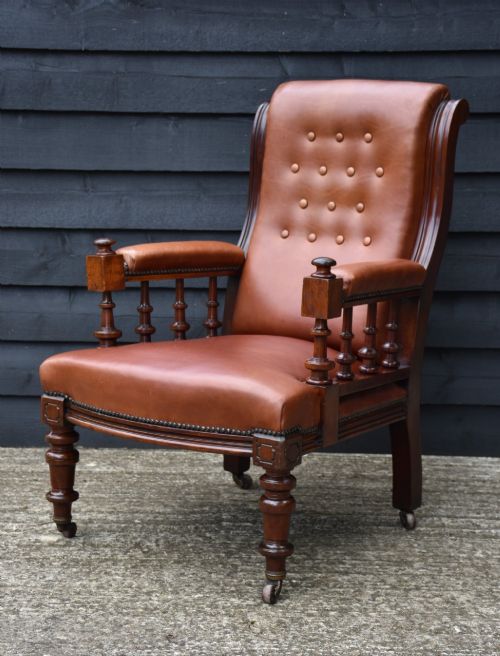
The form appears across several variations, with Victorian and late Victorian examples dominating alongside earlier Regency models. Buyers encounter swivel desk chairs alongside library armchairs and club elbow chairs featuring the characteristic tufted upholstery.
Makers shaped these seats from dense hardwoods like mahogany, walnut, and oak, often mounting them on brass castors for ease of movement across a study floor. The combination of sprung or padded backs with durable leather creates a functional seat built for daily work.
How they were made
Upholsters worked with leather, velvet, and textile coverings, securing the hide with deep buttoning to hold the internal padding in place. This method distributed the stuffing evenly and kept the surface taut through years of daily use.
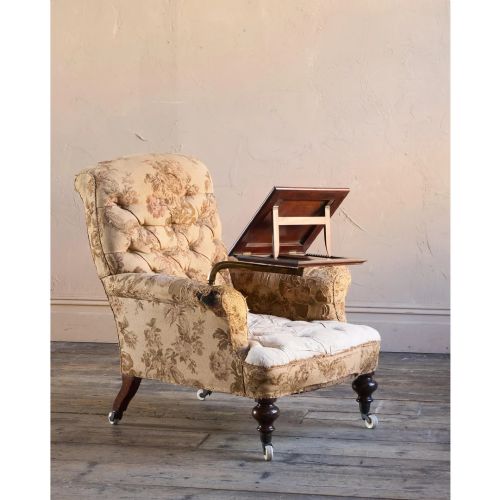
Several armchairs arrive equipped with reading stands, proving nineteenth-century scholars took their study ergonomics very seriously.
What varies in quality
Timber selection dictates the baseline quality of a button backed desk chair, with dense, well-figured mahogany or walnut outlasting softer or plainer woods. The depth and definition of hand-carving on the frame reveal the original maker's skill and ambition.
The execution of the leatherwork and buttoning defines the finish, requiring precise tension to ensure the upholstery remains supportive without sagging. Mechanism quality in revolving examples separates standard pieces from higher-grade work intended for serious libraries.
C. Hindley & Sons
The Button Backed Desk Chair Glossary
- Button-back
- Upholstery secured with deep buttons arranged in a diamond pattern. This technique creates distinct tufts that hold internal padding firmly in place.
- Library armchair
- A sturdy, upholstered seat designed for reading rooms and studies. These chairs often feature generous armrests and durable leather coverings.
- Bergère
- An enclosed armchair with cane or upholstered sides. The frame is typically made of exposed timber such as mahogany or beech.
- Revolving desk chair
- A swivelling seat mounted on a central pillar or castor base. It allows the user to turn easily between a desk and surrounding bookshelves.
- Curule
- An antique chair design featuring intersecting scroll-shaped legs. The form derives from ancient Roman folding stools.
Button Backed Desk Chair: Frequently Asked Questions
Are these chairs comfortable for daily work?
Most button backed desk chair models offer robust lumbar support through deep padding and sprung or webbed bases. Their generous proportions suit extended periods of writing or reading at a desk.
Heavier frames and stable bases keep the seat secure, while swivel mechanisms on selected variants allow easy movement around a workspace.
How do I identify a Victorian desk chair?
Victorian examples typically feature dark hardwoods like mahogany, walnut, or oak combined with buttoned leather upholstery. Turned wooden legs or revolving castor bases are common structural elements.
Stylistic cues range from heavy, carved late Victorian frames to simpler mid-century office armchairs built for functional studies.
What is the difference between a library chair and a desk chair?
Library chairs generally prioritise deep comfort with wide arms and substantial upholstered frames for relaxed reading. Desk chairs often incorporate swivel actions and more upright backs suited to working at a table surface.
Many nineteenth-century pieces overlap in function, combining the padded comfort of a library armchair with the mobility required for a writing desk.
Did Regency chairs have buttoned backs?
Regency seating frequently relied on smooth leather or caned panels rather than deep buttoning, though later revivals introduced tufted upholstery. Regency pieces often showcase brass inlays and fine mahogany or rosewood grain.
When buttoning appears on earlier forms, it typically reflects nineteenth-century reupholstery or later Victorian adaptation.