
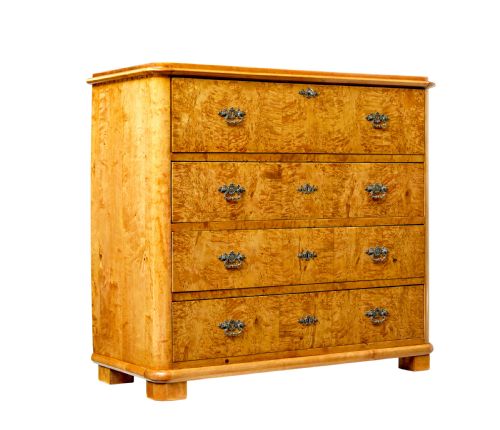


Burr Wood Secretary Desk
A burr wood secretary desk brings together knotted grain and fitted writing compartments from the seventeenth century to the twentieth.
Burr Wood Secretary Desk
A burr wood secretary desk is a form of writing furniture typically found as a bureau, secretaire chest of drawers, or bureau cabinet. These pieces combine a writing slope or fall-front desk with interior compartments, drawers, and sometimes upper bookcase sections.
You are most likely to encounter walnut, burr walnut, and burr elm examples spanning the Georgian and eighteenth-century periods, alongside nineteenth-century iterations. Styles range from Queen Anne and George I to Dutch Baroque and Biedermeier, showing the varied regional interpretations of the form.
The objects serve as both functional writing places and decorative cabinet work, utilising figured timbers to create striking patterned surfaces on the fall fronts and drawer facades.
Materials and construction
Cabinetmakers constructed these pieces using solid timbers like oak, pine, and walnut for internal carcases and drawer linings, applying highly figured veneers to the primary display surfaces. Burr walnut, burr birch, burr elm, and burr mulberry provide the distinctive swirling grain patterns characteristic of these desks.
Makers utilised brass for handles, escutcheons, and hinges, often employing cast drop handles or backplates appropriate to the period. The decorative schemes rely on book-matching and banding the burr veneers to frame the writing surfaces and drawer fronts.
Listings feature burr timbers including walnut, elm, birch, and mulberry across periods spanning the seventeenth to the twentieth centuries.
Distinctions in quality
Quality rests upon the selection and matching of the burr timber veneers across the facade, where symmetrical grain patterns denote superior craftsmanship. The intricacy of the interior fitments, including secret compartments, small drawers, and pigeonholes, further separates standard examples from finer commissions.
The integrity of the structural carcase and the handling of edge mouldings, dovetailing on internal drawers, and patination on the timber surfaces dictate the standing of an individual bureau or secretaire cabinet.
The Burr Wood Secretary Desk Glossary
- Bureau
- A desk featuring a sloping lid that opens to reveal a fitted interior of pigeonholes and small drawers. It often sits upon a chest of drawers or a frame.
- Secretaire chest of drawers
- A piece that appears to be a standard chest of drawers from the exterior, but possesses a top drawer that pulls out and folds down to form a writing surface.
- Bureau cabinet
- A tall piece of furniture comprising a lower bureau desk section surmounted by an upper bookcase or display cabinet with glazed or panelled doors.
- Burr wood
- Timber harvested from tree growths, such as burls or excrescences, which yields a swirling, highly figured grain pattern prized for decorative veneering.
- Fall front
- A hinged flap that drops down to create a horizontal writing surface, concealing the internal compartments when closed.
- Book-matching
- A technique of placing successive veneer slices from the same flitch side by side to create a symmetrical mirror-image pattern.
Burr Wood Secretary Desk: Frequently Asked Questions
What is a burr wood secretary desk?
A burr wood secretary desk is a piece of antique writing furniture featuring a fall front or sloping lid that conceals internal compartments. These items are constructed using highly figured burr timbers such as walnut, elm, and birch.
The category includes bureau cabinets, standard bureaux, and secretaire chests of drawers originating from seventeenth-century roots through to Edwardian interpretations.
How were these desks used historically?
These desks served as private writing stations for correspondence, record-keeping, and the storage of important documents. The fitted interiors provided secure spaces for letters, inkwells, and valuables.
Larger bureau cabinet variations also functioned as libraries and display units, housing books behind upper doors while providing a fold-down writing surface below.
How do I date an antique bureau?
Dating relies on examining the construction methods, secondary timbers like oak or pine used in the carcase, and the style of the brass hardware. Cabinet proportions and veneer thicknesses also shift between the seventeenth, eighteenth, and nineteenth centuries.
Early pieces often feature walnut or burr elm with specific regional characteristics, whereas later nineteenth-century and Edwardian examples may show revival styles such as Queen Anne or Early Georgian manners.
Where should I place one in my home?
A secretary desk functions effectively in a study, living room, or hallway where the depth of the piece allows the fall front to open comfortably. Placing the desk away from direct sunlight and heat sources protects the delicate burr veneers from drying out.
The compact footprint of a bureau makes it suitable for rooms requiring both surface workspace and concealed storage.