




Queen Anne Bureau Stand
A queen anne bureau stand is a sophisticated writing cabinet raised on slender legs, combining compact workspace with refined cabinetmaking.
Queen Anne Bureau Stand
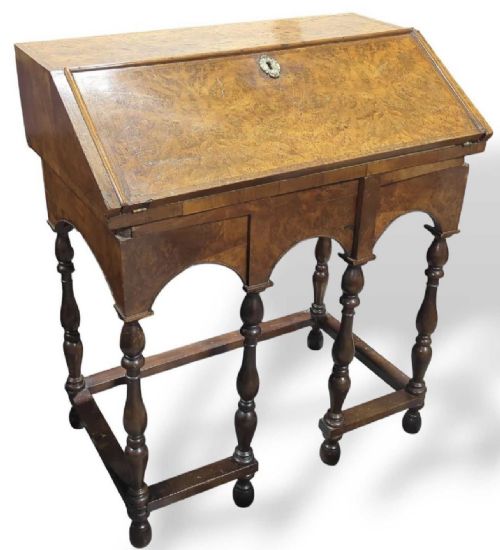
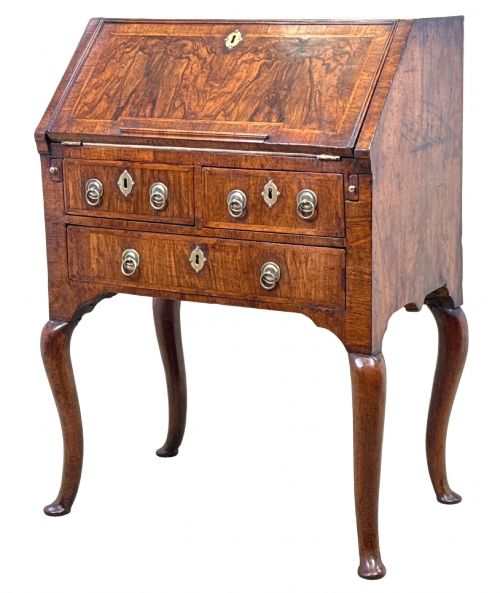
A queen anne bureau stand comprises a sloping writing lid enclosing small drawers and pigeonholes, supported by a distinct frame or stand rather than resting on a chest of drawers.
The versions met most frequently on this page span the eighteenth century alongside later revival periods, utilising timber forms such as walnut, burr walnut, elm, oak, and yew.
Makers produced these writing desks and related dressing mirrors in styles ranging from early eighteenth century originals to George I style, Queen Anne style, and Edwardian revival interpretations.
Materials and construction
Cabinetmakers constructed these pieces using dense hardwoods including walnut, burr walnut, elm, oak, and yew, often highlighting decorative grain patterns across the sloping fall front.
Surfaces frequently display intricate marquetry inlay, whilst brass fittings provide functional hardware for handles and escutcheons.
Secret compartments hidden inside pigeonholes remind us that eighteenth century writers valued privacy just as much as a sturdy writing surface.
Judging quality and execution
Excellence in these pieces rests upon the choice of veneer, where richly figured burr walnut or marquetry inlay demonstrates superior visual depth and material selection.
The harmony between the upper cabinet and the supporting stand reveals the maker's proportion and structural precision.
The Queen Anne Bureau Stand Glossary
- Bureau stand
- A writing cabinet featuring a sloping lid, raised upon a separate open frame or leg structure. This elevated form provides a lighter visual presence than traditional cabinet bases.
- Burr walnut
- A highly prized wood timber harvested from walnut tree growths, displaying swirling grain patterns. Cabinetmakers utilised this material across prominent surfaces for decorative effect.
- Marquetry
- The art of applying pieces of veneer to a structure to form decorative patterns. Craftsmen utilised contrasting woods to create detailed designs on the fall fronts.
- Fall front
- The hinged sloping lid of a bureau that lowers to create a writing surface. It conceals internal compartments and small drawers when closed.
Queen Anne Bureau Stand: Frequently Asked Questions
What is a bureau on stand?
A bureau on stand combines a compact writing compartment with an elevated base or legs. This configuration creates a lighter appearance compared to standard heavy desks.
Such pieces functioned primarily for private correspondence and record keeping in domestic rooms.
How do I identify walnut furniture?
Walnut furniture displays a rich brown colour with varied grain patterns, ranging from straight figures to swirling burls. Craftsmen valued it for its strength and fine carving properties.
Surfaces often acquire a warm patina over decades of use and polishing.
What distinguishes revival periods?
Revival periods such as the Edwardian era or the early twentieth century reference earlier eighteenth century proportions and decorative motifs. Makers utilised traditional timbers like walnut and oak to echo historical aesthetics.
These later interpretations reflect changing domestic tastes for antique styling.
Where were bureau stands used?
These writing cabinets served in private chambers, drawing rooms, and studies for letter writing and managing personal accounts. Their compact scale allowed placement in smaller residential spaces.
The elevated stand kept the writing surface at a comfortable height.