




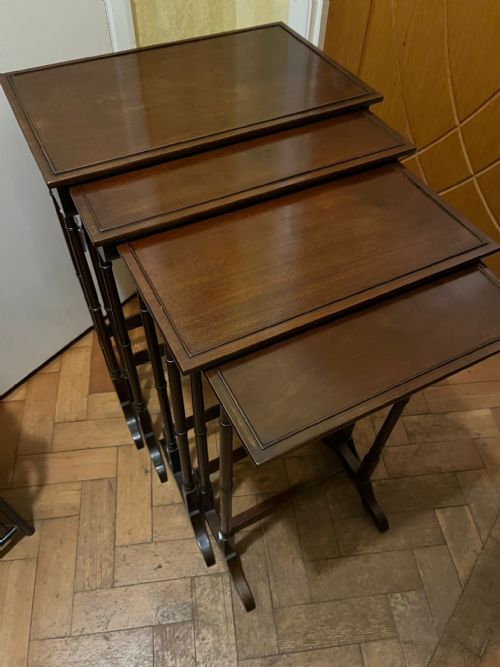
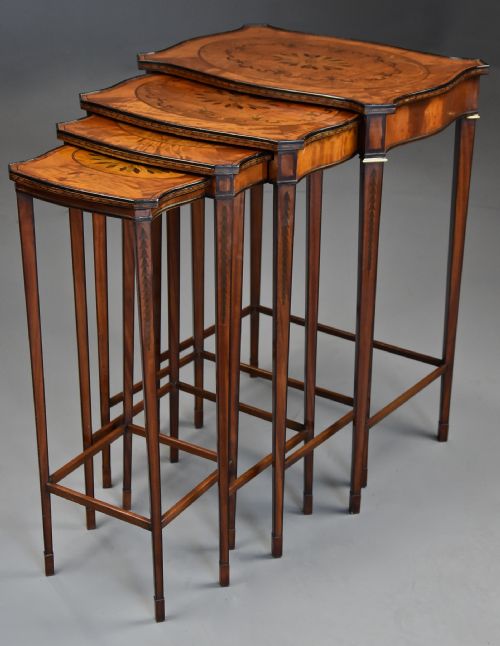


Brown Wooden Nest Tables
Brown wooden nest tables offer a practical tiered design in mahogany, walnut, and oak, stacking neatly when floor space matters.
Brown Wooden Nest Tables
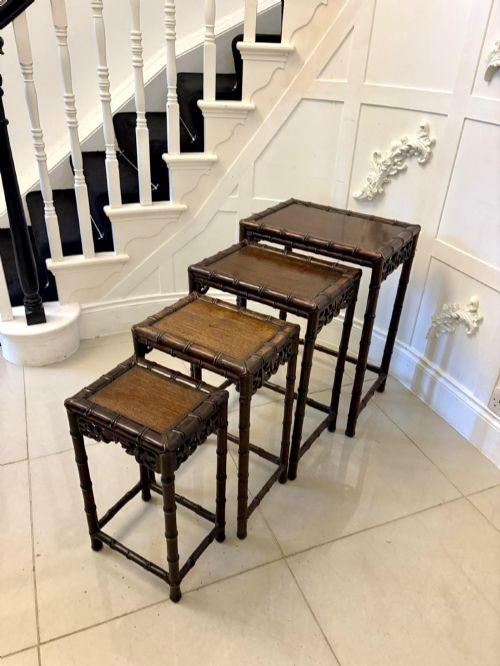
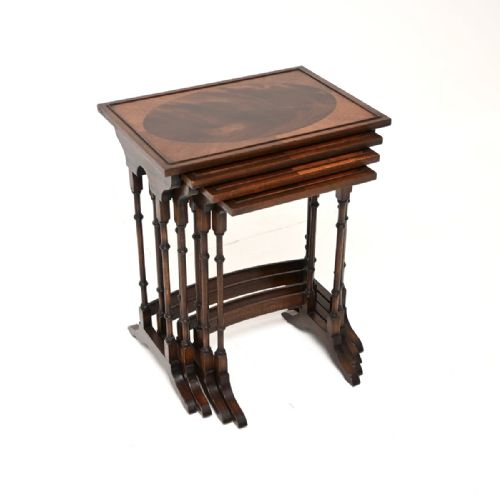
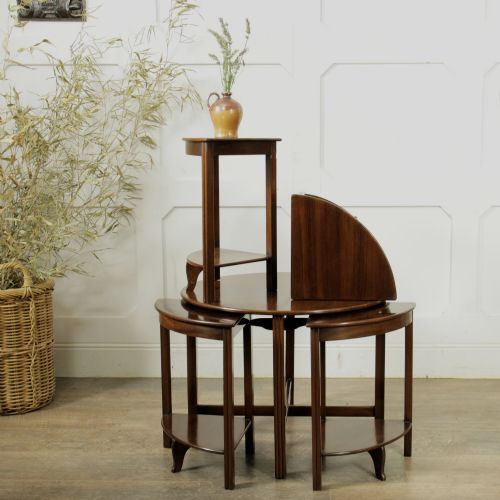
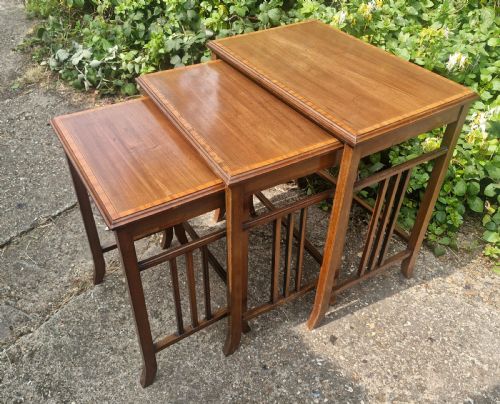
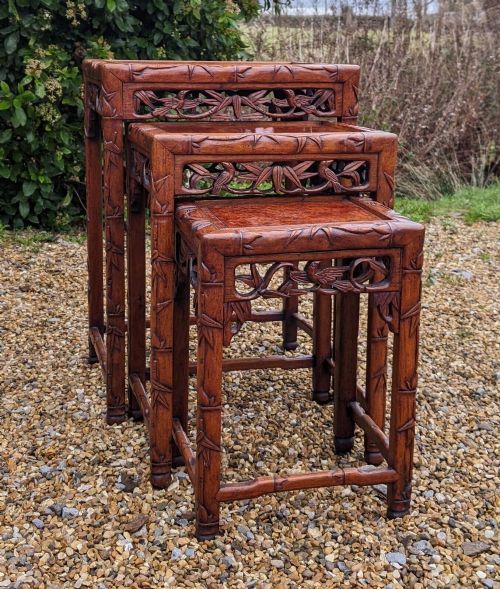
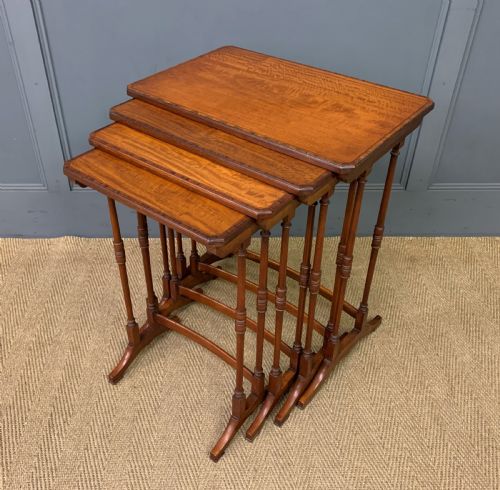
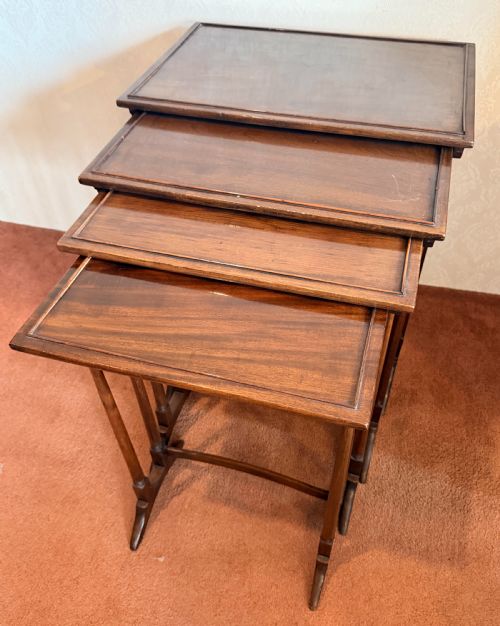
Brown wooden nest tables comprise sets of occasional tables designed to slide beneath one another into a single compact footprint. The examples appearing here span from the 19th Century and Victorian eras through the Edwardian period and into the 1930s Art Deco movement. A buyer exploring brown wooden nest tables encounters varying formations, from sets of three or four graduated pieces to circular configurations and quartetto groupings.
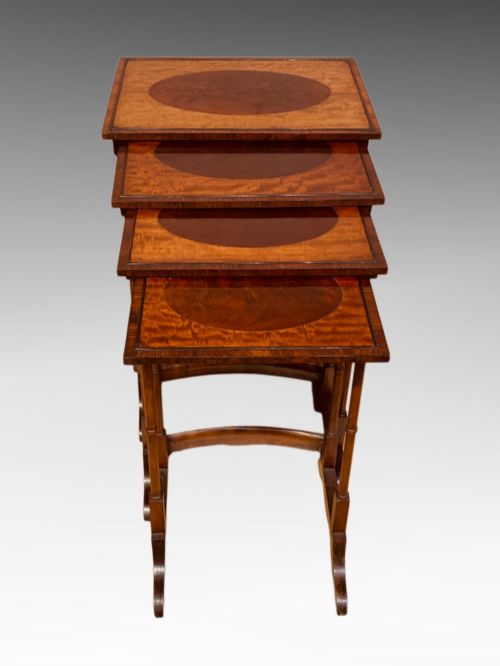
Edwardian and late 19th-century mahogany versions dominate the selection, frequently displaying satinwood inlay or boxwood stringing. Earlier Regency and Victorian interpretations appear alongside 20th-century walnut, oak, and teak iterations. These objects function primarily as flexible living room furniture, deployed individually for tea or writing and stored compactly afterward.
Materials and Construction
Cabinetmakers utilised solid timbers and veneers such as mahogany, walnut, satinwood, and oak, often mounting them on slender turned or tapering supports. Decorative elements include satinwood inlay, brass stringing, embossed leather inserts, and carved faux bamboo or figurative motifs. Individual tables within a set are scaled incrementally so the smaller frames slot precisely beneath the next larger top.
Joinery methods reflect the period of production, employing traditional framing to ensure stability across multiple load-bearing surfaces. Tables featuring specialised work such as Killarney marquetry, Chinese huanghuali construction, or carved teak demonstrate diverse regional woodworking traditions.
Some Edwardian households deployed five tables in a single nest, requiring guests to dig astonishingly deep into the stack for a teacup.
Gradations in Execution
Quality in brown wooden nest tables rests upon the selection of timber figures and the crispness of inlaid details like satinwood or boxwood. Finer pieces demonstrate precise graduated proportions that allow smooth stacking without rubbing the polished surfaces. Superior sets maintain structural rigidity in the leg joints despite the slender scantlings required for nesting furniture.
The refinement of secondary details, such as shaped serpentine tops, fine veneer matching, and specialised marquetry or embossed leather surfaces, distinguishes standard production from exceptional examples.
Gillows·Heal's
The Brown Wooden Nest Tables Glossary
- Quartetto tables
- A matching set of four small occasional tables designed to nest together. This term appears frequently in 19th-century and Edwardian descriptions.
- Satinwood inlay
- A contrasting light-coloured exotic wood inserted into the primary timber surface to create geometric or floral borders. It is typical of Sheraton revival and Edwardian cabinetwork.
- Boxwood
- A dense, pale yellowish wood frequently employed for fine stringing and inlay lines on mahogany and walnut furniture.
- Killarney ware
- Irish ornamental woodwork characterised by intricate marquetry depicting local scenes and flora, often executed in native arbutus woods.
Brown Wooden Nest Tables: Frequently Asked Questions
What is a quartetto table set?
A quartetto set comprises four graduated occasional tables built to slide one beneath the other. They originated in the 19th century as versatile furniture for drawing rooms.
Each table steps down in height and width, allowing the entire group to occupy the floor space of just one small table when stored.
How do I date a nest of tables?
Dating relies on timber choice, secondary woods, and decorative styles. Mahogany and rosewood are common in 19th-century and Victorian sets, while satinwood inlay strongly points to the Edwardian period.
Art Deco examples from the 1920s and 1930s often feature teak, Indian rosewood, or geometric carved motifs without traditional stringing.
Were these tables used for tea?
Yes, nest tables served as portable surfaces for serving afternoon tea, holding books, or writing letters in Victorian and Edwardian drawing rooms. Individual guests could pull out a smaller table as needed.
Their lightweight construction made them easy to reposition around a fireplace or seating area.
Are all nesting tables made of mahogany?
While mahogany is the most common timber seen in Edwardian and 19th-century examples, sets also appear in walnut, oak, satinwood, teak, and huanghuali. Cabinetmakers matched the wood selection to contemporary stylistic preferences.
Inlays frequently introduce contrasting materials like boxwood and satinwood to enhance the visual depth of the top surfaces.