


Carved Wooden Nesting Tables
These carved wooden nesting tables offer clever multi-tiered surface space that tucks away neatly when floor room matters.
Carved Wooden Nesting Tables
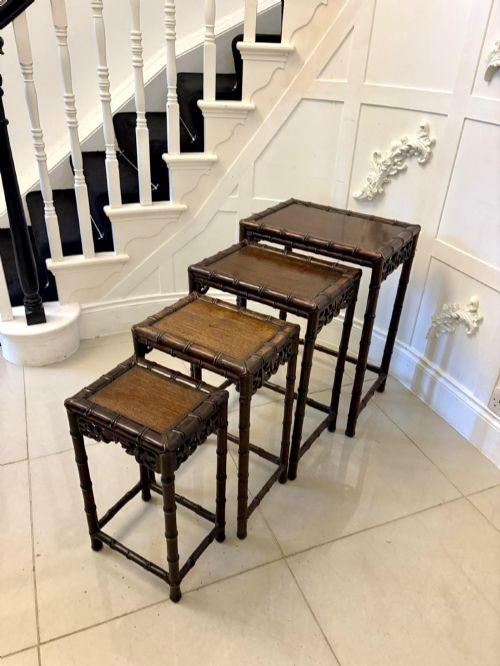
Carved wooden nesting tables comprise sets of graduating surfaces designed to slide beneath one another for compact storage. The pieces listed here span the nineteenth century through the 1930s, encompassing both British periods like the Edwardian era and extensive Chinese export items.
Most examples appear as sets of four tables, known historically as quartetto sets, though three or five-table sets also occur. Forms range from low coffee table heights down to traditional side table proportions used for serving or display.
Origins divide broadly between traditional British cabinetmaking in mahogany, walnut, or teak, and intricate Asian workshop pieces utilising dense hardwoods such as hongmu, rosewood, and huanghuali.
How they were made
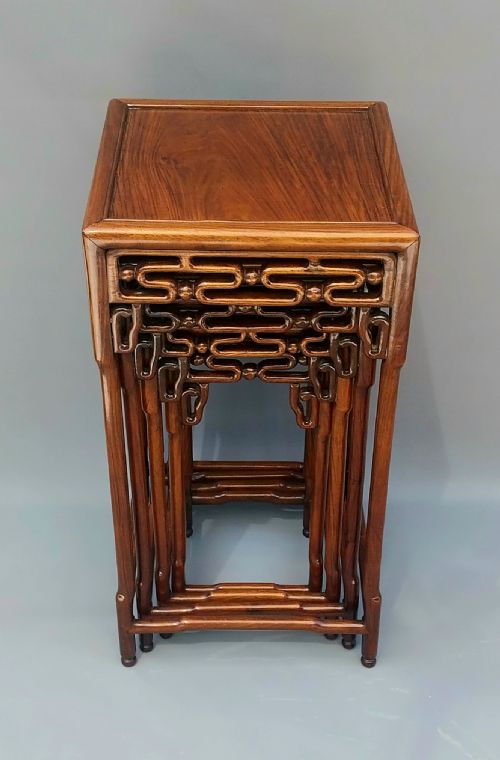
Construction relies upon dense timbers including mahogany, rosewood, teak, and hongmu, chosen for their structural strength under slender framing. Joinery accommodates individual tabletop frames sized precisely to clear the legs of the table above.
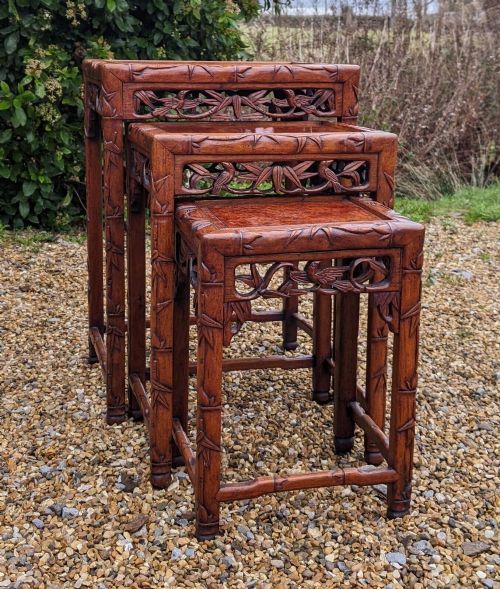
Carving techniques vary from restrained edge moulding on Edwardian mahogany to deep relief work depicting figurative scenes or fauna on Chinese export pieces. Selected examples incorporate contrasting burr walnut panels or inset glass tops.
Surface finishing involves traditional polishing methods that highlight natural grain patterns, particularly on rosewood and burr walnut variations.
Art Deco sets bring unexpected character to traditional nesting forms by carving playful elephants directly into the woodwork.
What varies in quality
Quality rests primarily in the density and selection of the timber, where finely figured grain and uniform coloration elevate a set. Heavy exotic hardwoods like hongmu and huanghuali represent superior material choice compared to general regional hardwoods.
The crispness and depth of the carved ornamentation distinguish standard production from exceptional craftsmanship. Construction integrity determines how smoothly the tables slide and fit within their designated hierarchy without binding.
The Carved Wooden Nesting Tables Glossary
- Quartetto
- A matched set of four graduating tables designed to nest together. This term appears frequently in nineteenth-century British furniture records.
- Hongmu
- A traditional Chinese classification for dense, red-toned hardwoods. It denotes heavy, durable timber utilised in fine export furniture.
- Chinoiserie
- European artistic styles reflecting Chinese motifs and decorative techniques. Artisans applied these designs to furniture forms popular during the Victorian and Edwardian periods.
- Burr walnut
- Wood taken from walnut tree growths, featuring swirling, complex grain patterns. Craftsmen utilised this material for decorative tabletop veneers.
- Graduated
- Describing tables built in decreasing dimensions so smaller units slide beneath larger ones. This sizing structure allows multiple surfaces to occupy the footprint of a single table.
Carved Wooden Nesting Tables: Frequently Asked Questions
How do you arrange nesting tables?
Sets typically arrange with the largest table positioned centrally and the smaller units pulled out to provide independent surfaces around a room. When space is limited, they stack completely into a single footprint.
Arrangements depend on the specific room layout and whether the tables function as side supports or coffee table surfaces.
What woods were used for these?
Maker materials range from traditional British cabinet timbers like mahogany and walnut to dense Asian hardwoods including rosewood, teak, and hongmu. Selection often reflects the regional origin of the set.
Certain pieces also feature decorative veneer panels such as burr walnut or glass surface inserts.
How many tables come in a set?
Most surviving sets consist of four graduating tables, historically referred to as quartetto sets. Examples comprising three or five tables also appear across the listings.
Each table scales down in height and width to slide neatly beneath the next larger unit.
Are these tables sturdy?
Structural stability depends on the density of the hardwood used, such as heavy rosewood or mahogany, and the precision of the original joinery. Slender frames are engineered to support everyday usage while maintaining clearance for nesting.
Properly maintained joints ensure the tables remain stable during daily deployment and stacking.