
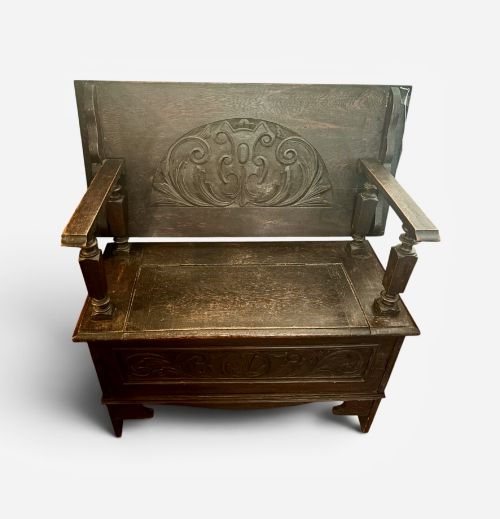


Brown Oak Settle Table
These brown oak settle table pieces are versatile dual-purpose seats and tables that convert effortlessly for practical daily living.
Brown Oak Settle Table
When you search for a brown oak settle table, you are examining dual-purpose timber furniture designed to serve as both a seat and a table. The selections here encompass monk benches, hall benches, and monks bench armchairs spanning from the eighteenth century through the 1930s. Most examples you will encounter date from the Victorian era up to the early twentieth century.
The forms range from rustic Catalan shepherd's benches to carved Jacobean revival styles and art deco coffee table variants. These pieces function traditionally by having a hinged back that tilts forward to form a flat table surface over the seat base. Such clever engineering made them ideal for smaller rooms where space efficiency mattered.
Originating across British and continental workshops, these items utilise robust timbers like oak to endure generations of domestic use. You will find both simple rustic interpretations and heavily carved iterations featuring traditional motifs. Each piece reflects the specific aesthetic tastes of its period, from gothic revival severity to art nouveau curves.
How they were made
Cabinetmakers constructed these brown oak settle table items primarily from solid timber and oak using traditional joinery methods. Panels were frequently framed and panelled to allow for the natural expansion and contraction of the wood over time. Iron fittings, hinges, and pins were commonly employed to secure the pivoting mechanism of the convertible backrest.
Surface ornamentation on these pieces often involved hand-carving directly into the solid oak, displaying relief patterns typical of Jacobean and gothic revivals. Finishing techniques ranged from natural wax polishes that enhanced the golden and dark oak tones to darker staining popular in early twentieth-century workshops.
Catalan shepherds evidently appreciated a sturdy seat just as much as Victorian monks, proving that good carpentry transcends any single profession.
What varies in quality
The distinction between standard examples and superior brown oak settle table pieces lies chiefly in the crispness of the hand-carving and the selection of the timber. Dense, well-figured oak with rich grain patterns elevates a piece, whereas plain or utility-grade timber produces a more rudimentary appearance. Finer examples display meticulous attention to the pivoting mechanism, ensuring the backrest converts smoothly without strain on the joints.
Proportion and structural integrity also dictate the standing of a piece within its period. Pieces that retain their original iron hardware and undisturbed timber patination command greater appreciation among collectors than those with excessive modern replacements.
The Brown Oak Settle Table Glossary
- Monk's bench
- A convertible piece of furniture featuring a hinged back that tilts over the seat to form a table. This clever dual-purpose design was historically favoured in compact domestic spaces.
- Jacobean Revival
- A nineteenth and twentieth-century style imitating the heavy, geometric carved woodwork of the early seventeenth century. It frequently appears on oak seating with strapwork and floral motifs.
- Patination
- The surface sheen and colour acquired by timber over decades of exposure, handling, and polishing. Good patination indicates age and honest use.
- Timber
- The general material used in cabinetmaking, encompassing various cuts and grades of wood. In these listings, oak is the predominant timber utilised by makers.
Brown Oak Settle Table: Frequently Asked Questions
How does a monks bench convert into a table?
The high back of the bench pivots forward on integrated wooden or iron pins positioned above the arms. When fully tilted, the rear of the backrest rests flat across the armrests to create a table surface.
This mechanism allows the furniture to switch rapidly from a comfortable seat to a functional dining or writing table.
What periods do these oak benches date from?
The selections span from eighteenth-century rustic vernacular pieces up to items made in the 1930s. Victorian and early twentieth-century examples are the most frequently encountered.
Revival styles from the Victorian era frequently mimic much older seventeenth-century designs.
Where were these settle tables used originally?
Historically, such convertible furniture sat in halls, parlours, and farmhouses where floor space was at a premium. They provided a place to sit near the hearth and a surface for meals.
Today, they function well in entrance halls, living rooms, and large kitchens.
How do I care for antique oak furniture?
Keep wooden pieces away from direct heat sources and sudden temperature fluctuations to prevent the timber from splitting. Regular application of a quality beeswax helps maintain the moisture and sheen of the oak.
Avoid using silicone-based polishes that can build up and dull the historic patination over time.