


Bronze Vanity Mirror
A bronze vanity mirror sits on the dressing table to catch the morning light, bringing weight and polish to the room.

Bronze Vanity Mirror
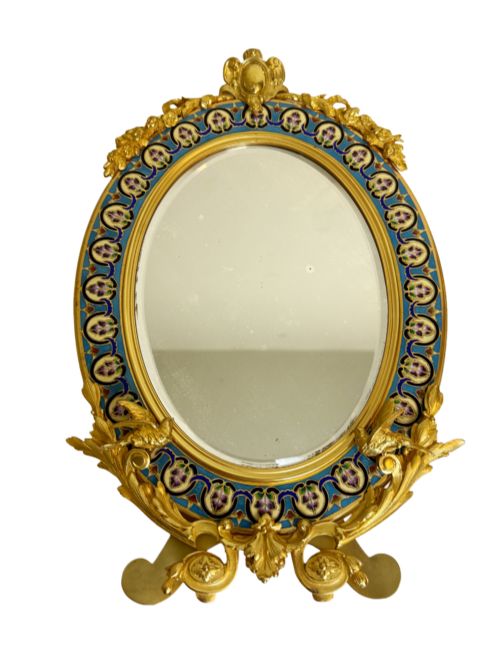
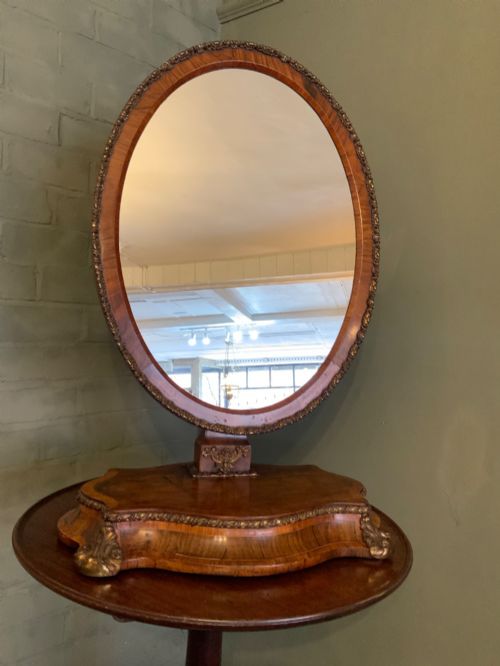
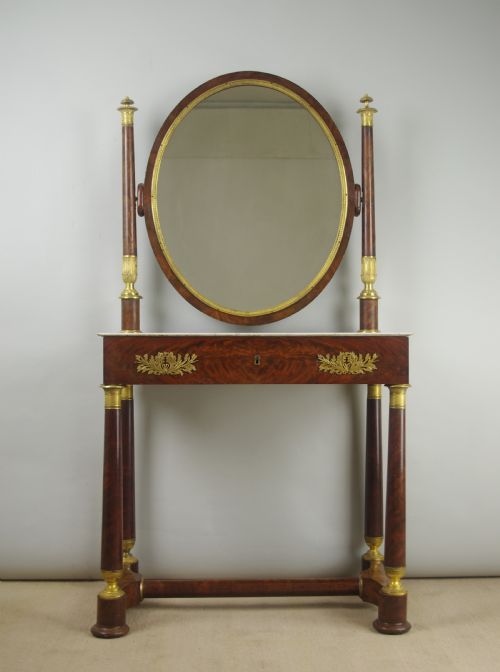
A bronze vanity mirror belongs to the dressing table and the tabletop, designed to stand upright or adjust on a pedestal. These pieces arrive in styles from French Empire and Napoleon III to Rococo Revival, spanning the nineteenth century and the early twentieth century.
How they were made
Foundry work combined cast bronze and brass frameworks, frequently finished with mercury gilding or ormolu to achieve a bright, durable surface. Artisans mounted bevelled glass plates within heavy metal bezels, securing them with screws and hinged struts.
Decorative panels incorporate champleve enamel and Sevres porcelain plaques set directly into the metal armature. Wooden supports in mahogany and walnut occasionally provide the base structure for larger dressing table mirrors.
The periods represented span from the early nineteenth-century French Empire through Victorian and Edwardian iterations.
What varies in quality
The crispness of the cast ornamentation dictates the standard of the piece, separating sharp, hand-chased foliage from soft, repetitive factory work. Heavier gauge bronze and thick ormolu plating hold their finish far better over decades of handling.
Makers who signed their work, such as Thiebaut Freres, Joseph Meissonnier, or F. Bienvue, introduced superior enamel detailing and heavier mounting hardware. The integration of secondary materials like marble bases and Limoges enamel elevates the ambition of the design.
Thiebaut Freres·Joseph Meissonnier·F. Bienvue
The Bronze Vanity Mirror Glossary
- Ormolu
- Gilded bronze produced by applying a mercury and gold amalgam to a cast bronze object and heating it to drive off the mercury. This technique creates a rich, lasting metallic lustre seen on French Empire frames.
- Champleve
- An enamelling technique where troughs or cells are dug into the surface of the bronze and filled with vitreous enamel before firing. It creates colourful geometric and floral patterns around the mirror glass.
- Bevel
- The angled edge cut around the perimeter of the mirror glass to catch and refract light. Older plates often feature a distinct hand-cut slope.
- Spelter
- A zinc alloy used as a cheaper alternative to bronze for casting decorative figures and frames. It takes a bronze-like finish but is lighter and more brittle.
Bronze Vanity Mirror: Frequently Asked Questions
How do I date a bronze vanity mirror?
Dating relies on stylistic clues such as the heavy symmetry of French Empire pieces versus the flowing asymmetry of Rococo Revival and Edwardian work. Materials like champleve enamel and Sevres porcelain mounts point towards specific decades in the nineteenth century.
Hardware fastenings and the presence of makers' signatures or foundry marks also help place the object in time. Examining the backplate and the casting quality clarifies the manufacturing period.
Were these mirrors meant to travel?
Most bronze vanity mirrors were designed as stationary table accessories for dressing tables and boudoirs. Their substantial weight from bronze, marble, and glass kept them stable during daily use.
Hand mirrors in the selection offer portability, while adjustable pedestal and toilet mirrors remain fixed on their stands.
How do I clean an ormolu frame?
Dusting with a soft, dry cloth is the safest way to maintain gilt bronze and ormolu surfaces. Moisture and abrasive cleaners can strip the historic gilding.
Professional conservation is recommended for pieces with delicate champleve enamel or fragile glass mountings.
What is the difference between ormolu and gilt bronze?
Ormolu specifically refers to gilt bronze created through the historic mercury-gilding process common in eighteenth and nineteenth-century France. The term gilt bronze can also describe other methods of applying gold to a bronze base.
Both terms describe the golden metallic finish that protects the bronze underneath from tarnish.