
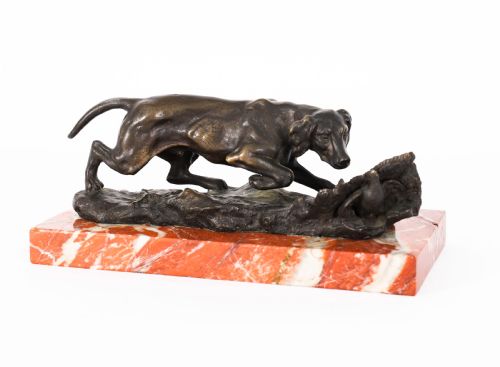
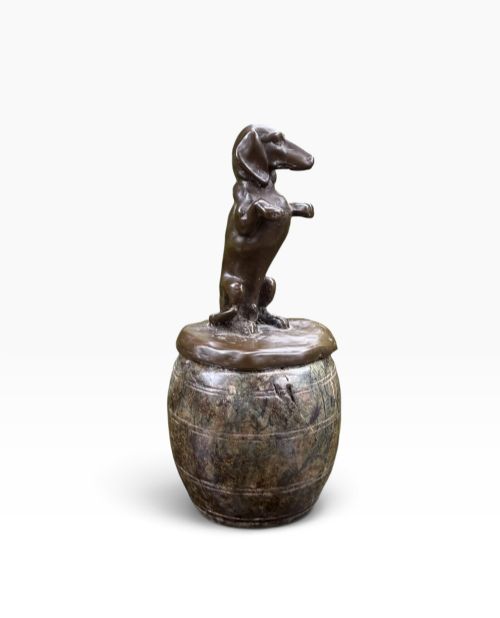



Bronze Dog on Marble Base
A bronze dog on marble base brings weighted presence to a desk, capturing nineteenth-century animalier realism or modernist contour.
Bronze Dog on Marble Base
A bronze dog on marble base is a figural work uniting metal casting with stone plinths, most often taking the form of hounds, gundogs, or retrievers. These pieces span nineteenth-century animalier studies and twentieth-century modernist interpretations.
The dominant version on this page is the nineteenth-century French animalier cast, followed closely by Art Deco table lamps, bookends, and night lights from the nineteen-twenties and nineteen-thirties. Subjects range from solitary resting hounds to complex hunting groups with pheasants.
Foundations vary from simple rectangular marble slabs to shaped onyx and multi-material bases supporting cast figures. Collectors encounter both signed artist casts and unmarked decorative workshop editions.
Materials and casting technique
Sculptures are primarily cast in bronze or spelter using traditional methods, then finished with patination to create dark, naturalistic tones. Metal figures are subsequently mounted onto heavy marble or onyx plinths using threaded pins or concealed fixings.
Twentieth-century variations introduce frosted glass elements for illuminated night lights and lamps, combining electrical fittings with metal and stone. Bases are cut and polished from natural marble blocks, providing a stable, contrasting weight to the metal above.
Listings feature works spanning the nineteenth century through the Art Deco period of the nineteen-thirties, using bronze, spelter, marble, onyx, and frosted glass.
Distinctions in quality
Quality rests in the fidelity of the metal chase work and the crispness of the original cast, which determines whether musculature and fur read with anatomical precision. Finer examples retain subtle hand-tooling on the surface, whereas lower tiers show softened detail from worn production moulds.
The selection of the plinth also marks the grade of the piece, with dense, finely veined marble or onyx elevating the work above plain stone bases. Signatures from recognised animalier sculptors or period founders add distinction to the cast.
Carl Kauba·Pierre Jules Mene·Prosper Lecourtier·Alexandre Kelety·Geo Maxim·Christophe Fratin·L Bureau
The Bronze Dog on Marble Base Glossary
- Animalier
- A nineteenth-century sculptural movement focused on realistic depictions of animals, particularly predators and hounds. Practitioners often worked in bronze to capture dynamic motion and muscular tension.
- Spelter
- A zinc alloy frequently utilised as a cost-effective alternative to bronze in twentieth-century decorative figures. It accepts patination readily but possesses a lighter weight and softer tensile strength than bronze.
- Patina
- The surface coloration and sheen developed naturally over time or applied chemically by the foundry. It enhances the depth of the metal casting and protects the underlying alloy.
- Ormolu
- Gilded bronze utilised for decorative mounts and subsidiary details on nineteenth-century pieces. The technique involves applying a gold amalgam to the metal surface.
- Night light
- A small electrified decorative lamp designed to cast a low ambient glow, often incorporating frosted glass panels behind or beneath the metal figure.
Bronze Dog on Marble Base: Frequently Asked Questions
Are these figures solid bronze?
Most animalier sculptures are hollow-cast bronze, a traditional technique that conserves metal and reduces overall weight while maintaining structural rigidity. Certain smaller elements or bookends may be solid cast.
Twentieth-century pieces frequently utilise spelter rather than bronze, which can be distinguished by its lighter weight and different internal colour where patination wears.
How do I date an Art Deco piece?
Art Deco examples on this page typically date from the nineteen-twenties and nineteen-thirties, identifiable through stylised geometric forms and streamlined hound silhouettes. Materials like frosted glass and stepped onyx plinths point directly to this era.
Signatures on the metal base or marble plinth often align with active workshop years of known modellers from the period.
What is an animalier bronze?
An animalier bronze is a nineteenth-century sculptural work dedicated to naturalistic animal subjects, particularly hunting dogs and hounds in repose or action. These pieces emerged from French studios aiming for anatomical accuracy.
The focus is on the authentic behaviour and musculature of the animal rather than stylised decoration.