
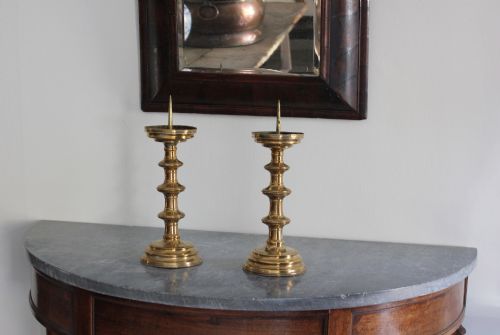


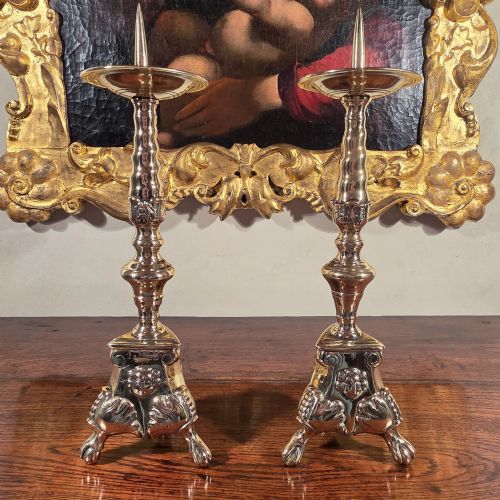


Brass Pricket Candle Holders
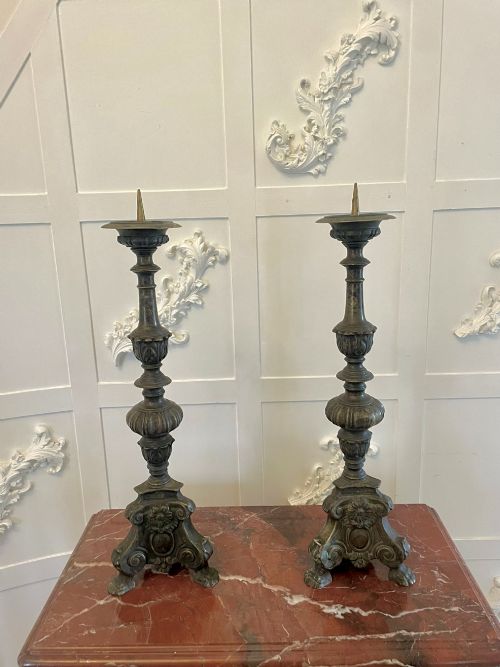
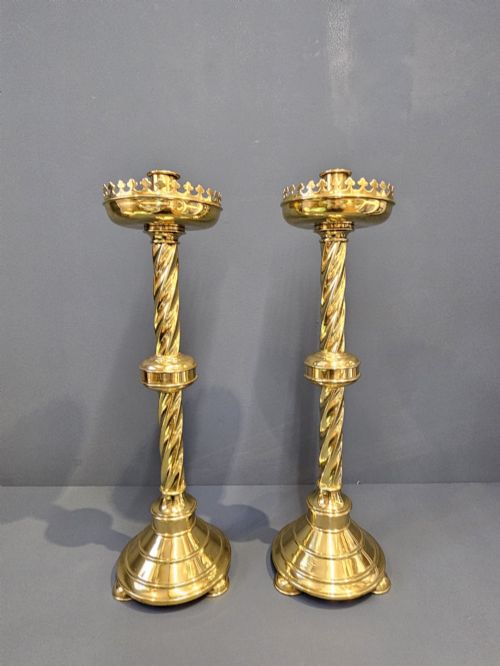
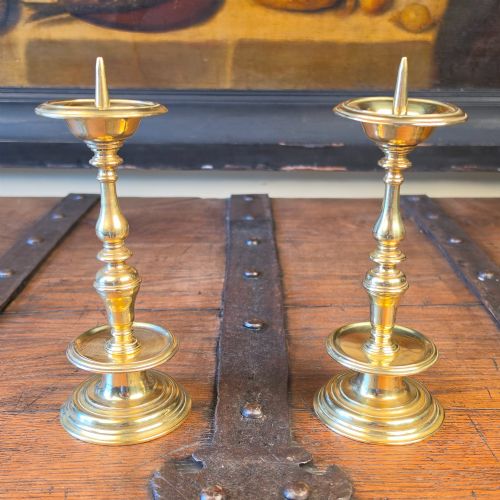
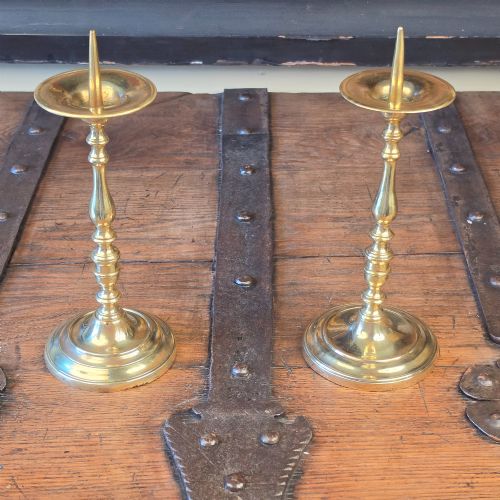
Brass pricket candle holders are altar and sanctuary lights featuring sharp central spikes, offering architectural presence and centuries of metalwork history.

Brass Pricket Candle Holders
When you search for brass pricket candle holders, you encounter altar lighting spanning from the sixteenth century to the early twentieth century. The selection ranges from monumental church floor standards to diminutive domestic pairs originating across England, France, the Low Countries, and Japan.
Victorian Gothic Revival examples dominate the current listings, alongside seventeenth-century style interpretations and twentieth-century Amsterdam School designs. These objects take the form of heavy candlesticks and tall floor candle holders constructed primarily for ecclesiastical and ceremonial use.
Materials and construction
Makers utilised cast brass, bronze, copper, and wrought iron, frequently combining metals within a single piece to achieve contrasting patinated surfaces. Gilt-brass finishes appear on ecclesiastical items, while Dutch School designs incorporate patinated metal and wood elements.
The defining feature across these items is the pricket, a vertical spike designed to impale the base of a candle rather than sit inside a socket. Heavier pairs rely on robust casting techniques for stability, supporting substantial heights in church and domestic settings.
Listings span from the 16th century through to the 1940s, featuring brass, bronze, copper, wrought iron, and patinated metal.
Distinctions in execution
The division between standard production and exceptional work rests on the crispness of the casting and the proportional harmony of the stem and base. Heavier specimens demonstrate superior metal density and more complex turned or chased ornamentation.
Design integrity separates revival pieces from period originals, with authentic seventeenth-century Low Countries items and signed Amsterdam School productions holding greater documentary weight than later interpretations.
The Brass Pricket Candle Holders Glossary
- Pricket
- A metal spike projecting upwards from the drip pan to secure the candle. This method predates the common socket candlestick.
- Gothic Revival
- An architectural and decorative style popular during the Victorian era that drew inspiration from medieval forms. Pieces in this style often incorporate ecclesiastical tracery and heavy proportions.
- Amsterdam School
- An architectural and design movement from the early twentieth century characterised by expressive forms and craft-based metalwork. Items from this movement utilise brass, copper, and iron with distinctive patination.
- Patinated metal
- Metal surfaces altered by age, chemical treatment, or environmental exposure to display a darkened or weathered tone. This finish indicates the natural ageing of the alloy.
Brass Pricket Candle Holders: Frequently Asked Questions
How do I secure a candle on a pricket?
The sharp central spike, or pricket, pushes directly into the base of the candle to hold it upright. A slight twist helps seat the wax firmly onto the metal point.
Traditional candles designed for these holders often feature a slightly recessed base to fit securely over the spike without splitting.
Were all pricket candle holders used in churches?
Many examples originate from ecclesiastical settings, including large floor-standing church candle holders and altar pairs. However, domestic variations also exist across different centuries.
Revival styles from the nineteenth and twentieth centuries brought these ecclesiastical forms into secular interior decoration.
How can I tell a 17th-century holder from a 19th-century revival?
Construction marks, metal composition, and wear patterns offer clues to the true age of a piece. Seventeenth-century Low Countries pieces show distinct casting irregularities and hand-finished surfaces.
Nineteenth-century makers often produced 17th-century style items with heavier, more uniform casting methods typical of the Victorian Gothic Revival period.
What materials are typically found in these holders?
The primary material is cast brass, frequently accompanied by bronze, copper, and wrought iron. Some twentieth-century examples also integrate wood elements into the stem or base.
Surfaces range from polished yellow brass to dark patinated metal and gilt-brass finishes depending on the period and origin.