


Brass Lantern Clock
A brass lantern clock brings mechanical weight and striking history to a wall, showing centuries of domestic timekeeping.

Brass Lantern Clock
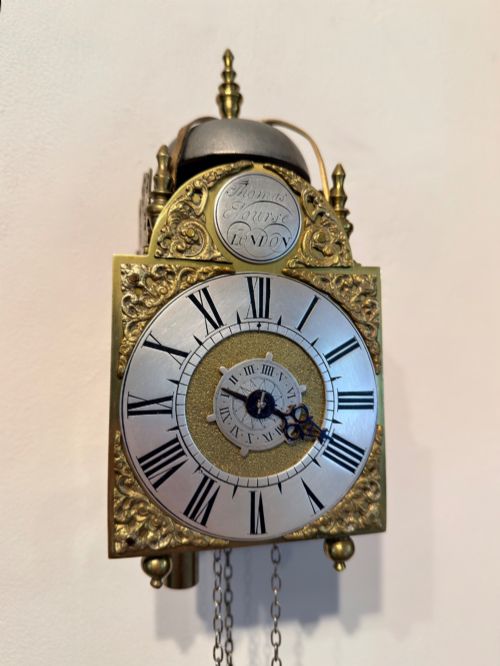
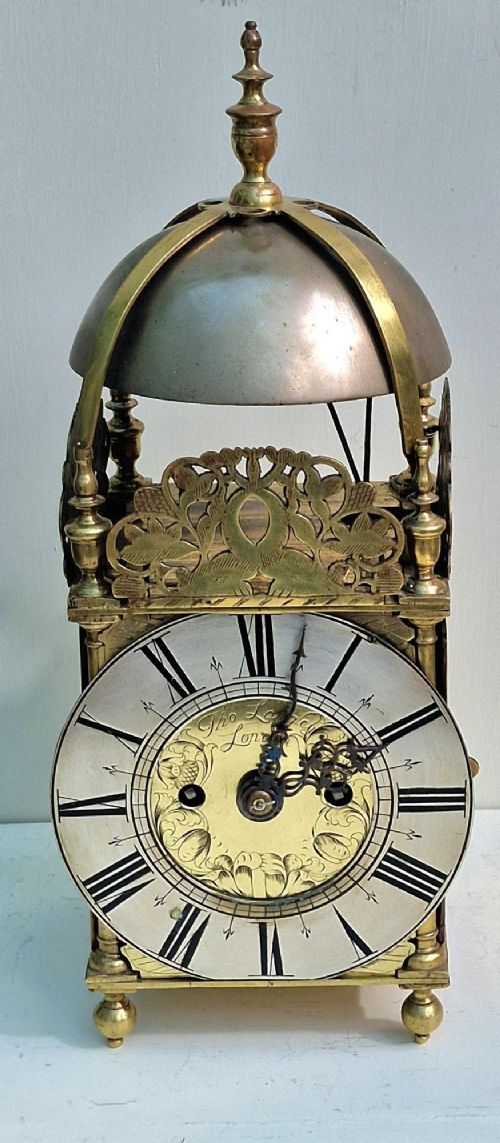
A brass lantern clock is a wall-hanging timekeeper with a cage-like metal frame, traditionally suspended from a wall bracket by a hoop and spikes. When you search for a brass lantern clock, you encounter pieces spanning from the seventeenth century through to later revivals and twentieth-century interpretations.
The form originates in the domestic interiors of the seventeenth century, constructed primarily to tell the hours in great houses and chambers before smaller table clocks became common. Examples on this page range from early seventeenth-century chamber clocks to Georgian and Victorian interpretations.
Most pieces seen here follow traditional English seventeenth-century designs, featuring distinctive top bells, pierced frets, and corner pillars. Alongside these, nineteenth-century and later makers produced substantial mantel versions and bracket clocks styled upon the earlier forms.
Assessing quality and authenticity
Quality in these clocks rests upon the integrity of the original movement and the crispness of the cast brass frets and dial engravings. Retaining original components such as the verge escapement or early bell-striking train elevates a piece significantly above later assembled examples.
The degree of hand-finishing on the brasswork and the presence of a named maker engraved upon the dial distinguish standard production from superior workshop output. Later nineteenth-century revival pieces vary in the weight of their brass castings and the fidelity of their historical styling.
Brass Lantern Clock Retail Price Guide 2026
Typical asking prices for brass lantern clock among the pieces listed under this phrase on Sellingantiques today, from the lower quarter to the upper quarter. They describe what is for sale here now, not the wider market.
Object types recorded include lantern clocks, wall clocks, mantel clocks, table clocks, and desk clocks spanning multiple centuries.
Thomas Langley·John Spershott·Windmills and Bennet·Samuel Tinham·Peter Closon·John Waller·James Ogden Senior·William Barrow·Grey of Edinburgh·William Clement·Mathias Bauerle·Jaeger Le Coultre·Winterhalder and Hoffmeier
The Brass Lantern Clock Glossary
- Verge escapement
- An early type of clock escapement that controls the drop of the weights or release of the spring, identifiable by its crown wheel and oscillating balance or pendulum.
- Chapter ring
- The circular band fixed to the dial face that bears the numerical hours, typically engraved and silvered on traditional models.
- Fret
- The pierced brass decorative panel situated below the bell on the upper part of the frame, often displaying heraldic or floral motifs.
- Fusee
- A conical pulley used in spring-driven clocks to equalise the torque of the mainspring as it unwinds.
- Hook and spike
- The traditional mounting system comprising an iron hook attached to the back of the clock frame that drops onto a wall spike.
Brass Lantern Clock: Frequently Asked Questions
How do you hang a brass lantern clock?
These clocks are traditionally hung from a sturdy wall bracket or a driven wall hook using the iron hoop and spikes mounted to the back of the frame. The weights or pendulum must hang freely below the base for the mechanism to operate correctly.
Ensure the wall material can support the combined weight of the brass frame and the driving weights before installation.
Were these clocks always wall clocks?
The earliest forms were designed specifically as wall-hanging chamber clocks, suspended to keep them clear of damp floors and draughts. Later nineteenth-century versions were adapted as mantel clocks with feet for shelf placement.
Most traditional examples retain the rear wall spikes intended for vertical hanging.
How do I distinguish an early clock from a later revival?
Seventeenth-century pieces display hand-cut brass work, engraved dial signatures, and early escapement mechanisms like the verge. Later nineteenth-century revival clocks often feature heavier cast frames and machine-finished internal parts.
Examination of the movement construction and the wear patterns on the brass plates usually reveals the true period of manufacture.
What is the purpose of the bell on top?
The bell serves to strike the hours, functioning as an audible timekeeper for the household before personal watches were common. A hammer strikes the exterior of the bell via the clock's striking train.
Some pieces include quarter-striking mechanisms using multiple bells to chime the intervals.