


Brass Inlaid Stationery Box
A brass inlaid stationery box organises correspondence with the weight and polish of Regency, Georgian and Victorian desk furniture.
Brass Inlaid Stationery Box
A brass inlaid stationery box and its close relatives, the writing slope and document box, serve to keep letters and papers in order on a desk. These pieces emerge chiefly from the Georgian, Regency and Victorian periods, carrying the domestic administration of the nineteenth century into modern rooms.
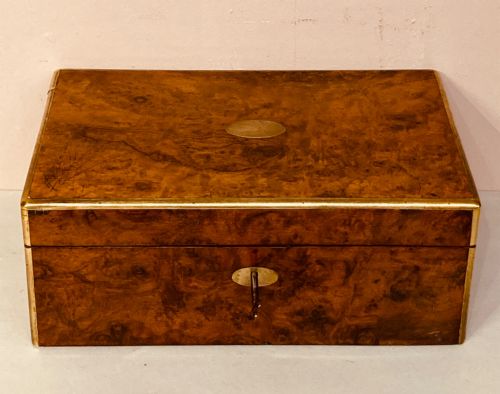
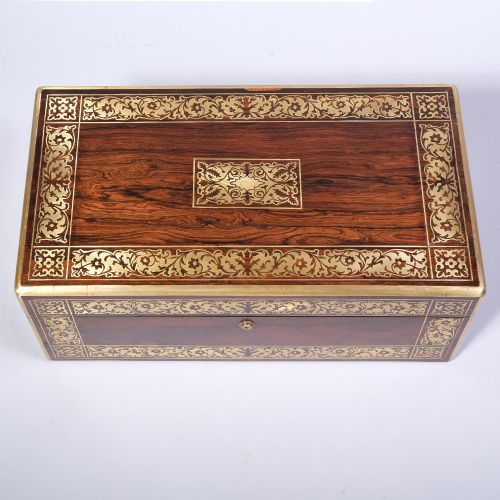
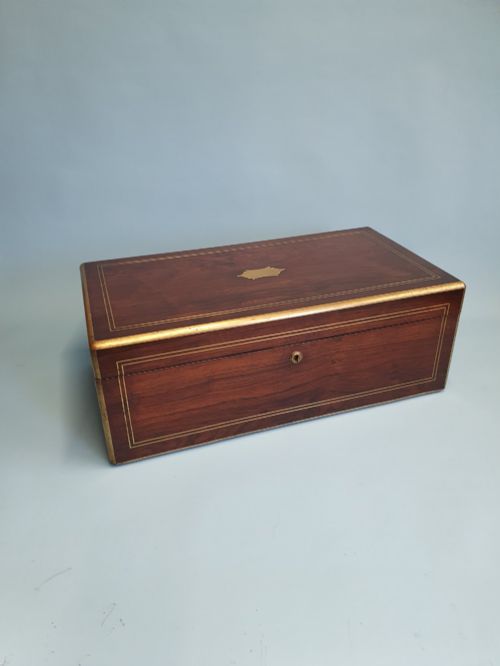
Rosewood, mahogany and walnut form the primary carcasses of these boxes, often enriched with brass stringing, cartouches or robust corner binding. The version most frequently encountered on this page is the slope or correspondence box, constructed to house paper, pens and inkwells.
Makers fashioned these containers for travel as well as stationary desk use, leading to military campaign variants alongside grander domestic pieces. Qing Dynasty and Napoleon III examples occasionally appear, showing how widely the brass inlay tradition travelled.
Materials and Construction
Cabinetmakers selected dense hardwoods such as rosewood, burr walnut and mahogany to form the robust body of each box. These timbers provided a stable, dark ground that would contrast sharply with bright metal embellishments.
Craftsmen channelled the timber surface to embed brass stringing, escutcheons and geometric plaques, frequently combining the metal with mother of pearl. Secure closures relied on specialised hardware, including Bramah locks, which required bespoke keys to protect private correspondence.
Listings feature rosewood, burr walnut and mahogany as the predominant timbers, frequently complemented by brass and mother of pearl.
Judging the Standard of the Work
The precision of the brass inlay work dictates the initial tier of quality, separating neat flush fitting from clumsy gaps in the wood. Cabinetmakers who achieved seamless joins between the timber and the metal created pieces that retained their structural integrity through decades of handling.
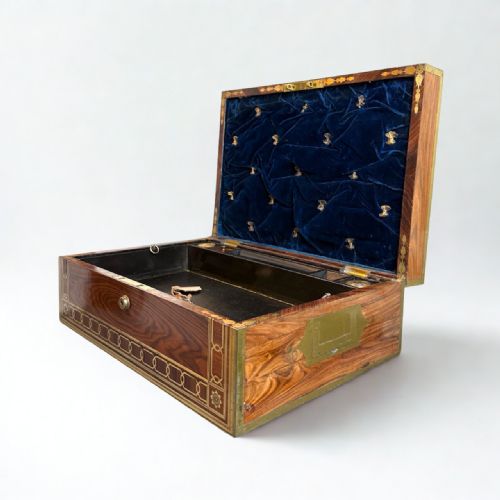
Internal fittings and secondary woods reveal the maker's commitment beyond the visible exterior surfaces. The presence of secret drawers, fitted glass inkwells and high-specification locks such as those by Bramah marks out a superior piece of desk furniture.
C.G. Hope Hastings·Erhard & Söhne
The Brass Inlaid Stationery Box Glossary
- Writing slope
- A portable desk with an angled lid that folds down to provide a writing surface. Inside, compartments hold paper, pens and inkwells.
- Bramah lock
- A patented high-security cylindrical lock invented by Joseph Bramah in the late eighteenth century. These mechanisms offered superior protection for confidential papers.
- Campaign box
- A sturdy container designed for military officers on the move, featuring recessed brass handles and reinforced corners for travel. These boxes prioritised durability alongside refined materials.
- Pietra dura
- An artistic technique using inlaid cut and fitted polished coloured stones to create images. This ornamental work appears on select luxury desk accessories.
- Stringing
- Thin strips of contrasting wood or brass inlaid into grooves on a furniture surface to create decorative borders. This linear detail defines Regency and Georgian case pieces.
Brass Inlaid Stationery Box: Frequently Asked Questions
What is the difference between a stationery box and a writing slope?
A stationery box stands upright or serves to hold loose correspondence and envelopes ready for use. A writing slope folds open to reveal a slanted writing surface with internal storage for paper and ink.
Both forms belong to the same family of nineteenth-century desk accessories, often sharing identical rosewood or walnut construction and brass inlay.
How do I care for a rosewood and brass box?
Keep the timber nourished with a suitable wax polish applied sparingly and buffed with a soft cloth. Avoid placing the box in direct sunlight or near heat sources to prevent the wood from warping and the brass from loosening.
Gentle cleaning maintains the natural lustre of both the dark hardwood and the metal inlay without damaging historic surfaces.
Are these boxes suitable for daily modern desk use?
These pieces function well on a modern desk to store letters, notebooks and everyday stationery items. Their historic compartments accommodate modern correspondence with distinct character.
Careful handling of the original hinges and locks ensures the box remains a practical desktop feature rather than a purely ornamental object.
How can I tell a Regency box from a Victorian one?
Regency pieces often display crisp brass stringing and geometric inlay on rosewood carcasses, reflecting neoclassical restraint. Victorian examples frequently employ figured burr walnut and heavier brass bound corners or decorative mother of pearl.
Examining the secondary woods and internal drawer construction helps confirm the specific period of manufacture.