


Brass Book Slide
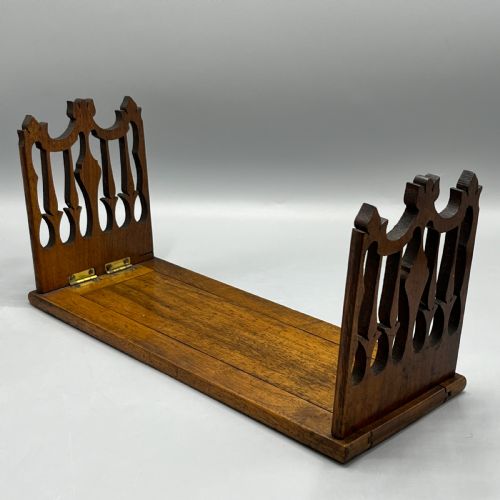
A brass book slide keeps volumes upright on a desk with a smooth, expanding action that adjusts to fit any collection.
Brass Book Slide
A brass book slide is a desk accessory designed to hold and display a row of books securely between two extending ends. These pieces appear primarily in Victorian formats, alongside earlier Regency examples and later pieces from the early twentieth century.
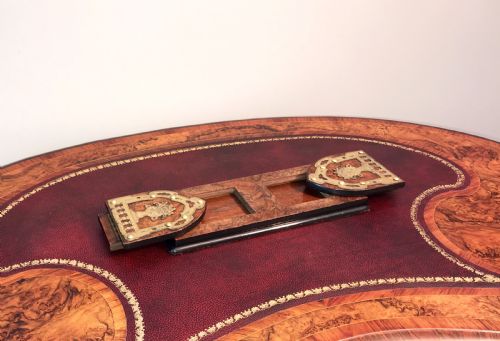
The most common version met on this page is the Victorian expanding book slide made from timber fitted with sliding brass mounts. These items serve to tidy a library table while offering a decorative element through contrasting wood grains and metalwork.
How they were made
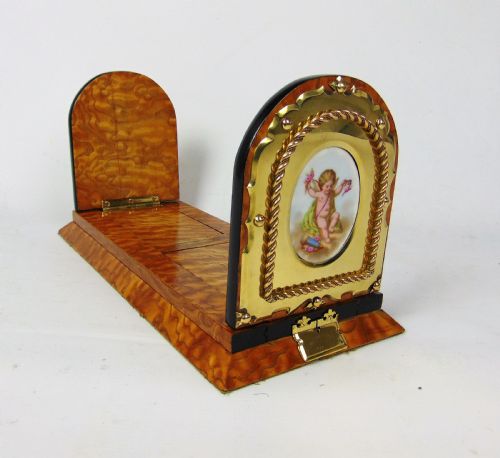
Makers built these pieces using dense hardwoods such as walnut, coromandel, mahogany and satin ash, often applying veneers to a solid carcase. They mounted robust brass mechanisms and decorative plates to the timber to manage the sliding action.
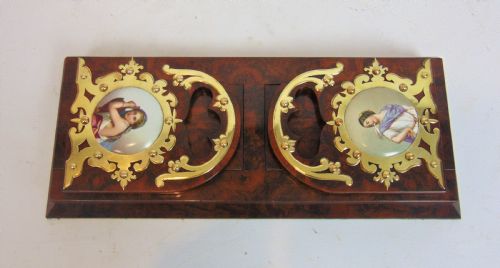
Detailing frequently involved inlays of porcelain, bone, pietra dura or ormolu mounts. Joinery relied on precise fitting to ensure the expanding sections moved smoothly without binding.
Owls peer out from metalwork on select pieces, watching over the library.
What varies in quality
Quality depends heavily on the choice of timber and the complexity of the secondary materials used in the construction. Fine examples combine figured coromandel or burr walnut with hand-painted porcelain plaques or intricate brass fretwork rather than plain woods and simple cast metal.
The precision of the extending mechanism also dictates the standard of the piece, where smooth, reliable movement reflects superior workshop production. Artisans who invested time in aligning the brass tracks and finishing the internal slides produced superior functional objects.
Betjemanns·Tiffany and Co
The Brass Book Slide Glossary
- Coromandel
- A dense, heavily figured timber from Asia with dark brown and black streaks. It was frequently used for luxury Victorian desk accessories.
- Pietra dura
- An inlay technique using cut and fitted polished coloured stones to create pictorial designs. It appears on the plaque insets of select desk pieces.
- Ormolu
- Gilded bronze applied as a decorative mount or trim. It provides a bright metallic contrast against dark hardwoods.
- Expanding
- The mechanical property allowing the two ends of a desk rest to pull apart or push together. This action accommodates varying numbers of volumes.
- Gothic Revival
- An architectural and decorative style drawing on medieval forms. Pieces in this category often feature pointed arches and heavy timber mouldings.
Brass Book Slide: Frequently Asked Questions
How do I use a brass book slide?
Place the base on a desk or table and position your books between the two upright ends. Pull the expanding sides outward or push them inward until the volumes are held firmly in place.
The extending mechanism allows the holder to grow or shrink as you add or remove books from your working collection. This keeps everything tidy without requiring external bookends.
Are these desk pieces sturdy enough for heavy books?
Most examples are constructed from heavy hardwoods like walnut and coromandel with reinforced brass mechanisms. They are designed to support standard rows of library volumes.
However, very large or extremely heavy reference folios may strain the expanding action. It is best to match the weight of your books to the substance of the wooden base.
How can I tell a Victorian piece from a Regency one?
Regency items date from earlier in the nineteenth century and often feature cleaner neoclassical lines or specific timber choices like rosewood. Victorian versions commonly incorporate richer veneers, ornate brass mounts, or Gothic Revival elements.
Examining the construction of the sliding mechanism and the style of any inlays helps narrow down the period of manufacture.
How do I care for the wood and brass?
Dust the timber regularly with a soft cloth and avoid placing the item in direct sunlight or near heat sources to prevent the veneer from drying out. Brass parts can be cleaned gently with a dry cloth to maintain their finish without disturbing the surrounding wood.
Keep moisture away from both the metal and the timber surfaces to preserve the original polish.