


Gothic Brass Desktop Accessory
These gothic brass desktop accessory pieces combine heavy metalwork with rich cabinet timbers, offering a robust way to organise a Victorian writing table.
Gothic Brass Desktop Accessory
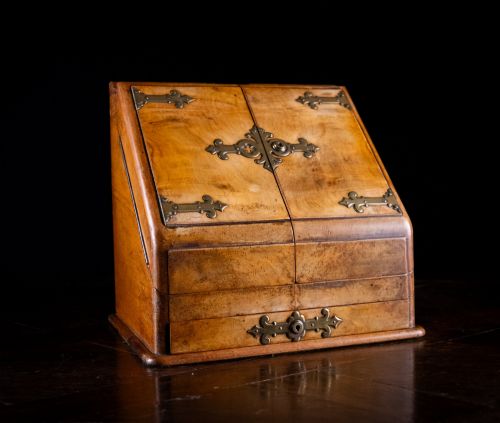
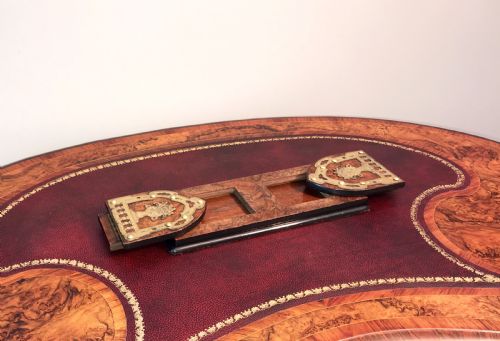
A gothic brass desktop accessory encompasses a variety of desk furniture from the Victorian era, specifically items designed to hold books and stationery. Book slides, bookends, and stationery boxes dominate the selections on offer, all sharing a distinct architectural influence. Buyers seeking these items will find functional wooden frameworks reinforced with decorative metal mounts.
Most examples date from the middle to the late nineteenth century, spanning decades such as eighteen sixty, eighteen eighty, and eighteen ninety. The aesthetic draws heavily on the Gothic Revival style, which translates into pointed arches and heavy metal strapwork. These desk items reflect the Victorian taste for solid, ornate desk accessories that brought medieval motifs into domestic studies.
Materials and construction
The foundation of these pieces relies on dense cabinet timbers such as walnut, burr walnut, pollard oak, and mahogany. Makers joined these woods with brass hinges, mounts, and galleries to create durable items capable of withstanding heavy folio volumes. The combination of dark wood and polished metal forms the structural core of the surviving objects.
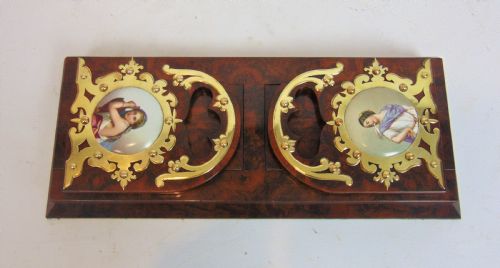
Surface ornamentation extends beyond plain timber and metal to include inset painted porcelain plaques, polished agate stones, and carved bone details. Extending book rests utilise mechanical sliding actions housed within the wooden base to adjust the length safely. These construction methods ensure that the functional items remain sturdy during daily use on a library table.
Listings feature items dated across the Victorian era, spanning the decades from eighteen sixty to eighteen ninety using walnut, mahogany, and brass.
Judging quality and craftsmanship
Quality in a gothic brass desktop accessory rests upon the choice of timber figures and the crispness of the brass mounting. Plain mahogany yields to figured burr walnut and pollard oak in the finer tiers of production. Heavier casting of the brass elements and more intricate openwork tracery indicate superior craftsmanship.
The presence of specialised embellishments such as finely painted porcelain plaques or inset semi-precious stones elevates an item above standard utility pieces. Patented mechanisms, such as those by Betjemanns, add a layer of mechanical ingenuity that collectors value. The integration of these decorative and functional components determines the overall standard of the desk accessory.
The Gothic Brass Desktop Accessory Glossary
- Gothic Revival
- An architectural and decorative style popular during the Victorian period, drawing inspiration from medieval forms. This style utilises pointed arches, quatrefoils, and heavy metal strapwork on domestic items.
- Book slide
- An extending desk accessory designed to hold a variable number of upright books between two fixed or sliding ends. These items often feature hinged or expanding wooden mechanisms.
- Stationery box
- A desk cabinet designed to hold writing paper and envelopes upright within fitted interior compartments. Many examples feature sloped or dome-shaped lids with brass mounts.
- Burr walnut
- A prized timber harvested from the irregular growths on walnut trees, known for its swirling, highly decorative grain patterns. This material was frequently utilised on the primary display surfaces of high-end Victorian desk accessories.
- Brass mount
- A decorative or structural piece of cast or stamped brass applied to the exterior of wooden boxes and book slides. These mounts reinforced corners and provided Gothic-inspired surface decoration.
Gothic Brass Desktop Accessory: Frequently Asked Questions
What is a gothic brass desktop accessory?
These items are nineteenth-century desk furnishings designed to organise books and writing materials, combining wooden bodies with decorative brass metalwork. They reflect the architectural tastes of the period through pointed motifs and heavy mounts.
Most surviving pieces function as extending book slides or lidded stationery boxes. They were standard fixtures in Victorian libraries and studies.
How do extending book slides work?
Extending book slides feature a base made of two or more overlapping wooden sections that pull apart to accommodate more volumes. A concealed mechanical action allows the wooden platform to expand smoothly while keeping the end supports upright.
Some versions utilise patented designs by makers like Betjemanns to control the sliding motion. This mechanism ensured heavy books remained supported as the shelf length adjusted.
Which woods were used for these pieces?
Cabinet makers utilised a range of dense hardwoods including walnut, burr walnut, mahogany, pollard oak, and coromandel. These timbers provided a dark, stable foundation that contrasted with polished brass mounts.
Figured woods like burr walnut were selected for visible surfaces to add visual texture. The structural timber choice often indicates the relative quality of the desk accessory.
How are periods identified?
Periods are determined by stylistic cues, construction methods, and materials associated with the nineteenth century. The presence of Gothic Revival motifs combined with specific timber choices points directly to the Victorian era.
Patent dates stamped into the metal hardware also provide a reliable guide to the decade of manufacture. These clues help distinguish mid-Victorian pieces from later nineteenth-century productions.