



Victorian Expanding Book Trough
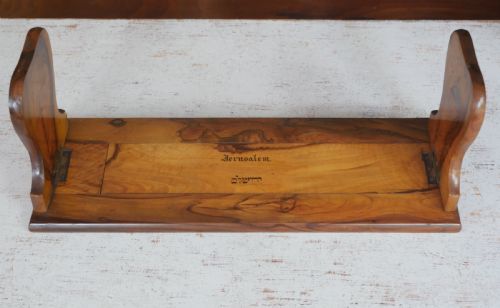
These Victorian expanding book troughs are clever library accessories that hold a growing row of volumes upright on a desk or table.
Victorian Expanding Book Trough
A victorian expanding book trough is a practical desk accessory designed to hold books securely between two hinged or sliding ends. As titles are added or removed, the base extends or contracts smoothly to fit the collection.
Most examples found here date from the nineteenth century, particularly the Victorian period. Walnut and brass mounted sliding bookends appear frequently alongside ebonised wood and exotic timbers.
Makers often incorporated folding book rests or novel rests into the design. These pieces sit comfortably on library tables, bureau bookcases, and writing desks.
How they were made
Cabinet makers utilised dense timbers such as walnut, burr walnut, coromandel, and rosewood for the structural bases and ends. Ebonised wood also provides a dark, uniform finish suited to formal libraries.
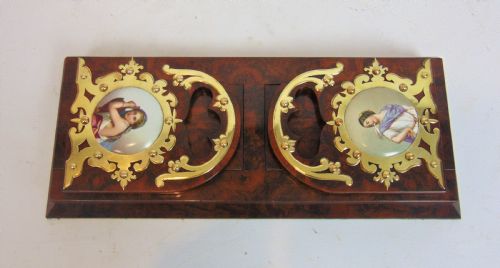
Functional brass mounts reinforce the sliding mechanisms and corners, combining durability with decorative contrast. Inlaid porcelain plaques, pietra dura panels, and Tunbridge ware mosaic decoration adorn the finer surfaces.
Several examples include novel rests, built so a Victorian reader could prop open a volume while keeping hands free for tea.
What varies in quality
The choice of primary timber and decorative technique dictates the standing of an individual piece. Burr walnut, coromandel, and intricate pietra dura inlay represent a higher tier of craftsmanship than plain polished hardwoods.
The engineering of the extending action matters just as much as the exterior decoration. Smooth sliding mechanisms that travel without catching demonstrate superior initial manufacture.
Betjemanns patent·Tiffany & Co
The Victorian Expanding Book Trough Glossary
- Book slide
- An extending desk accessory designed to keep volumes upright between two ends. It adjusts in length to accommodate varying numbers of books.
- Tunbridge ware
- Small wooden objects decorated with mosaic patterns formed from tiny wood blocks of natural colours. This technique created detailed geometric and pictorial scenes.
- Pietra dura
- An inlay technique using cut and fitted polished coloured stones to create pictorial designs. Hardstones such as lapis lazuli and agate form floral or geometric motifs.
- Coromandel
- A dense, dark tropical hardwood with contrasting striations, prized for luxury nineteenth-century cabinet work. It offers a rich, polished surface finish.
- Ebonised wood
- Timber treated to resemble ebony through staining and polishing. This process produced a solid black finish popular during the Victorian period.
Victorian Expanding Book Trough: Frequently Asked Questions
How do expanding book troughs work?
These accessories feature overlapping or telescoping wooden bases that slide outward to accommodate more volumes. A central platform moves while the end supports remain upright.
Friction holds the sides at the desired width once adjusted. This keeps rows of books tidy on a shelf or desk without tipping over.
Where were book troughs used?
Victorians placed these items on library tables, writing desks, and parlour sideboards. They kept frequently referenced volumes within arm's reach.
They also served as display stands for decorative editions in domestic drawing rooms. The compact footprint suited the cluttered surfaces of nineteenth-century interiors.
What woods are most common?
Walnut is the timber most frequently encountered in these nineteenth-century designs. Burr walnut provides a richer, patterned grain for more decorative examples.
Dark ebonised wood, coromandel, and olive wood also appear across the selection. Brass mounts frequently accent these primary materials.
How do I care for antique wood?
Keep wooden book slides away from direct heat sources and strong sunlight to prevent warping and drying. Maintain a stable indoor humidity.
Apply a light application of appropriate wax polish periodically to nourish the surface. Buff gently with a soft cloth to preserve the finish.