


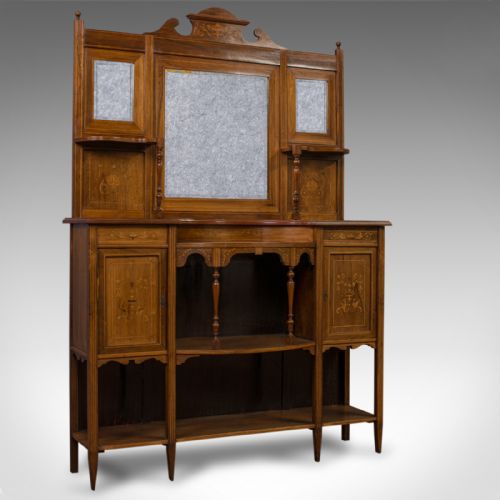
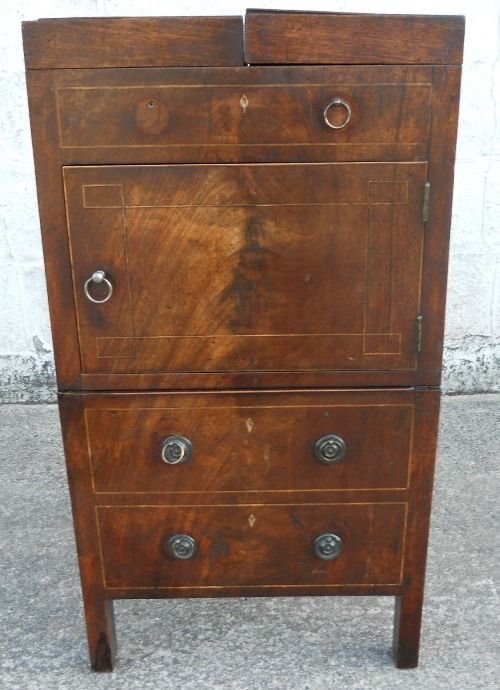
Boxwood Inlay Cabinet
A boxwood inlay cabinet brings together rich timbers and precise pale stringing, offering a practical storage piece with sharp visual contrast.
Boxwood Inlay Cabinet
A boxwood inlay cabinet encompasses a variety of storage and display furniture, including pier cabinets, chiffoniers, bedside units, music cabinets, and chests of drawers.
When searching for a boxwood inlay cabinet, a buyer is most likely to encounter Victorian and Regency examples alongside Edwardian and 19th-century pieces.
The forms range from glazed display cupboards and drawer chests to sideboards, buffets, and gentleman's washstands, each incorporating light wood details into darker foundational timbers.
How they were made
Maker workshops built these cabinets using primary structural woods such as mahogany, walnut, and rosewood, applying boxwood for contrasting inlay, stringing, and marquetry details.
Many examples incorporate glass doors for display functionality, while mounts and hardware utilise brass and ormolu to accent the timber surfaces.
Listings feature woods like mahogany, walnut, and rosewood contrasted with boxwood inlay, spanning periods from Georgian to Edwardian.
What varies in quality
Quality rests upon the precision of the boxwood inlay work and the depth of figure in the foundational mahogany, walnut, or rosewood timber.
Refined pieces display meticulous execution in their marquetry motifs and harmonious proportions across forms like chiffoniers and pier cabinets.
John McClean
The Boxwood Inlay Cabinet Glossary
- Marquetry
- Decorative patterns formed by fitting together thin veneers of wood and other materials onto a structural surface. This technique allows for elaborate floral or geometric designs.
- Pier cabinet
- A narrow display cabinet designed specifically to stand against the wall space between windows. These pieces frequently feature glass doors and internal shelving.
- Chiffonier
- A low sideboard or cabinet developed in the 19th century, often fitted with enclosed cupboards and shelving above. They provide both display and concealed storage.
- Stringing
- A narrow strip of contrasting timber inlaid flush into the surface of a piece to form linear borders. Boxwood is frequently utilised for this bright, pale detailing.
Boxwood Inlay Cabinet: Frequently Asked Questions
How do I style a pier cabinet?
A pier cabinet fits neatly into narrow wall spaces, making it ideal for living rooms or hallways where floor space is limited.
Its glass doors and internal shelves provide a secure enclosure for displaying books, ceramics, or small collections.
What woods were used for these cabinets?
Cabinet makers utilised dark or richly figured timbers such as mahogany, walnut, and rosewood as the primary structural and surface materials.
Boxwood was chosen specifically for its pale, uniform colour to create sharp contrast through inlay and stringing.
Are music and collector cabinets different?
Music cabinets and collector cabinets were designed with specialised internal storage tailored to specific hobbies or household requirements.
Music cabinets housed sheet music, while collector cabinets featured configuration suited to specimens or small objects.