


English Walnut Credenza
An English walnut credenza brings warmth and architectural presence to a room, offering display space and cabinetry shaped by Victorian and Regency hands.
English Walnut Credenza
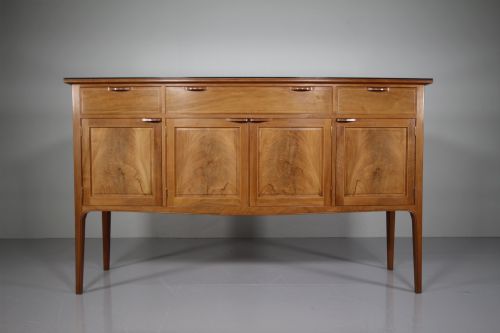
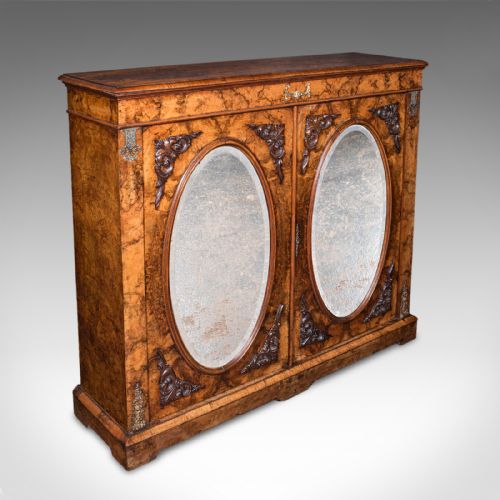
An English walnut credenza is a substantial display cabinet or sideboard designed for formal reception rooms, drawing its character from Victorian and Regency tastes. You are most likely to meet pieces finished in figured walnut or burr walnut, often built with glazed doors and internal shelving.
The form crosses over with related cabinet types, appearing alongside pier cabinets, breakfront libraries, and console tables in the wider record. These items share a lineage of fine timber construction, though the true credenza typically presents a low profile suited to holding ornaments and books.
Materials and construction
Cabinet makers utilised solid English walnut and applied decorative veneers of burr walnut to create striking grain patterns across the primary surfaces. Frames were constructed using traditional joinery, providing a stable carcass for heavy glass doors and tiered shelving.
Decoration relied on precision inlay work, employing boxwood and Tunbridgeware to form geometric or floral borders. Metal accents such as ormolu mounts and brass fittings completed the hardware, while interiors were sometimes lined with velvet.
English Walnut Credenza Retail Price Guide 2026
Typical asking prices for english walnut credenza among the pieces listed under this phrase on Sellingantiques today, from the lower quarter to the upper quarter. They describe what is for sale here now, not the wider market.
Some nineteenth-century makers hid secret compartments behind decorative marquetry panels, giving owners a private place to stash their love letters.
Distinguishing quality in walnut cabinetry
The distinction between standard production and exceptional work rests on the selection of the timber veneers and the crispness of the inlay. Master makers chose burr walnut with deep, swirling figures and matched the grain symmetrically across panel fronts.
Subtlety of secondary detailing separates the finer examples from simpler workshop output. The precision of boxwood or Tunbridgeware banding and the weight of the cast ormolu mounts indicate the level of investment a maker put into the piece.
Edward Barnsley·Druce And Co
The English Walnut Credenza Glossary
- Burr walnut
- A highly figured timber veneer harvested from the knot growths of the walnut tree, prized for its swirling grain patterns. It creates a decorative, mottled surface on cabinet doors.
- Tunbridgeware inlay
- A form of mosaic woodwork originating in Kent, using thousands of tiny coloured wood blocks to form pictorial or geometric mosaics. It appears as delicate banding on panels.
- Ormolu
- Gilded bronze ornamentation applied to furniture for decorative effect. It provides a bright metallic contrast to dark walnut timbers.
- Breakfront
- A cabinet design where the central section projects forward from the flanking wings. This configuration adds architectural depth to large library cabinets and credenzas.
- Pier cabinet
- A narrow display cabinet designed to fit the wall space between windows. These tall, glazed pieces share materials and proportions with larger credenzas.
English Walnut Credenza: Frequently Asked Questions
What is an English walnut credenza?
An English walnut credenza is a low, decorative cabinet traditionally used in Victorian and Regency drawing rooms to display fine porcelain and books. It combines timber framing with glazed doors and intricate veneer work.
These pieces serve as both storage furniture and decorative focal points, often featuring inlaid banding and mirrored elements to reflect light in a formal room.
How do I style a credenza at home?
Place your credenza against a principal wall in a dining room, hallway, or drawing room where its timber grain can be appreciated. Balance the surface with lamps, ceramics, or framed works without obscuring the grain.
Keep the interior shelves arranged with curated collections of books or glassware, allowing the glazed doors to protect the contents while maintaining visual openness.
How do I date a walnut cabinet?
Dating relies on examining the secondary timbers, construction methods, and decorative styles visible across the piece. Regency examples lean towards architectural restraint, while Victorian pieces often feature heavier marquetry and ormolu.
Look closer at the hardware, hinge types, and veneer thickness, as these manufacturing details shift discernibly between the Regency period and the later Victorian era.
Is burr walnut different from regular walnut?
Burr walnut is taken from the abnormal growth knots of the tree rather than straight trunk timber. This produces an intense, swirling grain pattern that cabinet makers reserved for the most prominent exterior surfaces.
Standard walnut offers a straighter, more uniform grain structure used for structural framing and less prominent panels, contrasting with the decorative impact of burr veneers.