

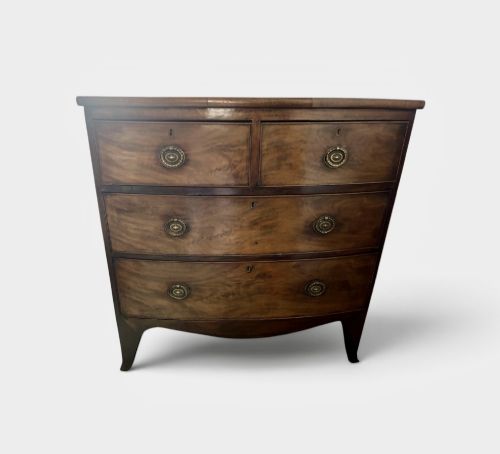
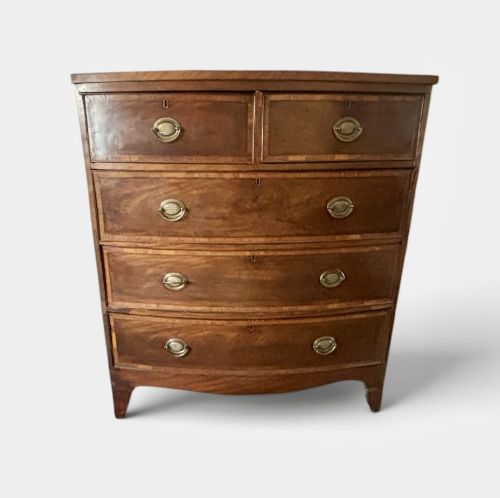

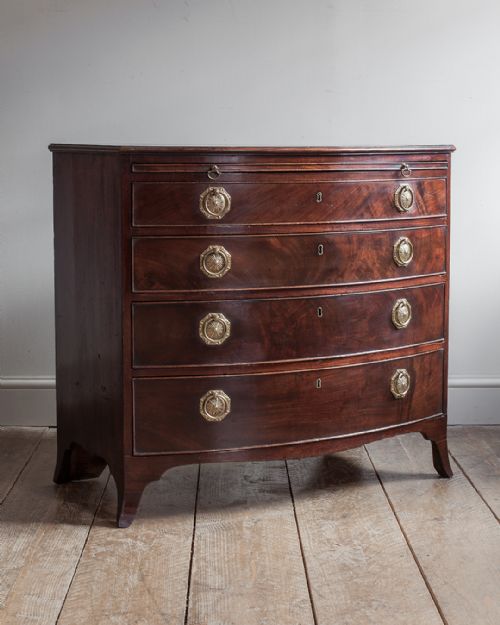
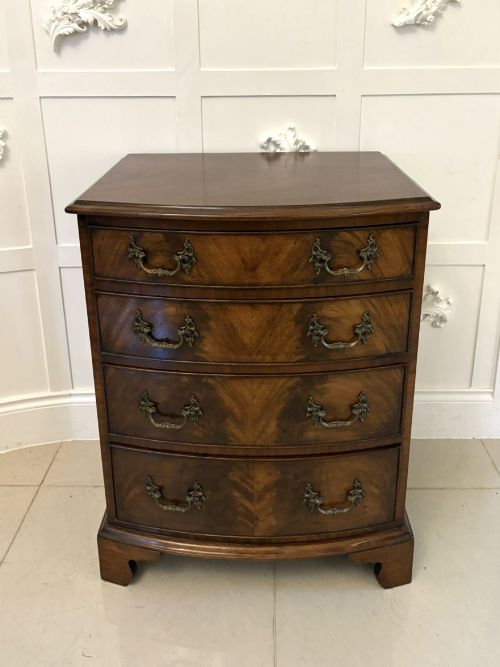
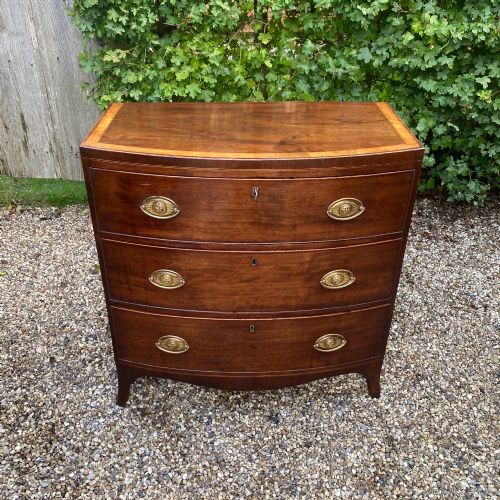
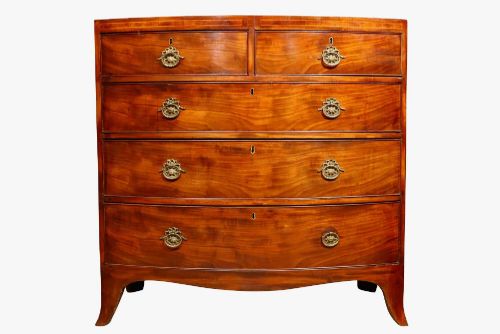
Bowfront Commode Chest
A bowfront commode chest brings together curving drawer fronts and rich cabinet timbers to anchor a room with calm presence.
Bowfront Commode Chest
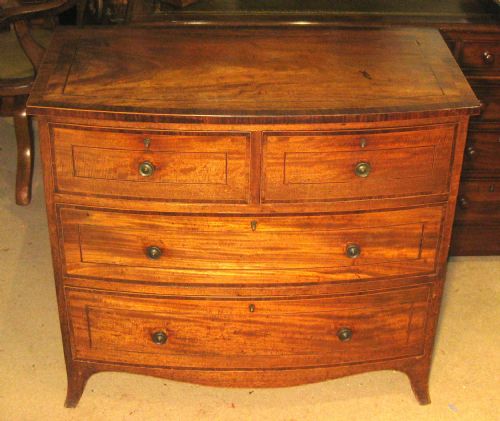
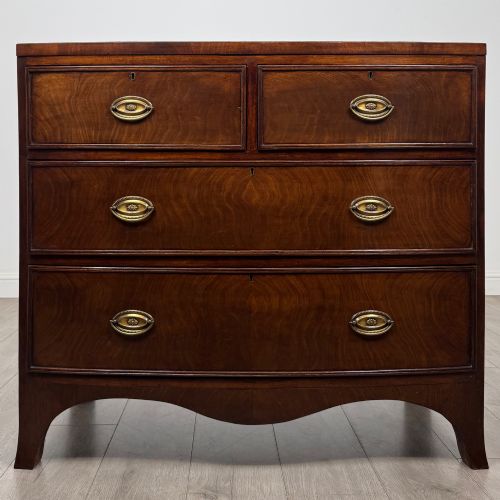
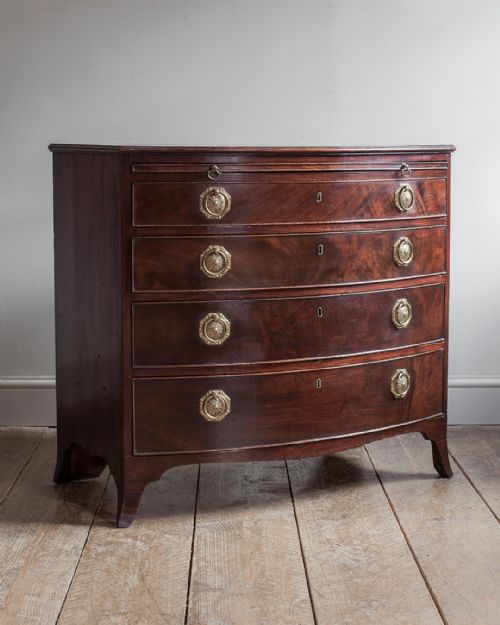
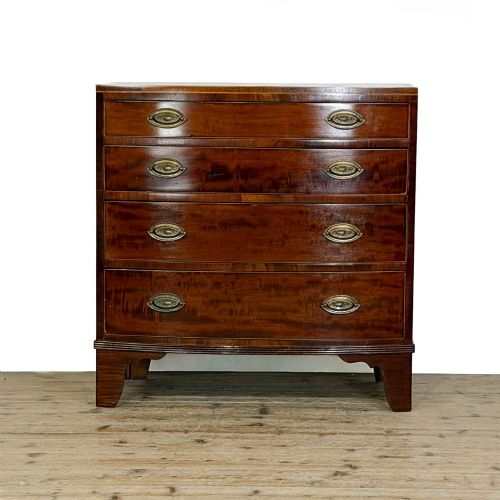
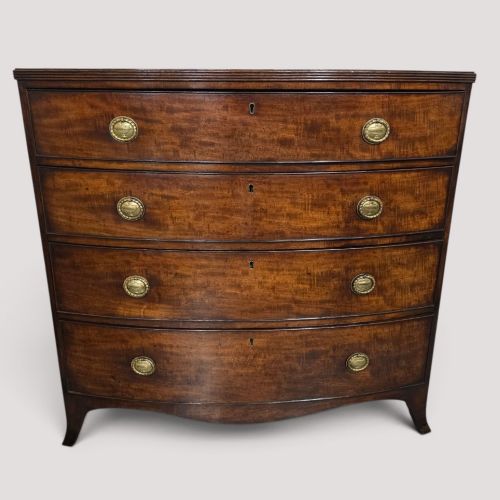
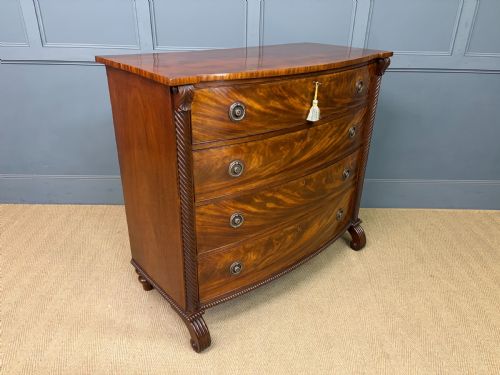
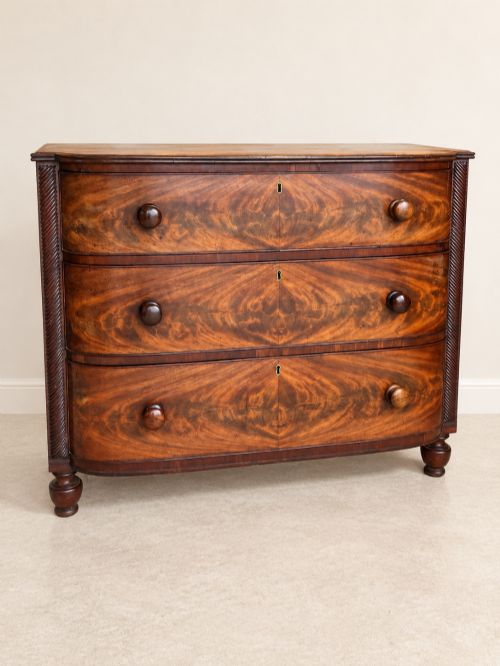
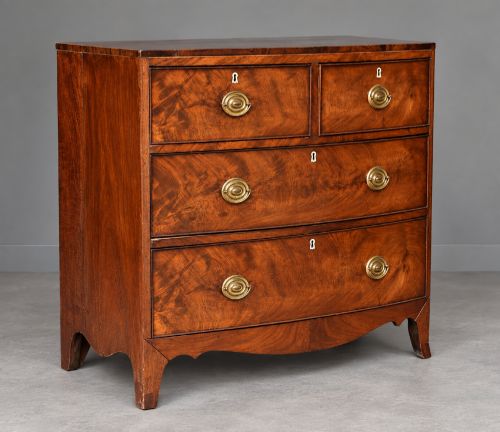
A bowfront commode chest presents a rounded front profile that softens the corners of a room while offering deep storage within its bank of drawers. These pieces emerge most frequently from the Georgian, Regency, and Victorian periods, carrying the proportions and architectural weight of their respective decades.
The standard form encountered here is the mahogany chest of drawers, built with graduated drawers and standing on bracket feet or short legs. Cabinetmakers designed these chests to balance utility with visual grace, using the outward curve to catch the light across polished timber.
Smaller variants, including miniature furniture and narrow Scottish forms, appear alongside full-scale chamber pieces. Each iteration maintains the signature curved facade that defines the type across eighteenth, nineteenth, and early twentieth-century workshops.
Materials and Construction Methods
Cabinetmakers relied heavily on solid mahogany and flame mahogany veneer, chosen for deep grain patterns and stability over large surfaces. Satinwood banding and crossbanding provided sharp linear contrast around the drawer edges and top boards.
Secondary timbers such as oak and pine formed the internal drawer linings and structural carcases, while brass hardware secured the drawer fronts and key escutcheons. Joinery relied on precise dovetail joints for the drawer construction, ensuring durability through decades of daily use.
Listings feature mahogany, oak, and pine construction across periods spanning the eighteenth, nineteenth, and early twentieth centuries.
Distinctions in Quality and Execution
The quality of a bowfront commode chest rests on the choice of veneer and the continuity of the grain pattern across the curved drawer fronts. Finer examples display carefully matched flame mahogany where the figure mirrors from side to side.
Subtleties in secondary woods, the delicacy of stringing or satinwood banding, and the crispness of the cabinetmaker's edge moulding separate standard utilitarian pieces from exceptional workshop output. The weight and patination of the timber further reflect the care taken during initial construction and subsequent handling.
The Bowfront Commode Chest Glossary
- Bowfront
- A curved convex front profile that projects outward from the centre. This shape softens the rectilinear lines common in traditional case furniture.
- Flame mahogany
- A highly figured wood veneer derived from the branch junctions of the mahogany tree. The grain displays a characteristic flickering pattern resembling flame.
- Crossbanding
- A strip of veneer laid perpendicularly to the grain of the main surface. It forms a decorative border around drawer fronts or top boards.
- Caddy top
- A tabletop style with a raised, moulded edge that sits slightly above the surface of the carcase. This detail appears frequently on Georgian and Regency pieces.
- Graduated drawers
- A set of drawers that decreases in depth from bottom to top. This arrangement creates pleasing visual proportions and accommodates larger items near the floor.
Bowfront Commode Chest: Frequently Asked Questions
What is a bowfront commode chest?
A bowfront commode chest is a set of drawers featuring a convex curved front that projects outward. These pieces were built primarily in mahogany and other cabinet timbers during the Georgian, Regency, and Victorian eras.
Cabinetmakers utilised the curved facade to catch light and soften room interiors while providing functional storage space for clothing and domestic linens.
How do I date a bowfront chest?
Dating relies on examining the proportions, handle hardware, drawer construction, and secondary timbers like oak or pine. Georgian and Regency pieces often exhibit slender bracket feet and fine satinwood stringing.
Later Victorian and Edwardian examples tend to have heavier carcases, darker finishes, and different interior secondary woods that reflect changing manufacturing methods.
Where were these chests placed?
These chests functioned principally as bedroom furniture for storing garments and personal items. Their finished sides and polished tops also suited them for placement in hallways and reception rooms.
The curved profile allowed them to sit comfortably against walls without presenting sharp corners in busy domestic spaces.
How do I care for mahogany surfaces?
Mahogany requires stable room humidity and protection from direct sunlight to prevent the timber and veneer from drying out. Regular dusting with a soft, dry cloth preserves the polished finish.
Applying traditional wax polish occasionally nourishes the wood and enhances the natural depth of the grain without building up heavy residues.