
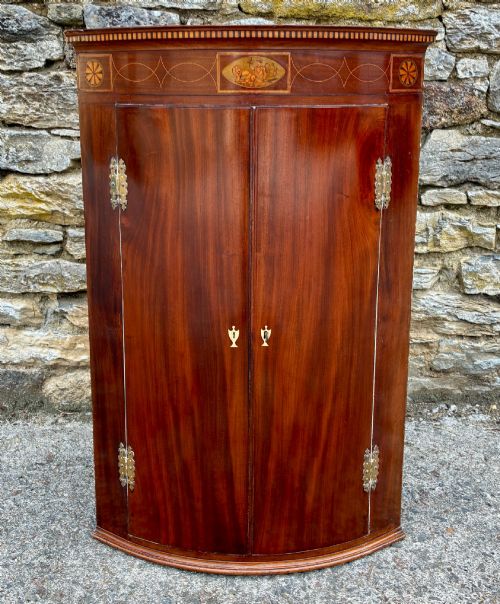


Bow Fronted Corner Unit
A bow fronted corner unit turns an awkward room angle into proper storage, bringing timber and glass curves to domestic interiors.
Bow Fronted Corner Unit
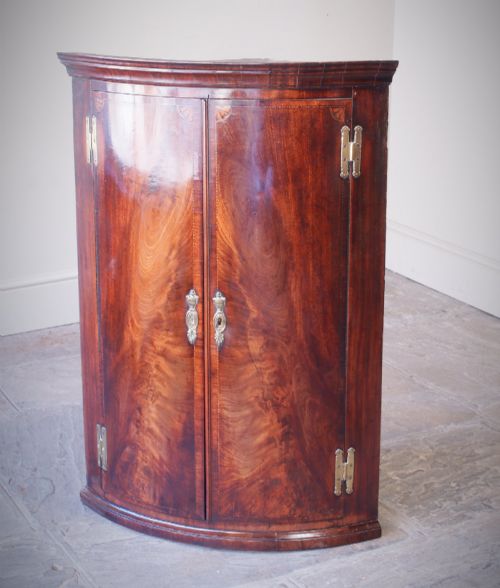
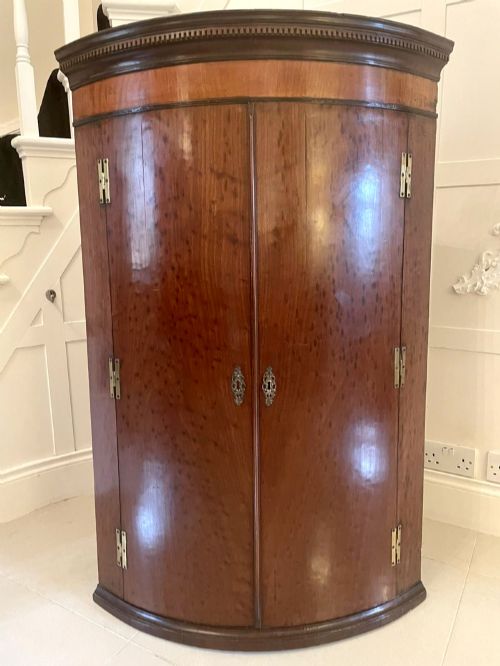
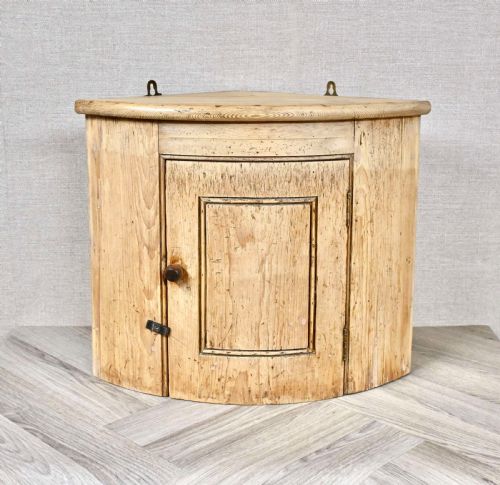
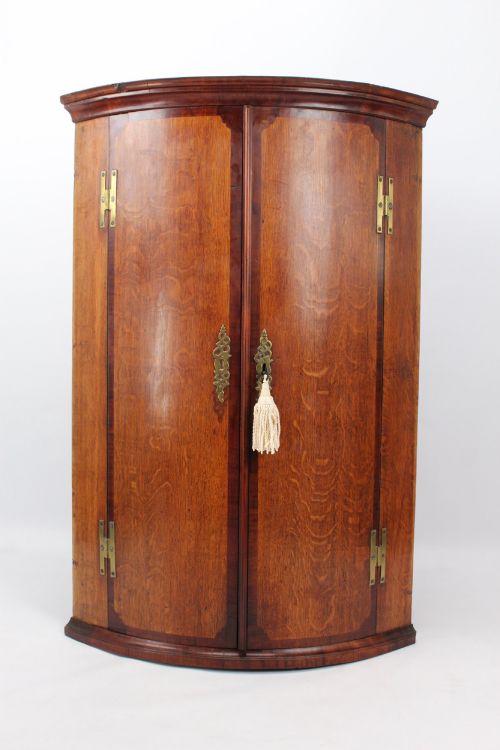
A bow fronted corner unit is a fitted or freestanding piece designed specifically to occupy the junction of two walls, softening the room with a convex curved door. The selection on this page draws heavily from Georgian, Victorian, and Edwardian periods, presenting both hanging wall cupboards and standing cabinets.
Most examples you encounter here are fashioned from timber, with mahogany and oak appearing frequently across the inventory. You will find simpler pine pieces alongside refined George III examples finished with boxwood inlay or Chinoiserie lacquer work.
Beyond standard cupboards, the category occasionally stretches to include display stands, washstands with fold-down tops, and corner whatsits. These variations provide both concealed shelving and surface display space tailored explicitly for room corners.
How they were made
Cabinet makers constructed these curved doors and frames using solid hardwoods like mahogany and oak, often applying fine boxwood stringing for decorative contrast. The curved bow front required precise joinery to shape the timber without compromising structural integrity.
Surface treatments range from clear polish that highlights natural wood grain to painted Chinoiserie lacquer schemes. Iron and brass hardware, including hinges and escutcheons, secured the doors and added functional detail.
What varies in quality
Quality in these pieces rests upon the precision of the curved joinery and the selection of timber veneers or solid boards. Finer examples display careful grain matching on the bow door and delicate, intact inlay work.
Construction methods also distinguish the cabinet range, where dovetailed joints and original brass furniture elevate the piece above utilitarian workshop output.
The Bow Fronted Corner Unit Glossary
- Bow front
- A convex, outward-curving front facade that breaks the flat angle of a standard cabinet. This shape requires specialised joinery to construct.
- Chinoiserie
- European decorative style imitating Chinese artistic traditions, often featuring painted lacquer scenes. It appears on selected period cabinets in this inventory.
- Escutcheon
- A protective plate surrounding a keyhole, usually made of brass. It prevents the wood around the lock from sustaining wear.
- Stringing
- Thin lines of contrasting wood inlay used to outline panels and drawers. Boxwood is frequently utilised for this decorative banding.
- Whatnot
- An open set of multiple shelves designed for displaying small objects. Examples in corner formats maximise otherwise unused room angles.
Bow Fronted Corner Unit: Frequently Asked Questions
How do I hang a wall corner cabinet?
Hanging corner cabinets require secure fixing points into solid masonry or proper wall studs to support the weight of the timber and contents.
Because these units project outward into the room, stable wall attachment is essential for safety.
What is the difference between standing and hanging units?
Hanging units mount directly to the wall to free up floor space, whereas standing cabinets rest on the floor with their own base support.
Standing versions often provide larger internal storage capacity and sometimes include lower drawers or cupboards.
How do I clean mahogany finishes?
Dust mahogany surfaces regularly with a soft, dry cloth to prevent the accumulation of abrasive particles.
Apply quality beeswax periodically to nourish the wood and maintain a soft sheen without using silicone-based polishes.
Are corner units suitable for small rooms?
These cabinets utilise neglected right angles, turning dead space into functional storage without crowding the main floor area.
The curved bow front reduces sharp corners in tight walkways while providing visible display or concealed shelving.